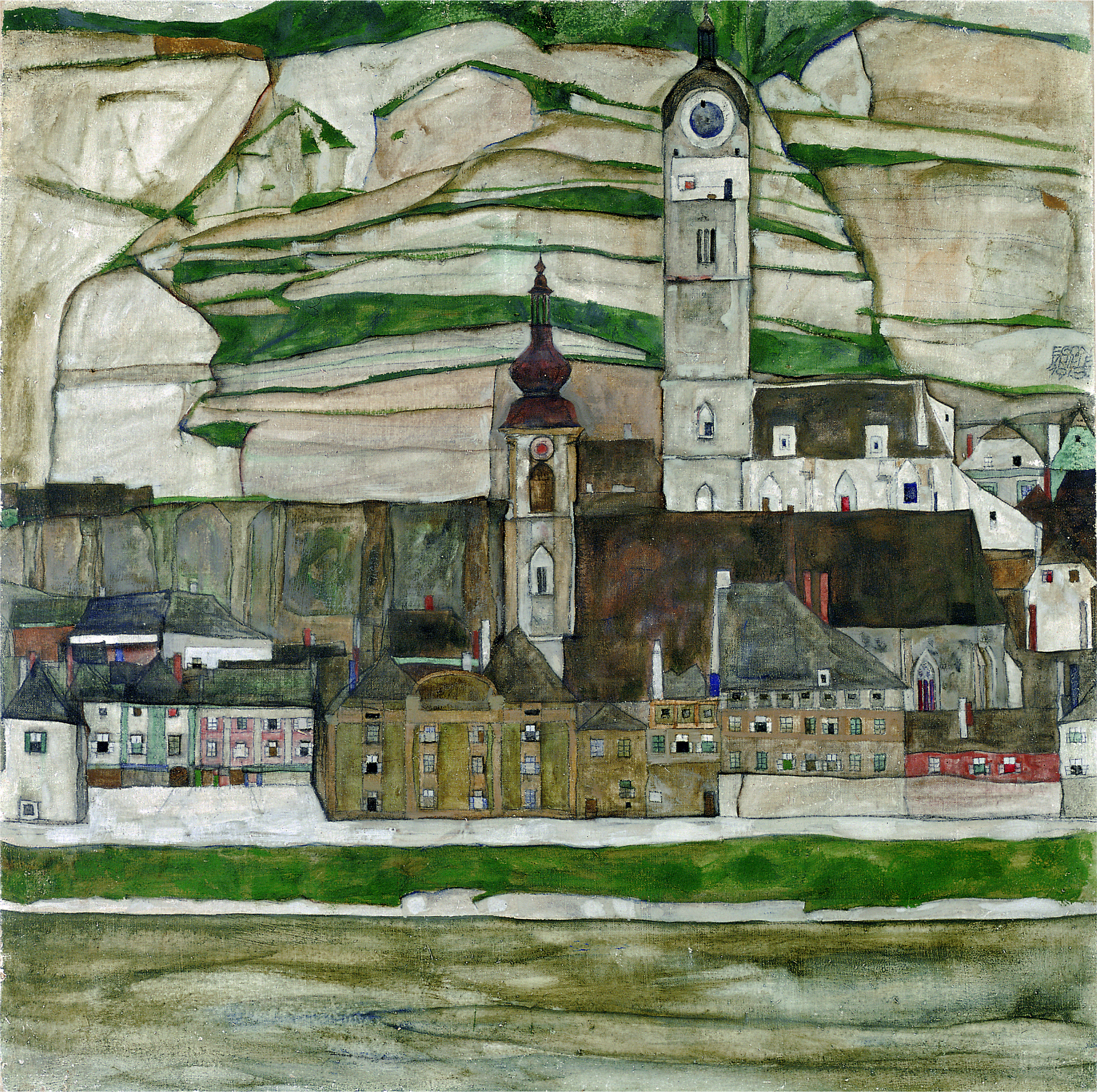
Egon Schiele: Living Landscapes is the title of the current visual diversion at Neue Galerie, and is a worthy epilogue to the museum’s springtime exhibition of landscapes by Gustav Klimt. Initially, Klimt was a mentor to the younger artist—one of the takeaways from this small, dense show is the realization that in the lightning strike of a truncated career, Schiele evolved from the influenced party to the role of rival. In the exhibition’s first room, Living Landscapes lays out early studies by Schiele, a precocious adolescent who rapidly cycled through romantic conventions, absorbed traditional perspectival lessons and then, dearer to his own inclinations, the predilection for elegant patterns for which Klimt would have been a decisive example. By his mid-twenties, in paintings like Houses by the River II (The Old City II), Schiele was riffing on his predecessor like a jazz virtuoso, appropriating Klimt’s compressed tiers of water, buildings and sky, flattened to a single plane. Klimt could have sued for copyright infringement if Schiele weren’t so good. From a modern template the younger artist spun a uniquely emotional body of work. He had to do it quickly. He was dead by twenty-eight.

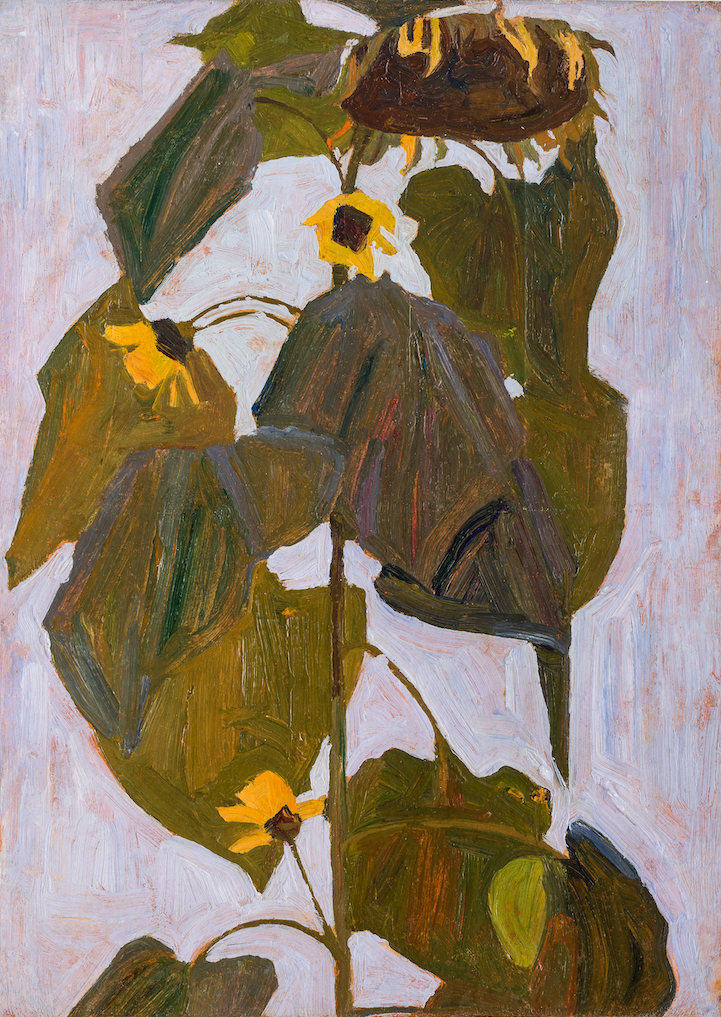
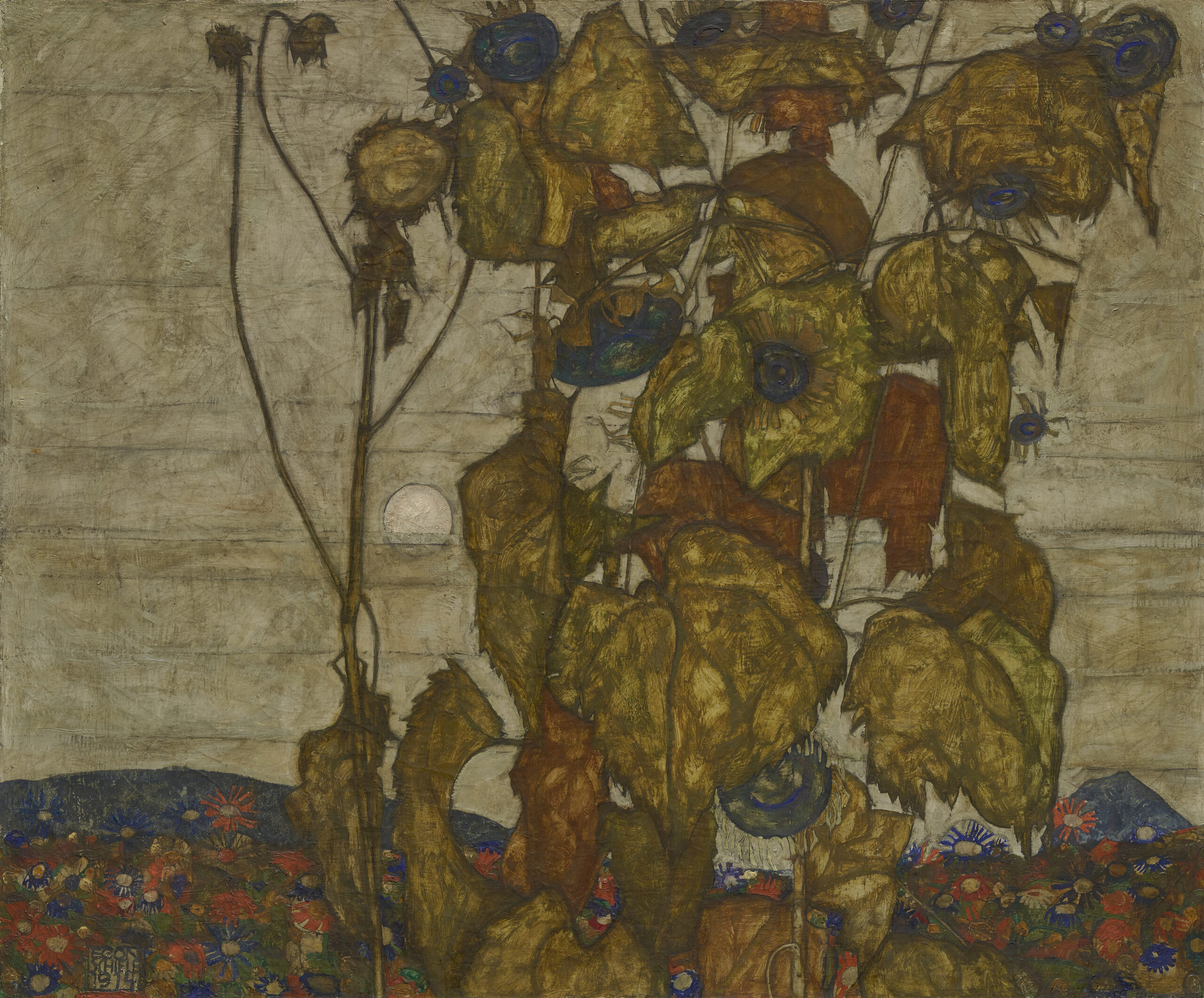
At eighteen and with Klimt—Vienna’s premier artist at the time—for philosophical support, Schiele was beginning to develop a personal expression. Christian Bauer, the show’s curator, calls Sunflower his first major work. It’s a small yet sophisticated composition. Whereas Klimt’s sunflowers exist amid abundant gardens claustrophobic with greenery, Sunflower I stands in a void, the topmost blossom facing downward, dying. Six years later, revisiting the subject writ large in Wilted Sunflowers (Autumn Sun II), there’s greater complexity in design and color, but the mood is dependably somber. “When one sees a tree in autumnal summer,” wrote Schiele, “it is an intense experience that involves one’s whole heart and being: and I should like to paint that melancholy.” Bauer sees in the first sunflower painting a metaphor for Schiele’s relationship with his mother, a reading I find too literal, though the artist made clear his intent to identify with and anthropomorphize trees, flowers and all things in nature. “Everywhere one is reminded of similar movements made by human bodies, similar strings of pleasure and pain in plants.”
The correspondence between the figure and the landscape is underscored in the second room. Trunks and branches are endowed with the disquieting life force of arms and legs. The space between a figure’s fingers could be the negative shape separating flowers. The abstracted foreground plane of River Landscape with Two Trees is composed of the same scorched and faceted textures as the figures in Man and Woman I (Lovers I) (or a personal favorite a few blocks away at the Guggenheim, the weathered coat worn by Johann Harms[1]). What these paintings share is the power of Schiele’s invention. Since he wasn’t painting from life, these broad masses of bodies and earth had to be filled with abstracted passages simultaneously flat and solid. Schiele activated the spaces with paint and color that had little to do with the substance of the objects, nor any logical optical phenomena related to them. This in itself wasn’t new to painting, but the desiccated feel of it was. The textures are unsettling, antecedents to Alberto Burri’s ripped and tattered burlap. More directly, they speak to Freud’s psychological explorations in pre-war Vienna, and are premonitions of the impending conflict and pandemic. In 1910, Schiele wrote of wanting to escape the city: “In Vienna there are shadows. The city is black and everything is done by rote.”
In 1911, Schiele escaped to Krumau, his mother’s hometown, about 130 miles northwest of Vienna. Though his affection for the town yielded haunting paintings, three of which form the nucleus of Living Landscapes, he was effectively banished from Krumau for living with his model and mistress, Wally Neuzil. All the same, he often returned for abbreviated visits between 1913 and 1917, during which he made precise drawings and watercolors of the townscape and its architecture from life. The studies were then synthesized into large compositions in Schiele’s studio. In his catalogue essay, Franz Smola distinguishes between canvases in which Schiele retains an identifiable topography, those in which the buildings are recognizable but transplanted to invented surroundings, and late works, referred to as “fictive townscapes”, that appear to be wholly concocted.
Among Schiele’s influences were the landscapes of the Swiss artist Ferdinand Hodler, cubism, and most significantly, Klimt. The dramatically compressed spaces of Houses by the River II (The Old City II) and Stein on the Danube, Seen from the South (Large) owe much to Klimt’s Attersee paintings for the prominence of the graphic design that replaced traditional atmospheric perspective. One major difference was that Klimt’s paintings are assumed to have been made with the aid of a telescope—the artist was responding to, and creating, novel optical perceptions. Schiele was less interested in the cause than the effect, and he coopted the effect for its design and emotive possibilities. Klimt’s landscapes were summer idylls, stylized but recognizably real. Schiele unfailingly located the lugubrious note. In case there was any doubt as to his intentions, a first batch of Krumau oils was titled Dead City.

The business of explaining composition has always struck me as a dreadful bore—suffice to say that Schiele’s bleak point of view, be it a projection of Austrian prewar culture or his own family dysfunction—was galvanized by brilliant design. Complex as the results might be, the works are often predicated on a basic foundation, that of a subject silhouetted against a light field. It’s a simple poster idea, brought to arresting fulfillment by Schiele’s draftsmanship. Envisioned as portraits, many of his sunflowers and trees are viewed darkly in front of a void or light gray sky (good luck finding a blue sky in a mature Schiele landscape). Structures like The Bridge and Single Houses (Houses with Mountains) are similarly formatted. For large canvases, a void was not deemed adequate to support the motif, so grids of horizontal lines were added—the mountains in Single Houses could as easily be striated clouds. It hardly mattered, so long as the space was sufficiently charged. In Stein on the Danube, Seen from the South (Large), the towers of the town’s medieval churches are cemented into place by a steep slope of terraced vineyards that rise behind them, creating an airtight interplay of verticals and horizontals (I keep thinking of George Bellows’s river paintings and their geometric explorations of the picture plane, painted at the same time but with vastly different sentiment).
The motif was often reversed, with lighter objects seen amidst a dark field, to sinister effect. In The Small City I (Dead City VI), rooftops become spears in the night, small windows are dark inarticulate eyes. In Sawmill, the eponymous structure is absorbed into an ominous hillside.
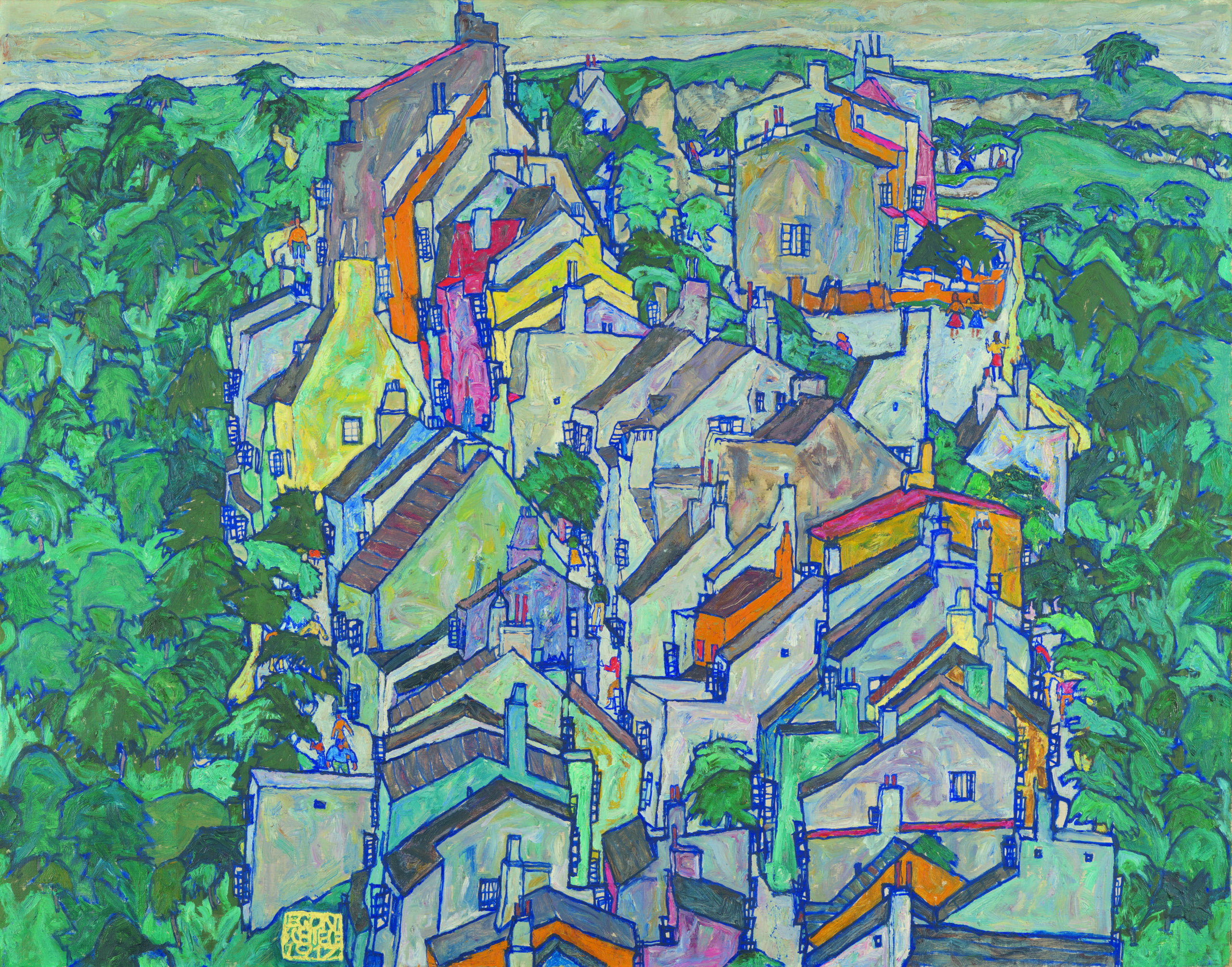
The landscapes aren’t all dirges. There is domestic comfort in the huddled frames of these small homes. Yellow Town is a jumble of houses with scant room for the horizon, the drab mood enlivened by the glow of yellow lamplight and red chimneys. The exhibition’s central work, Town among Greenery (The Old City III), underwent restoration prior to the show. Painted the year before Schiele’s death, it shares with his later figures an interest in saturated color, generously applied—the palette is analogous to the striped dress worn by Edith Schiele for her portrait. As with many of the Krumau landscapes, the town is observed from a high vantage point, its houses spilling down (or rising up) in several rows at the center of the painting. The nondescript buildings, their multi-hued grays interspersed with yellow, red and orange, overlap unevenly. Flanked on each side by verdant forests, the houses are separated by narrow streets. It is a setting yet to be identified, one that may have resided solely in the painter’s imagination.
Schiele’s artistic maturation was astonishingly quick. He was barely more than twenty when he reached his peak as a draftsman, most famously of erotica. By twenty-five, he jettisoned his mistress and model for a socially favorable marriage. When I was younger I assumed the transition from provocateur to bourgeoisie heralded a creative demise, but Schiele’s late portraits (“late” being a relative term for someone who lived to be twenty-eight) became more complex as paintings and psychological studies. The landscapes followed a parallel evolution from the wilting flowers and Dead City paintings to the increasingly colorful and fictionalized views of Krumau. They are as emotionally loaded as his portraits, and more open to the exploration of architectonic design than his figure paintings allowed.
The connecting thread, as Kimberly A. Smith calls it, is “Schiele’s characteristically lively, tactile line.” We can go further: by turns constructive and fracturing, organic and synthetic, it is the most energized line in Western art, and a convincing argument for the primacy of graphic design over atmosphere. A lot of credit is given to cubism for shattering the paradigm of illusionism in painting, but without abandoning figuration, Schiele makes a compelling case for an alternative to the centuries-long celebration of three-dimensional form. His art reminded us that there are ways to create depth outside the conventions of sfumato or chiaroscuro. All that’s required is a preternatural talent for drawing.
An intuitive feel for one’s surroundings doesn’t hurt. Paintings like The Small City I (Dead City VI) tap into the subterranean id of European history, and anticipate the abyss of two world wars that originated nearby. Living Landscapes is an abridged tour of Schiele’s Austria, in its dense and problematic beauty. Evoking the groundbreaking show at the Leopold Museum twenty years ago, it reaffirms his genius as a landscape painter.
Egon Schiele: Living Landscapes is on view at Neue Galerie through January 13, 2025.
- weathered coat worn by Johann Harms: https://www.guggenheim.org/artwork/3836