At what age did you decide to become an artist?
I began drawing regularly as a small child and never stopped.
How did your parents react when you told them you wanted to be an artist?
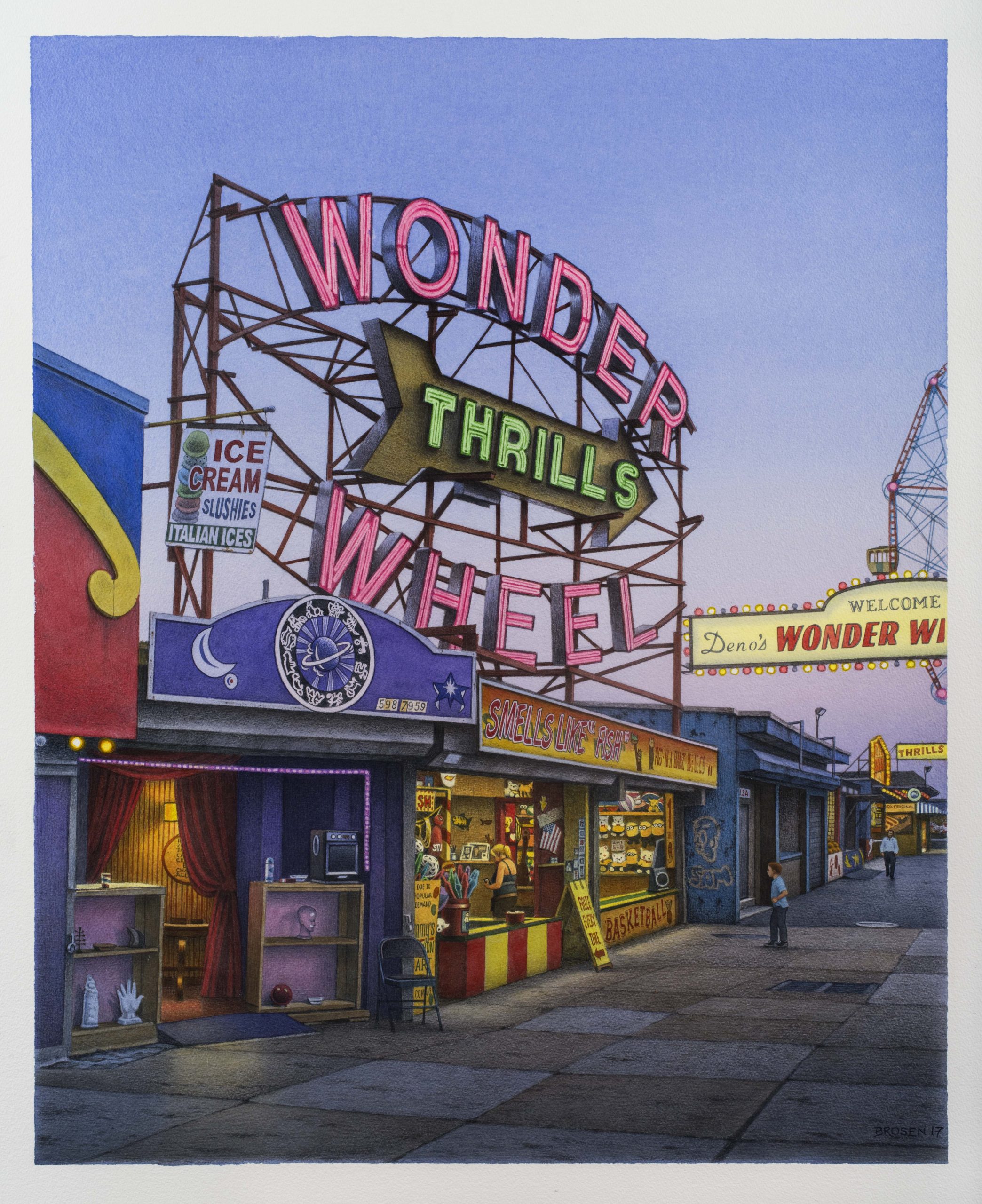
Early on, my mother was extremely proud of the artwork I did from the age of six on. Later, as a teenager, my dad was absurdly proud of the art I did at the High School of Music & Art, declaring, “Ricky, you’re already better than Hopper.” I was proud that he lived long enough to see the Metropolitan Museum acquire a watercolor[1] of mine.
Who are your favorite artists?
Vermeer. Chardin. In watercolor, Turner, von Alt, and Zorn. Far too many to list further.
Who is your favorite artist whose work is unlike your own?
Paul Klee
Art book you cannot live without?
Most well-produced surveys of seventeenth-century Dutch landscape and cityscape, my original loves.
What is the quality you most admire in an artist?
Authenticity. Integrity. A true vision.
Do you keep a sketchbook?
In my earlier years, I always did, lately not as much, which is probably not a good thing!
What’s your favorite museum in the world?
The Mauritshuis, in The Hague, Netherlands. The crème de la crème of the Dutch Golden Age. All triple-A examples of the greatest Dutch artists.
What’s the best exhibition you have ever attended?
A private viewing of forty seventeenth-century Dutch drawings and watercolors at the Rijksmuseum — Saenredam, van Ostade, Cuyp — arranged on easels on tables for us. A unique experience I will never forget.
If you were not an artist, what would you be?
A writer, most likely.
Did you have an artistic cohort that influenced your early creative development?
Rather than a specific artistic cohort, my artistic mentors were the historical artists I studied and traveled to Europe to experience firsthand. The gift my best teachers conveyed was how to live as an artist, how to prioritize the work, and how to sustain the hope of achieving excellence.
What is one thing you didn’t learn in art school that you wish you had?
Perhaps to accept that the life of an artist has tremendous highs and terrible lows; that ups and downs are natural, and not to let the outside world dictate your life in the studio.
What work of art have you looked at most and why?
Ahh! I do have a clear answer: Vermeer’s View of Delft[2]. I have traveled to Amsterdam perhaps twenty times or more since I was 18. I always go to the Mauritshuis to see this supreme work. As I have grown in my own work, this painting has revealed itself to me more and more. It changes every time, as I do. It has been a bottomless well of inspiration. For all the analysis, technical and otherwise, the great truth lies in its visceral recreation of a moment in time: the clouds move, the wind skirts the surface of the water, aged brick walls are damp with moisture, the sun breaks through in the distance, illuminating the distant spires. Vermeer takes us by the hand and lets us feel what it is like to be alive at that very moment, almost four hundred years ago. Sigh.
What is your secret visual pleasure outside of art?
A bike ride in Central Park on a sunlit morning. The sensation of gliding through the park reconnects me to childhood joys, a path to transcendence.
Do you listen to music in your studio?
Mostly what I grew up with, the Beatles, Motown. Show tunes and Sinatra.
What is the last gallery you visited?
The renovated Frick Collection.
Who is an underrated artist people should be looking at?
Neither Scandinavian nor Russian art was taught in my college classes. So great painters like Christian Købke and Ivan Shishkin were unknown to me, well-known in their own countries, but underappreciated here.
What art materials can you not live without?
Pencil and paper. The simplest and most beautiful of materials, and the foundation we all must master.
Do you create art every day?
Yes.
What is the longest time you went without creating art?
A month or two.
What do you do when you are feeling uninspired?
Ninety percent of art is perspiration, ten percent inspiration. Work through it.
What are the questions that drive your work?
Who am I? And with the skills I have acquired, what do I most want to express through them?
What is the most important quality in an artist?
Authenticity coupled with skill and vision.
What is something you haven’t yet achieved in art?
True excellence. That aspiration is worth the journey.
What is the best thing about art in the era of social media?
As social media and AI surround us with a world of simulacra—copies of copies, images of images—it is critical to both sequester yourself in your studio and seek out the authentic works of art that draw you. Not on the computer, but in person, up close. See the scale, the textures, and the colors of the actual objects.
FREDERICK BROSEN is a painter and instructor emeritus at the Art Students League, where he continues to lead workshops. On Instagram: @frederick_brosen[3].
- watercolor: https://www.metmuseum.org/art/collection/search/486958
- View of Delft: https://www.mauritshuis.nl/en/our-collection/artworks/92-view-of-delft
- @frederick_brosen: https://www.instagram.com/frederick_brosen/