
Sylvia Plath. Diane Arbus. Mark Rothko. Gregory Gillespie. The utterance of their names cannot help but bring to mind not only their work, but a reminder of how they chose to leave the planet: by their own hands. Twenty-five years after his tragic death, Gregory Gillespie, one of the most successful painters to ride the resurgence of realism from the 1960s through the 1980s, is having a moment. First, with the release of the documentary The Painted Life of Gregory Gillespie, a rich portrait of the artist’s life from director Evan Goodchild, followed by Forum Gallery’s museum-quality exhibition at the gallery and at the Independent Art Fair, surveying his output from the early 1960s through 1977.
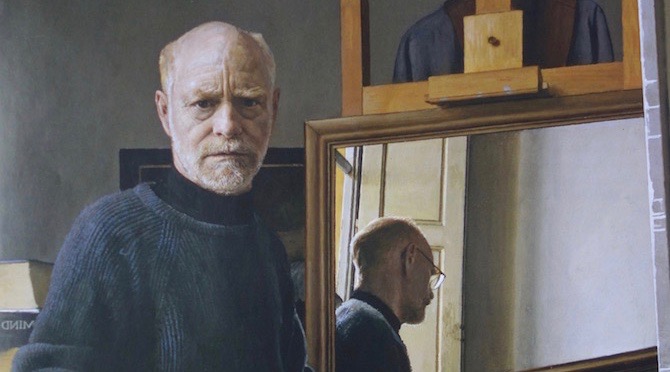
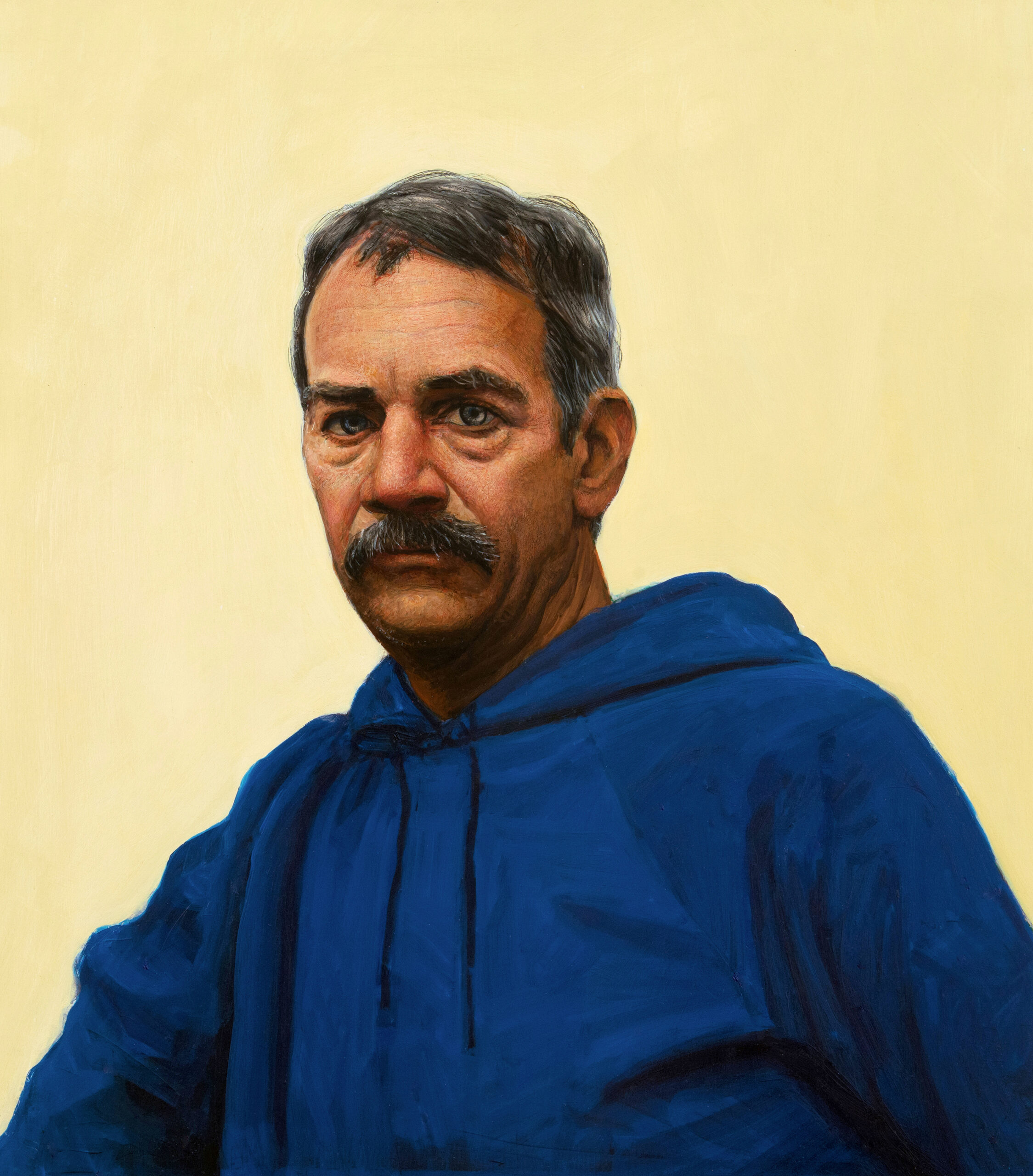
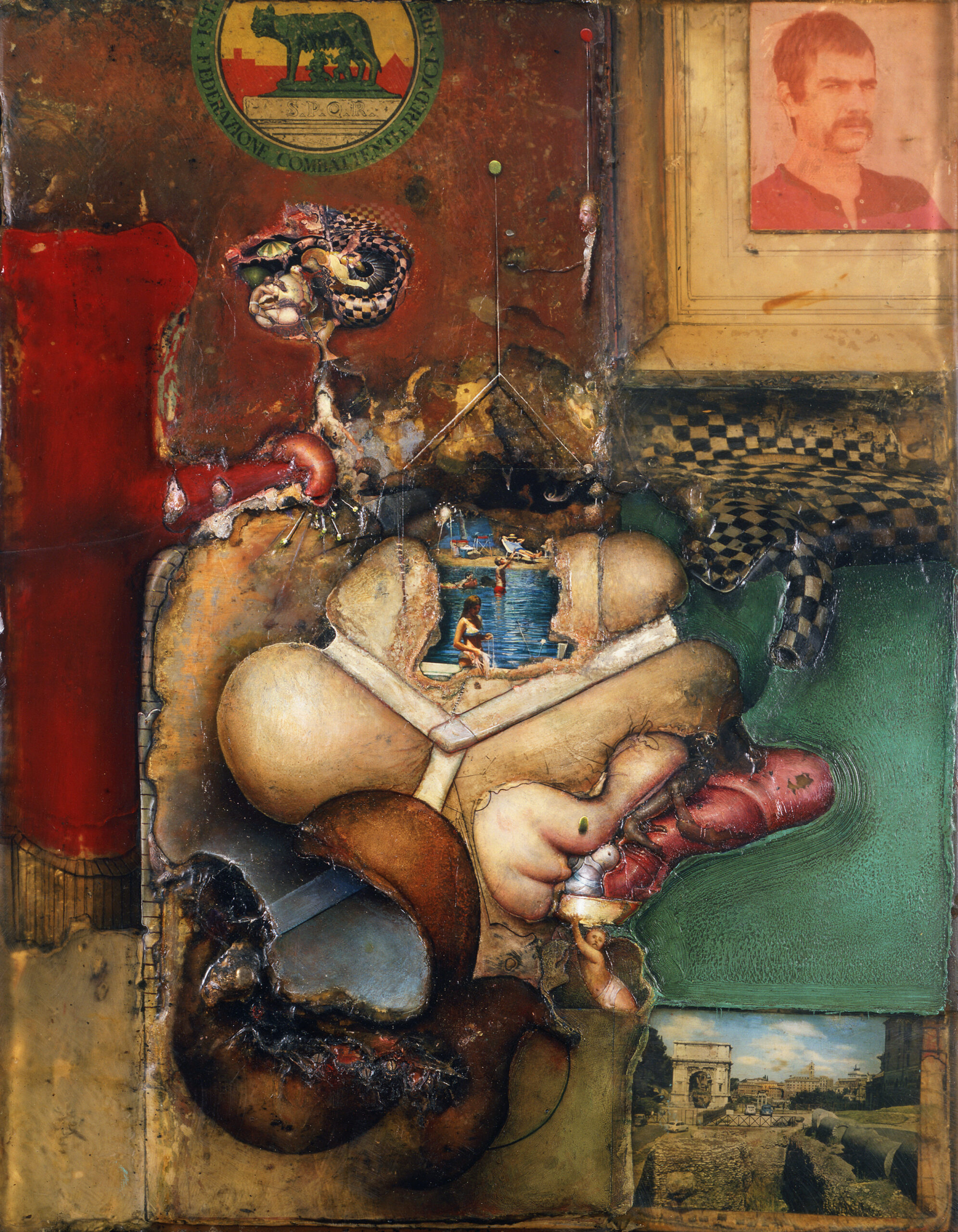
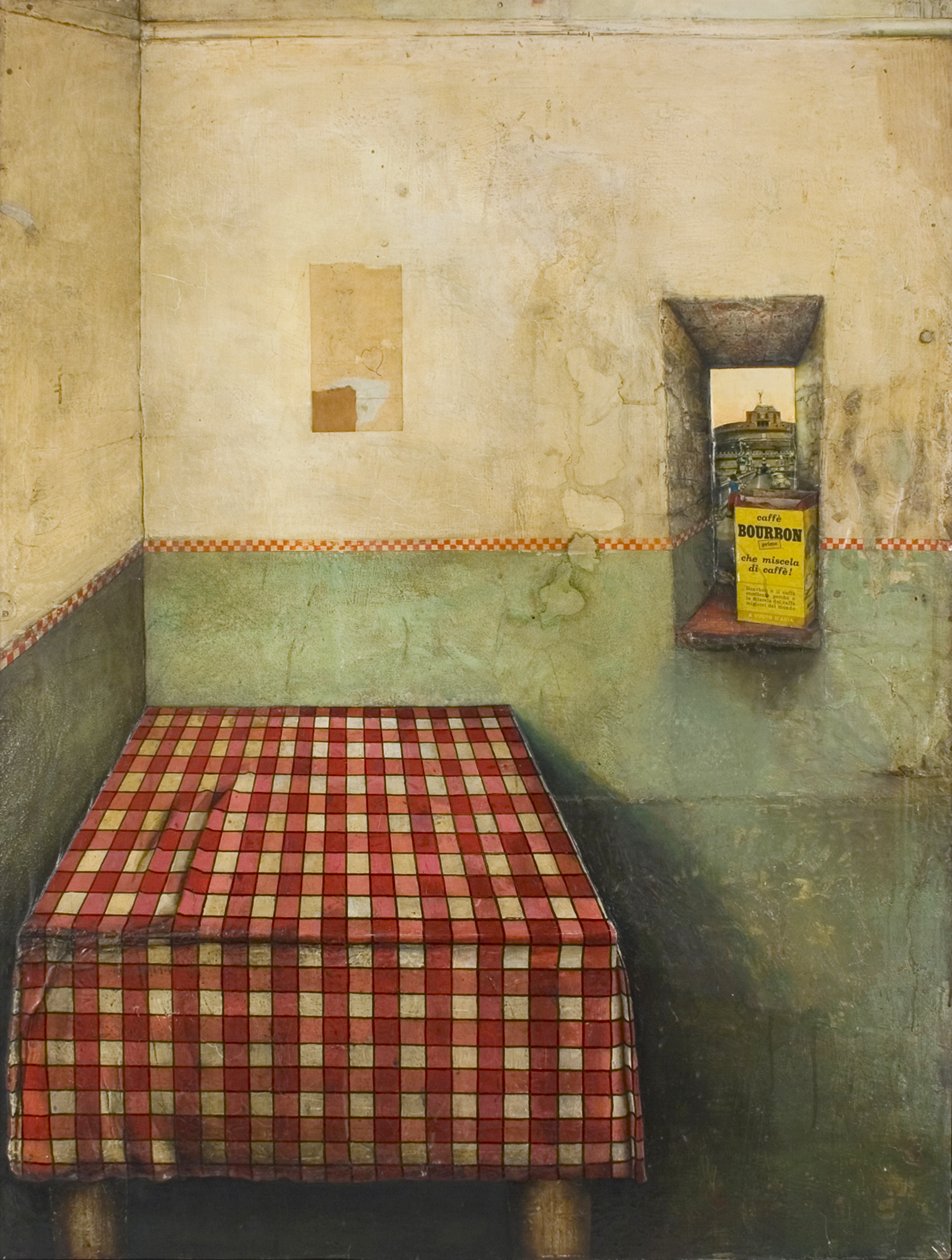
Gregory Gillespie’s work has always been impossible to categorize. In both his choice of imagery and painting techniques, he may have been the most chameleonic artist to arrive in centuries. From his earlier work, heavily influenced by his six years in Italy, and his endless stream of self-portraits, each somehow resembling different people, to his later, playful 3D painting assemblages, replete with everyday objects, he was constantly in a state of reinvention. In a single work, his style could range from classical depiction worthy of the Italians he worshipped to extreme caricature, to childish scrawls and painted-over photo collages. Even the most innocuous of subjects are imbued with a palpable sense of terror, never mind the often disturbing, explicitly horrific, sometimes violent, borderline surreal, sexually fetishistic tableaux he explored in a series of small paintings. The Hirshhorn Museum’s first director, Abram Lerner, noted, “His work abounds in disturbing variations of reality, which mirror our normal experiences, but transform what is hauntingly familiar into an alarming blend of hallucination and sharp observation. Nothing is as it seems.” Gillespie’s cohort at the American Academy in Rome observed that “he definitely was the dark angel of the Academy.” Throughout his career, spirituality would be a constant theme, from the early works heavily influenced by his then-rejected Catholicism to the later explorations of Buddhism and other Eastern religions. Asked about work he painted just down the road from St. Peter’s, he stated, “The Pornographic stuff are [sic] religious paintings, definitely because they come out of a violent reaction to repression, the impulse to do sacrilege, which is a religious impulse. If you look at Christian art, what percentage of the paintings do you think involve somebody being mutilated? Maybe most of it.”
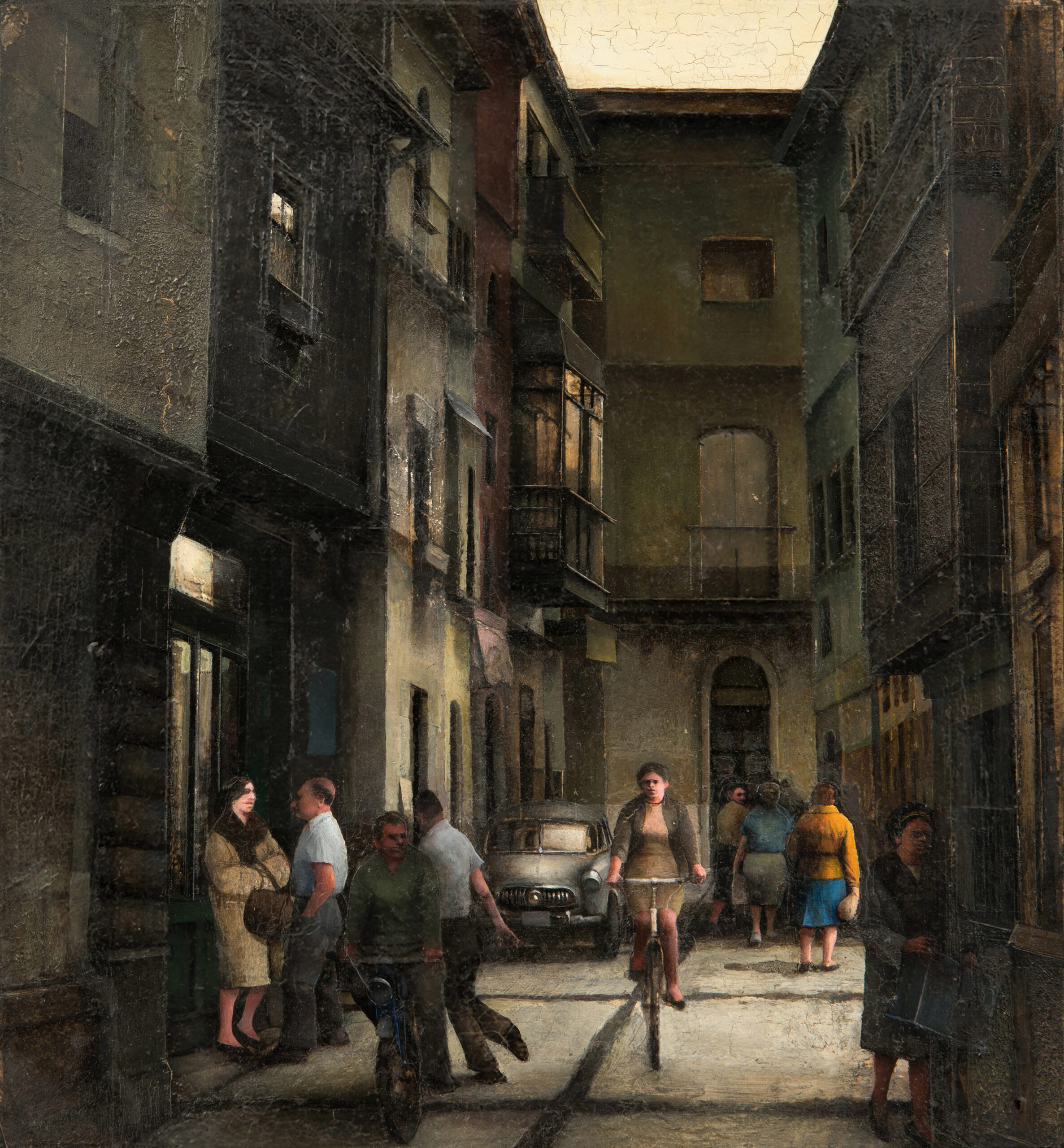
Gillespie garnered great success from an early age, earning his first Fulbright in 1962 and presenting his inaugural solo exhibition at Forum Gallery at age 30. He would go on to have over forty solo shows during his lifetime, including a retrospective at the Hirshhorn Museum at age 40. In a New York Times review, John Canady stated that he “might just emerge as the most important painter at work today,” comparing Gillespie’s body of self-portraits unequaled, except perhaps, to those of Van Gogh.
Yet as his reputation grew, his work evolved in new directions, be they the mysticism of Buddhism, deeper explorations of the unconscious, and a nearly gruesome abstraction of the figure to which the public was less receptive. In addition, America was losing its infatuation with realism.
At the time, he said, “The pieces I’m making now combine eros and death and birth. Pieces that I think of as universal symbols of everything we worship and fear. From the wombs to the tombs.” One of his last creations was his own actual tomb, replete with a shelf for his remains. (Conditions were that the buyer had to house his ashes in perpetuity in one of the many urns he also created.) He once said, “Painting is a form of prayer.”
Many were not surprised when they heard the news of his suicide, myself among them. Suddenly, much of his work from those later years seemed prescient. Therefore, when I took my seat for the New York premiere of The Painted Life of Gregory Gillespie, I braced for the darkest of portraits and was delivered quite the opposite. Evan Goodchild presents a Gillespie with an ear-to-ear grin in every frame of footage and every photograph in which he appears. Early on, he says, “I feel like I’m one of the luckiest people on earth. I swear to God, I love doing this so much. How many people love their job so much? And I don’t feel stuck at all. You know, it just feels like it keeps getting easier and better and more fun… I can’t wait to get down here in the morning.”
This is a film as visually compelling and beautifully frenetic as the artist’s work itself. A skillfully edited montage of the artist’s paintings, recently unearthed studio interviews, and footage of him at work, animation, diary entries, photographs, and 35mm slides he labeled, the film paints a complex picture of both the oeuvre and the man himself. We meet a painter obsessed with working seven days a week, but also a generous, playful soul, a beloved central figure in the social lives of his artist peers working in western Massachusetts, organizing picnics and softball games. Along with art world insiders, Goodchild interviews Gillespie’s closest friends; chief among them Jane Lund, Scott Prior, Robin Freedenfeld, and especially his best friend, William Beckman, all of whom remain baffled some twenty-five years later over his abrupt departure from this mortal coil.
Evan Goodchild’s very involvement in the project is a nearly eerie story worthy of a Gillespie painting. He and his girlfriend, later his wife, moved into Greg’s studio in 2016 and stayed for three years. He knew close to nothing about Gillespie. “Still. We both had an intuition that he had died here in the studio, and with a little research, confirmed it.” Sometime after moving, he was recommended as the director for the documentary, no one involved having known he’d lived there. “I felt uniquely qualified to make this film. I had lived with Greg’s ghost for three years.”
We do learn that Gillespie’s mother was bipolar and was institutionalized when he was in the second grade, that his father was an alcoholic, and that he was sent to live with an aunt and uncle with whom he was not particularly close. But friends would testify that none of this would plague him as it might others. He worked those demons out in his work. Amy Lighthill, former Boston Museum curator, said, “I’m sure it was challenging to be Greg Gillespie. He knew he wasn’t like other painters. And probably that was painful for him sometimes because not everyone grasped what he was trying to do.”
In an interview near the end, he states, “I guess I feel kind of a depression. I got people whispering in my ear ‘You are one of the best, man, in the world. Your paintings are, you know, right up there.’ There’s another part of me that thinks it’s ridiculous. I mean, the people that like them, I know there’s a lot of people that like them, but they’re just okay. You know, like, kind of like a footnote in history. Maybe if I’m lucky.” His friend William Beckman called him to say, “Your last show was a caricature of your previous work.”
Gillespie’s suicide made no sense to his friends and family. Even his therapist was shocked. Scott Prior said, “He had lots of things to complain about in his life, but he always would laugh. So to take whatever he was going through so seriously as to kill himself did not seem in character. You know, people, because of the way he died, would think, ‘Oh, the tomb. This was a premonition of suicide.’ Not true at all. He thought it would be funny and ironic, and he said, ‘I hope this winds up in some museum with my ashes in it because maybe if I couldn’t get into that museum alive, I can get into it dead.’”
Near the end of the documentary, Goodchild asks the coterie of friends what they would say to Gregory today, given the chance. Without fail, they all replied, “Why did you do it?” It just didn’t make sense. Anger is perhaps the most frustrating of emotions a suicide leaves behind, and his friends can’t help but express that. Yet the love for him and the utter worship of his work shine brightly in this film.
Contrary to other forms of art, the face of the painter is rarely seen. We feel we know the actors and musicians we admire. Even writers are forced to come out of hibernation to discuss their latest book. But with rare exceptions, such as Dali, Warhol, and Mary Boone’s bad boys of the downtown 80s, few artists have cared to cultivate public personas. Goodchild’s documentary corrects the misperception of Gillespie as a brooding soul, a time bomb, painting ever more terrifying visions until he felt the only way out was to leave. Instead, he shows us how much of the work involved play, created out of pure joy. Perhaps it’s our interpretation in the face of his suicide that would assign his entire body of work an even darker meaning.
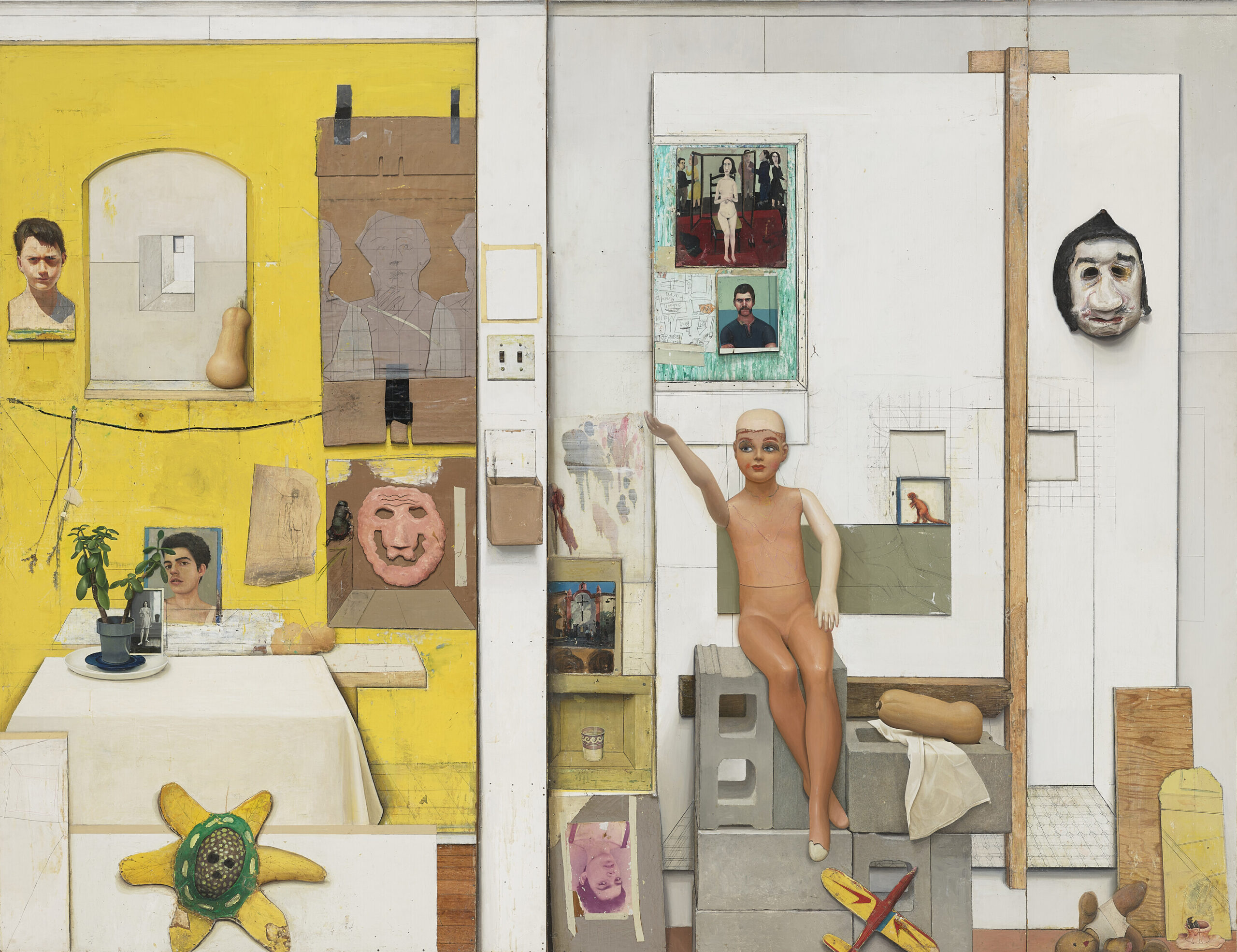
Seeing that work in person at Forum’s carefully curated survey of his career on the heels of viewing the film, one cannot help but marvel at the contrast between the very small, early, often grotesque pieces and the gargantuan statement made with Studio Wall (Still Life with Self-Portrait), whose bright yellow glow stands in stark contrast to most of the work in the room. Asked about his use of brighter colors later in life, he replied, “At first I was scared of, like, when I started off, my colors were darker and grimmer, and I was much more interested in mood. And as I got older, I’m using the brightest reds. I can find the brightest yellows I can find. And it’s something to do with facing death, and just wanting to be a lot brighter and more intense with the color.”
His preoccupation with mortality would be a constant in his life, as his death itself would forever be for his audience. My hope is that this film might correct that focus and return it to the work where it belongs.
PATRICK KING (patrickking.org) teaches painting workshops at the Art Students League of New York.