
On the last day of May, I visited the city and took in a few museum shows, not all of which included Sargent. That needs to be said, because it seemed like every day I taught last month, someone urged me to go to the Met to pay homage to the nineteenth century’s most exalted prestidigitator of portraiture. But I like the road less traveled, and a colleague brought another exhibition to my attention, featuring Rembrandt in a limited role, at the Jewish Museum. As it happens, there are two shows there right now that are very much worth seeing.
On the first floor is Ben Shahn, On Nonconformity, organized by the Museo Nacional Centro de Arte Reina Sofía, Madrid, and adapted by the Jewish Museum. Both exhibitions were curated by Dr. Laura Katzman, Professor of Art History at James Madison University; the New York exhibition was realized in collaboration with Dr. Stephen Brown, Curator at the Jewish Museum. It is an overdue retrospective that doubles as a timely sociopolitical critique.
Shahn’s credentials for the role of liberal social commentator were impeccable. He was born in Lithuania in 1898 to Orthodox Jewish parents. His father was exiled to Siberia as a suspected revolutionary before escaping to the United States. The family reunited and settled in Brooklyn, and Shahn trained as a lithographer. He attended NYU, City College, and the National Academy of Design, and studied anatomy with George Bridgman at the Art Students League of New York in 1916-17. Shahn returned to the League years later to sharpen his skills as a fresco painter—among other skills, Shahn would become one of this country’s great muralists.
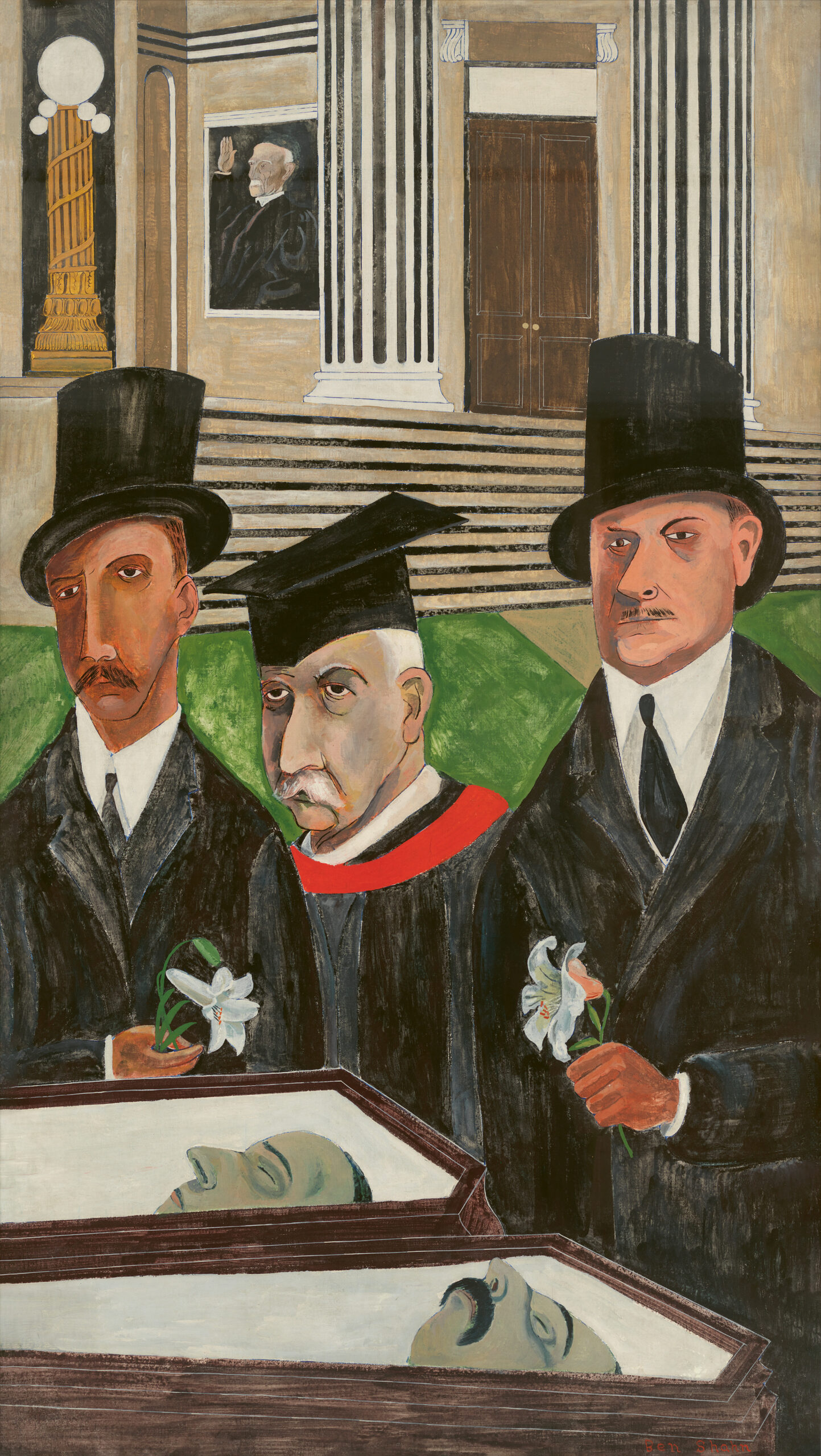
Two trips through Europe in the 1920s fostered an interest in modern art, but the Great Depression and the rise of fascism in Europe inspired a change of direction, dramatically announced in a series of paintings titled The Passion of Sacco and Vanzetti (1931–32). “Ever since I could remember,” Shahn said later, “l’d wished that l’d been lucky enough to be alive at a great time-when something big was going on, like the Crucifixion. And suddenly realized I was! Here I was living through another crucifixion. Here was something to paint!”

The exhibition opens with the series’s centerpiece, one of this country’s great protest paintings. Nicola Sacco and Bartolomeo Vanzetti, Italian immigrants executed for murdering two people in an armed robbery, are shown in their open coffins. Standing over them and holding lilies in mock tribute are the then-presidents of Harvard and MIT and a probate judge, the three of whom were appointed to determine whether Sacco and Vanzetti had received a fair trial. The case generated tremendous interest here and abroad—H. G. Wells called it “a case like the Dreyfus case, by which the soul of a people is tested and displayed.” The defendants were political anarchists whose guilt is still contested. Shahn’s deadpan depiction of judicial arbiters, expressionless in formal dress, juxtaposed with the lifeless faces of Sacco and Vanzetti, evokes the suspicion that the violation of the pair’s civil liberties was a foregone conclusion. The nominally three-dimensional figures and fractured perspective are evidence that Shahn retained features of Modernist art while adopting a figurative expression.
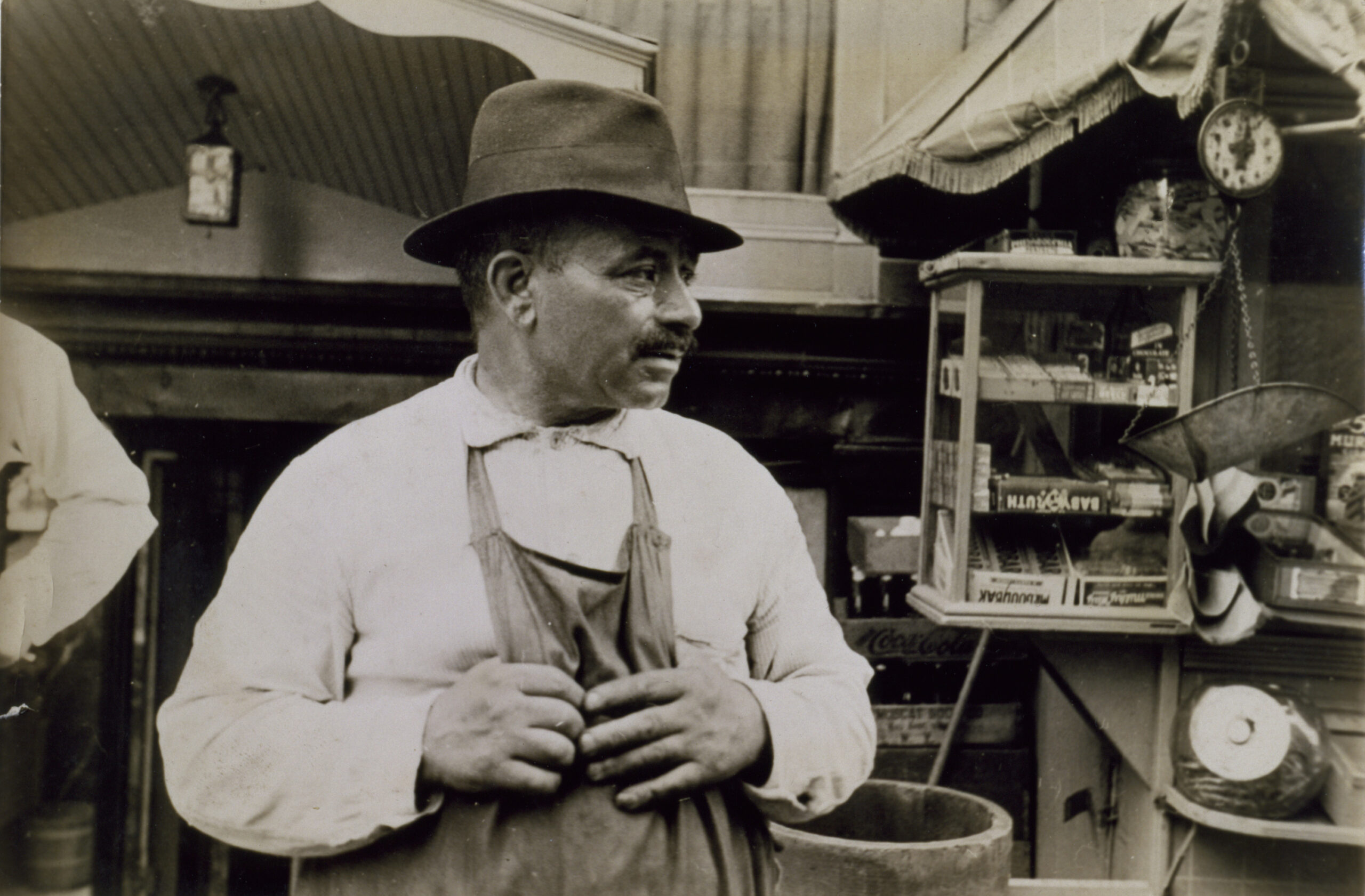
The pictorial tension of stylized figuration would animate Shahn’s socially conscious images for nearly forty years. Figures symbolic of everyman might dominate the picture plane, as in the standing job seekers of Unemployed (ca. 1938) or the brooding man behind barbed wire in 1943 AD (ca. 1943), or appear small amid their circumstances, like the children “playing” in post-war Liberation (1945) or Handball (1939), a relative anomaly in that it avoids obvious commentary, the immense wall providing a blank slate upon which the viewer may inscribe meaning. Handball, like many of Shahn’s paintings, was based on his own black-and-white photography. In the 1930s he was employed as a photographer by the Resettlement Administration-Farm Security Administration and traveled the Deep South along with Walker Evans and Dorothea Lange. The photographs, amply represented here, were far more than a reference for future paintings. They hold their own alongside Evans’s and Lange’s photographs, adding a humane documentary aspect to Shahn’s creative output.
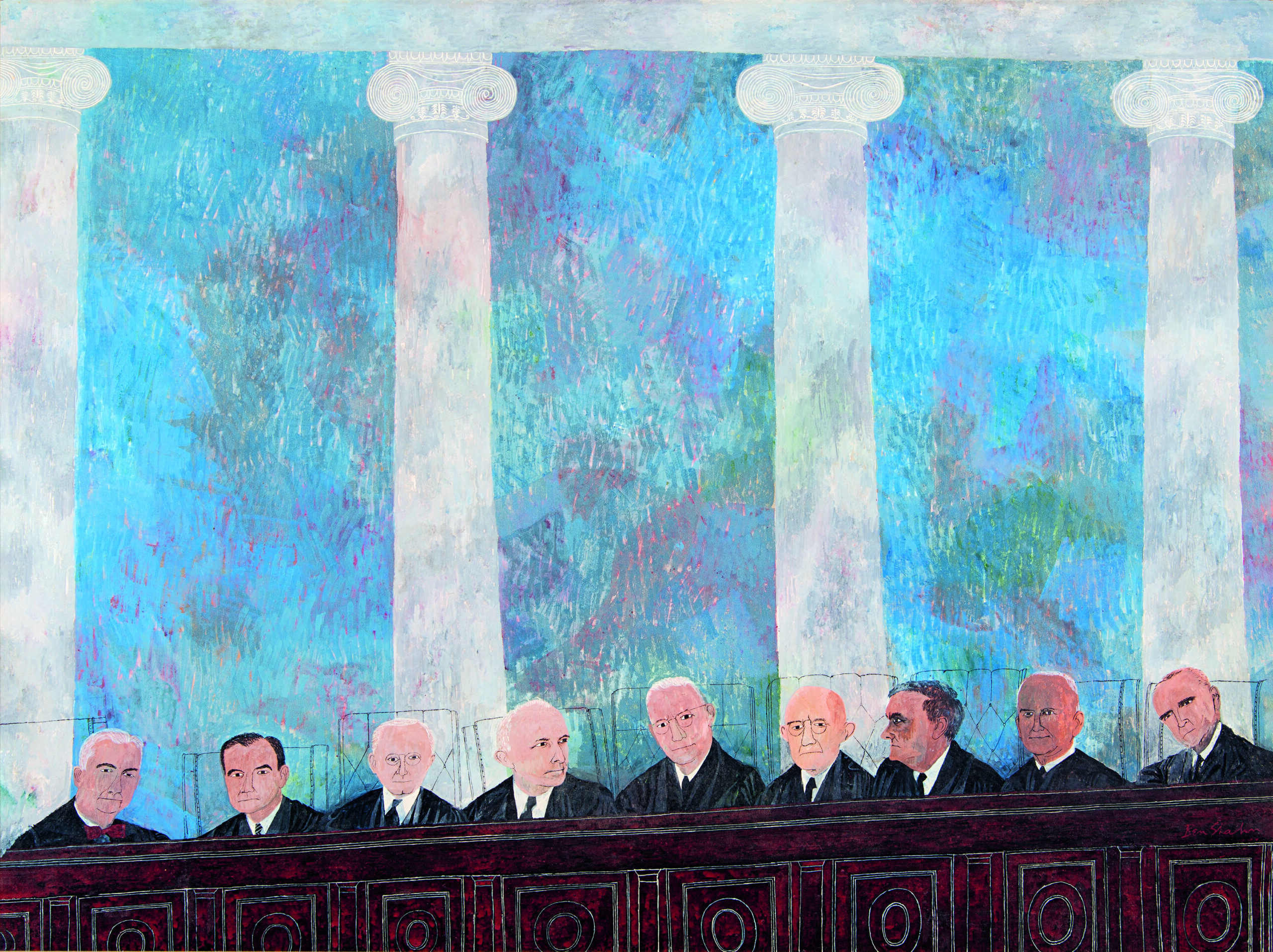
The political landscape Shahn covered is too familiar. A watercolor and ink depiction of Father Charles Coughlin depicts the priest spewing bile in a Hitlerian pose—the photo I took shows exhibition lights reflected in the picture glass, tiny white dots strung like airborne spittle from Coughlin’s open mouth. Coughlin’s antisemitism and support of Nazi policies were immensely popular with radio listeners in the 1930s. The screen print Vandenberg, Dewey, and Taft (1941) and a 1948 lithograph of Harry Truman and Thomas Dewey show politicians as smilingly duplicitous characters, reminders that distrust of elected officials is a venerable tradition. In Integration, Supreme Court (1963), the nine white justices are seated at the bottom of the painting, dwarfed by a cavernous space and classical columns, disconnected from the real-world impact of their decisions.
Although Shahn’s reputation rests upon his response to social injustices—war, corruption, civil rights and the working man were recurrent themes—he sometimes exercised a more whimsical strain in work from the 1950s onward, as in Everyman, with its harlequins reminiscent of Cézanne and Picasso. An association with Diego Rivera in the 1930s gives context to his mural work and shared politics, but polemics never displace Shahn’s natural lyricism. Shahn’s art gives way neither to idealism nor disillusionment. He responds to the issues without succumbing to their oppressive weight.
Immersed in religious studies as a child, Shahn became, in the words of his wife and fellow artist Bernarda Bryson Shahn, “pagan in spirit.” Nonetheless, he engaged with Jewish themes throughout his career, with increasing interest in spiritual subjects late in life. Ben Shahn, On Nonconformity closes with the artist’s interpretations of text from the Hebrew Bible, painted in Hebraic script. They are predictably iconoclastic. In the end, Shahn explained, he was “more of an anarchist, more of a perpetual radical than a visionary utopian.”
One flight up, The Hebrew Bible is central to The Book of Esther in the Age of Rembrandt, an exhibition of fine and decorative arts that illuminates the story of Esther, whose heroism on behalf of Persian Jews is commemorated by the holiday of Purim. Esther, taken by King Ahasuerus as his wife, pleaded successfully for the lives of her fellow Jews, thus saving them from a genocidal plot by a royal advisor. According to Abigail Rapoport, Curator of Judaica at the Jewish Museum, and Michele Frederick, Curator of European Art at the North Carolina Museum of Art, the story’s symbolism appealed not only to Amsterdam’s Jewish population, who enjoyed religious freedom after fleeing the Inquisition and pogroms elsewhere in Europe, but to the Dutch in general, who celebrated their recent independence from Spain.
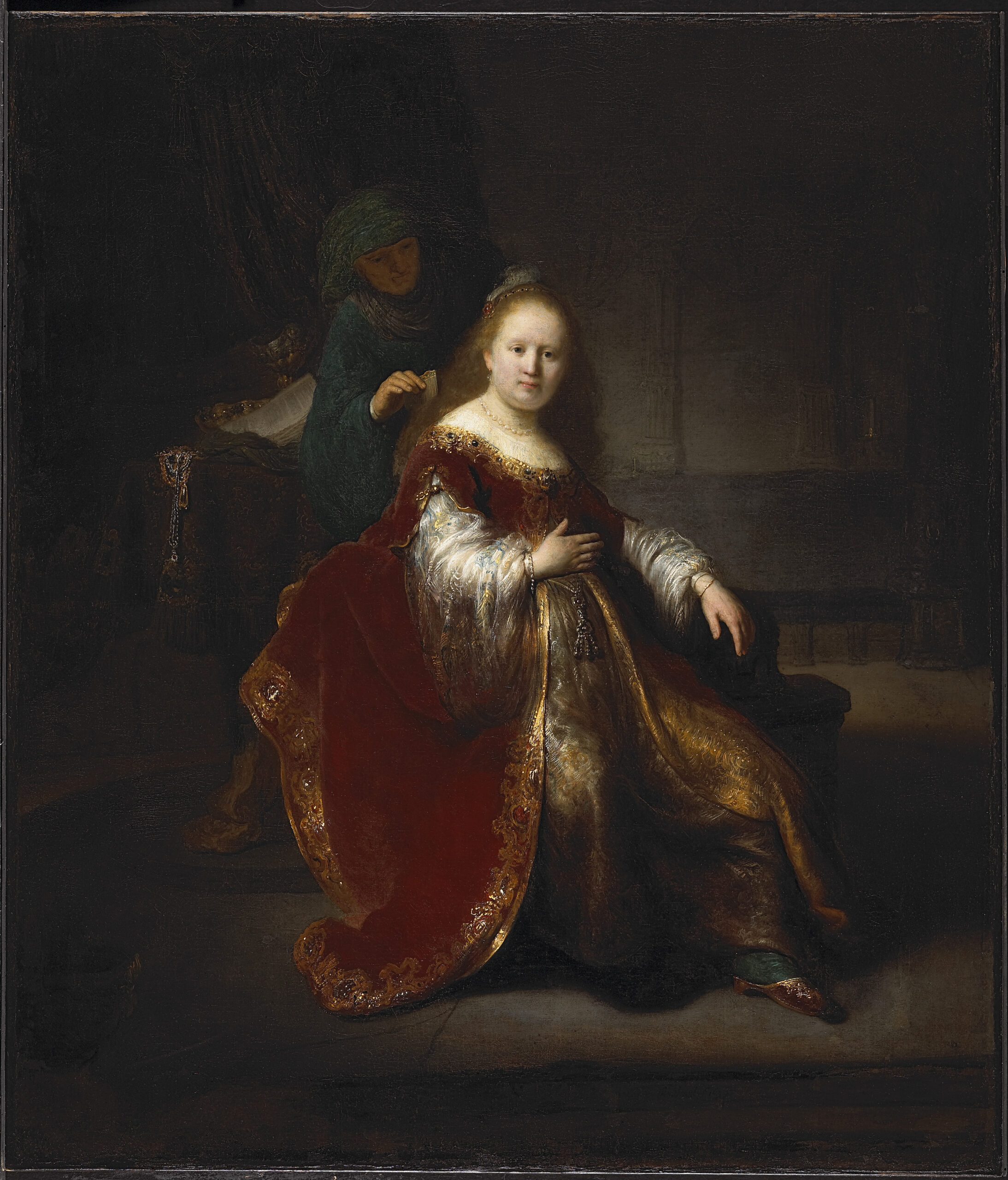
Rembrandt lived in Amsterdam’s Jewish Quarter, and his humane portrayal of his neighbors has generated conjecture about his sympathies. In the nineteenth century, a story was floated that Rembrandt had converted to Judaism—a modern counter-theory is that his Calvinist upbringing would have instilled the belief of Christian superiority. Whether one subscribes to a philosemitic or antisemitic reading of Rembrandt’s personality, his respect for his subjects was more than an opportunity to paint luxurious fabrics and exotic faces, to partake in cultural “slumming.” That much is obvious in paintings like The Jewish Bride and Portrait of an Old Jew (neither in show), and to a lesser extent, the exhibition’s centerpiece, A Jewish Heroine from the Hebrew Bible. It is a fairly early Rembrandt, beautifully rendered with an emphasis on opulent dress, as would have been expected by patrons, though with less emotional depth than in his later work.
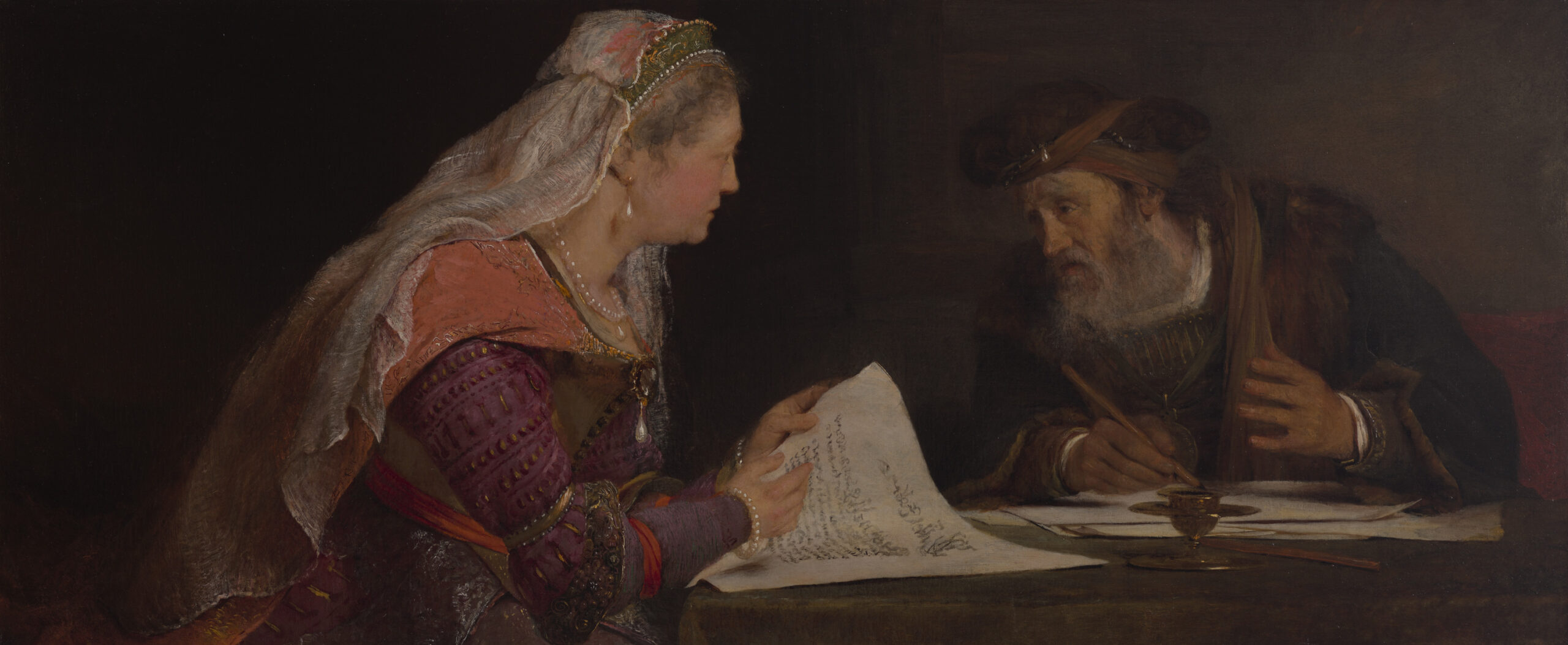
For the purposes of the exhibition, there are two problems with A Jewish Heroine from the Hebrew Bible. It’s a good Rembrandt, not a great one. The second issue, as has been noted by Rebecca Schiffman in Hyperallergic, is that the identification of the painting’s subject as Esther is inconclusive. The exhibition’s wall note admits as much, and given the presence of a maidservant at her toilette, I see her as a tentative first essay on Bathsheba, a subject Rembrandt would nail twenty years later. A similar uncertainty clings to Rembrandt’s majestic etchings of The Great Jewish Bride, thought to be modeled by his wife Saskia. Each of these works share the parenthetical description, “probably Esther.” In the same vein, I harbor misgivings about the excellent Esther and Mordecai by Rembrandt’s student, Aert de Gelder. Although so titled at least since the painting was acquired by the Rhode Island School of Design in 1917, it was previously attributed to Ferdinand Bol—another Rembrandt student—and known as The Misers. The gray-haired woman, seen in profile wearing a veil and ornate dress, is too old to represent the presumably youthful Esther. Indeed, de Gelder’s other known paintings of Esther and Mordecai together show her as a much younger woman.
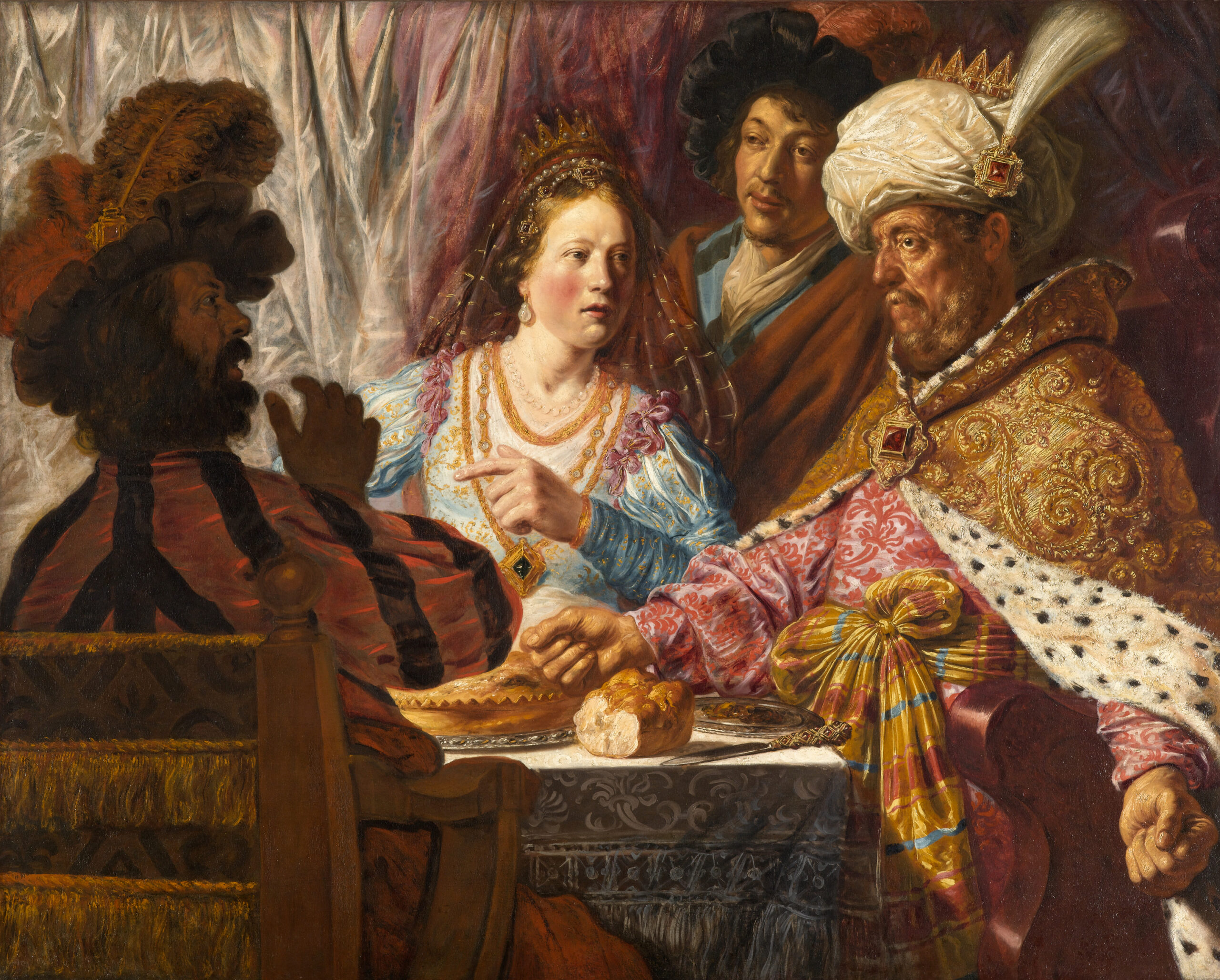
Attributions and titles are fluid matters, subject to evolving scholarship and the caprices of taste. Rembrandt and His Wife, Saskia, now attributed to Bol, was once unaccountably ascribed to Rembrandt. The portrait of Saskia aligns closely with Rembrandt’s later painting of a woman trying on earrings, now in Russia. But its connection to Esther is beyond tenuous. Nor do the etched studies of a turbaned man, the first by Jan Lievens and the second, a free copy by Rembrandt, relate directly to the theme of the exhibition. They offer an interesting sidebar on the friendship and rivalry between the two artists that began when they were precocious teenagers apprenticed to the same master in Leiden. There’s a large Feast of Esther by Lievens, the figures compressed into a tight space and dramatically lit in the Caravaggisti manner. It’s a flawed piece, yet admirable—Lievens was eighteen when he painted it, and his unconventional paint handling may have influenced the slightly older Rembrandt (a wall note erroneously claims Lievens was the elder of the two), or a course the two young artists arrived upon in unison.
Even in an Amsterdam that admired her, Esther doesn’t appear to have been a particularly compelling visual subject, as were heroines like Bathsheba or Judith, who could provide the dramatic goods of coerced adultery and murder. The best paintings of Esther were by Tintoretto and Artemisia Gentileschi—in both, fearing for her life, she falls into a dead faint before Ahasuerus. The episode was not part of the Hebrew Bible’s account and was added in Greek texts. Did Dutch painters avoid this scene because they were unfamiliar with the Greek version, or because it emphasized Esther’s vulnerability?
Though reading “probably Esther” in wall notes doesn’t help matters, one need not be discouraged by the asterisks. The subtext of The Book of Esther in the Age of Rembrandt is a reunion of Rembrandt and his contemporaries. Plus, there are other compelling reasons to visit. Until very recently, neither an exhibition devoted to the erosion of civil liberties nor one about a Biblical heroine would have been especially controversial. Now, amid outside efforts to dictate visual content and whitewash history, such installations practically constitute acts of valor. As Ben Shahn said in 1952, “It is not the survival of art alone that is at issue, but the survival of the free individual and a civilized society.”
Ben Shahn, On Nonconformity is on view through October 12, 2025, and The Book of Esther in the Age of Rembrandt is on view through August 10, 2025; both exhibitions are presented at the Jewish Museum.