
Even if his memorials to Martin Luther King Jr. are recognizable, the art of John Wilson (1922–2015), currently the subject of a retrospective at the Met, will still be something of a revelation to many. His drawings, prints, paintings, and sculptures focused almost exclusively on African-American life and literature. Wilson’s treatment of Black life began in the years that preceded World War II and continued for a half-century, evolving from themes of disenfranchisement and racial terrorism to empowerment. As in all effective social realism, the impetus was personal. Wilson explained his motivation in 1995:
I am a [B]lack artist. I am a [B]lack person. To me, my experience as a [B]lack person has given me a special way of looking at the world and a special identity with others who experience some injustices…. I don’t sit down and think, “Well, I have to do a picture on [B]lack people today.” What I’m doing to some extent in my art is exercising some of these conflicting kinds of messages that this racist world has given me…. Some of the themes I have dealt with are not because I sat down and said I wanted to make a political statement but because of emotional experiences.
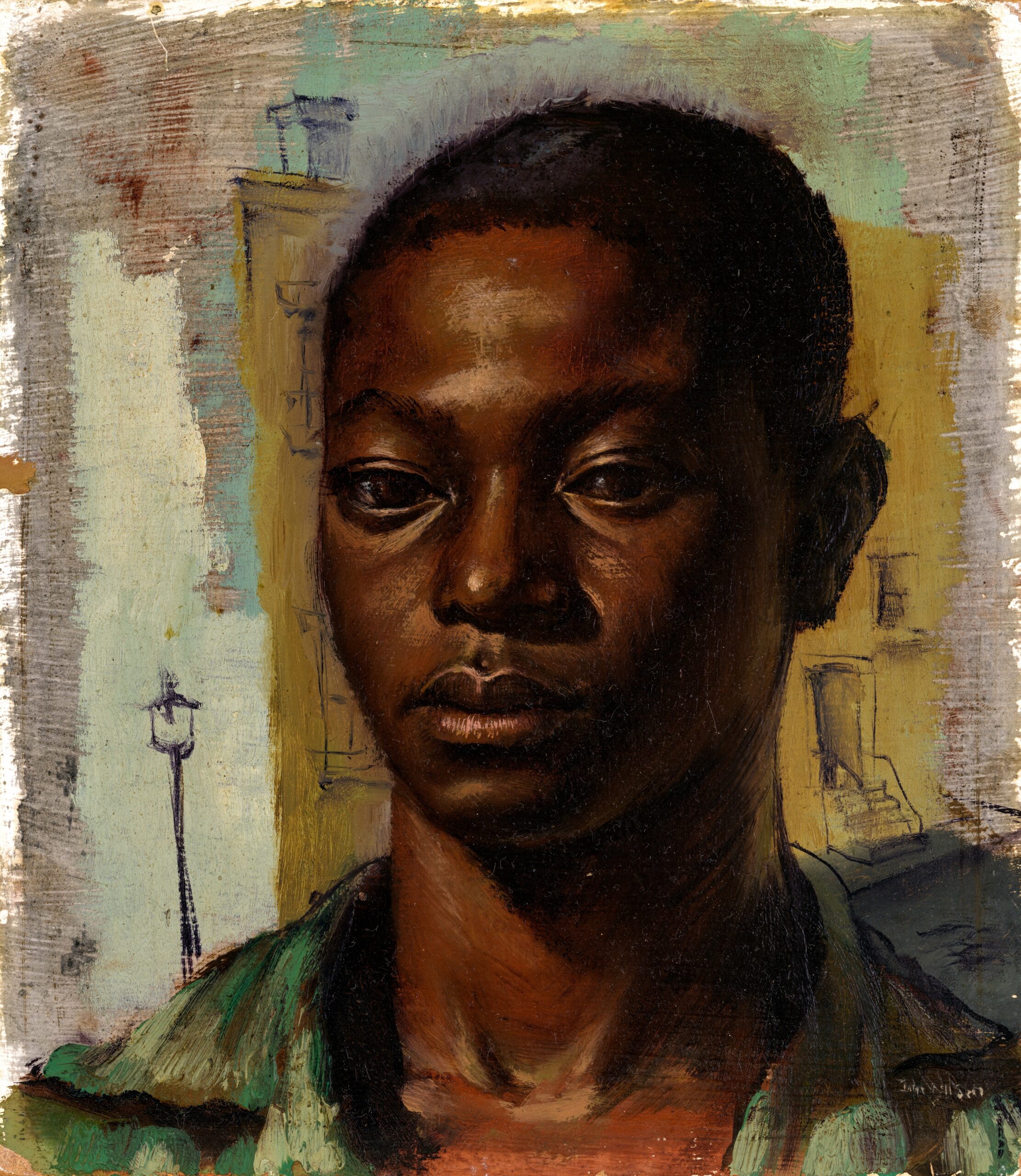
Wilson’s experiences began in the Roxbury section of Boston, where he was born to parents who had recently emigrated from British Guiana. By the mid-twentieth century, Roxbury would become the center of Black culture in Boston, but disparities were ubiquitous in a city with a reputation for racial inequality. Wilson was initially passed over for a scholarship to the city’s School of the Museum of Fine Arts, where white instructors only considered white students. He subsequently received a full scholarship to the school, graduating with high honors in 1945, and graduated from Tufts University in 1947. While attending classes, Wilson taught art and produced portraits and works of social commentary so good that some were quickly acquired by museums. My Brother was painted when the artist was barely twenty and snatched up by the Smith College Museum of Art the following year. Along with Wilson’s early self-portraits, it heralds his determination to present images of the Black man in the rhetoric of dignity. Wilson never surpassed the quiet power of these early works—his monumental bronze Eternal Presence and its studies, created forty years later, are the sculptural manifestation of the youthful drawings, paintings, and prints.

Courtesy of the Estate of John Wilson
Early forays into social themes were more experimental and compositionally ambitious. The lithograph Streetcar Scene (1945), which places a Black laborer (presumably a stand-in for the artist) amid white women on public transit, suggests familiarity with Daumier and the Fourteenth Street School of Kenneth Hayes Miller. Wilson better captures the rhythms of urban life and labor in Street Scene (1942), Straphangers (1947) and the gouache Strike (1946). Most ambitious is the lithograph Deliver Us from Evil (1943), which equates racism with nazism. On the left is a tableau of horror from wartime Germany; at right, multiple scenes show the double standard of Black and white life in America. A public hanging on one continent is mirrored by a lynching on the other. The impact is diffused by visual overabundance, but it’s impossible to miss its timeliness. And it is a remarkable commentary and technical accomplishment by a twenty-one-year-old student.
After the war, Wilson received a traveling fellowship that was earmarked for Europe, and in 1947 he arrived in Paris. The accompanying catalogue notes that Wilson missed the “vibrant Black diasporic community” that existed between the wars, but even then there had been perhaps a dozen African American artists in Paris in fifteen years. “My whole business of being,” he explained, “of the special experience that I had as a Black person, certainly didn’t exist in France, in Europe.” Still, he maintained an active social life while corresponding with other artists.
In Paris, Wilson enjoyed the collection of African art at Musée de l’Homme, and studied with Fernand Léger. Léger’s short-term influence was obvious in Wilson’s adoption of formal qualities like two-dimensional design, primary colors, and monumental forms, as well as the emotional detachment of content. Gouaches like Man with Bicycle (1949) and Woodworker (1948) have an unequivocal force, and their faceless laborers reflect Léger’s socialist leanings. “Léger,” he recounted years later, “was really a bad teacher in that you had to be a ‘Little Léger’ to get anything from him…. There was only one way of doing it —that was Léger’s way .…” Nonetheless, the time spent in Europe bolstered his confidence as a picture maker. Over the long term, Léger’s impact can be seen in more powerfully abstracted forms—evident in the much later Richard Wright Suite of lithographs—even as Wilson returned to a more realistic and socially engaged vernacular.
If the choice of Léger as a mentor seemed at odds with Wilson’s natural inclinations, his next course of study was more sympathetic. First, he returned to Boston in 1949 and was recommended as an art camp counselor by Ernest Crichlow (whose class at the League I attended briefly in the early 1980s). Wilson also worked as an instructor at the Museum of Fine Arts, Boston, and married Julia Kowitch in 1950. An interracial couple, they drove through the south in separate cars on their way to Mexico City, where Wilson studied mural painting and settled until 1956. He had wanted to meet the muralist José Clemente Orozco, but Orozco died before Wilson’s arrival. He enrolled at the Instituto Nacional de Bellas Artes (La Esmerelda) and made prints at the Taller de Gráfica Popular.
Though there’s a tradition of American artists pursuing their education as expatriates, five-plus years (in addition to two years in Europe) is a long stint, and expatriate life as a means of escape from racism has offered considerable appeal for Black artists. In Mexico, Wilson followed the news from the States, including the murder of Emmitt Till and the arrest of Rosa Parks. In the end, he felt compelled to return: “I wanted my work to express the experience of an African American in the States. I couldn’t do it long distance.”
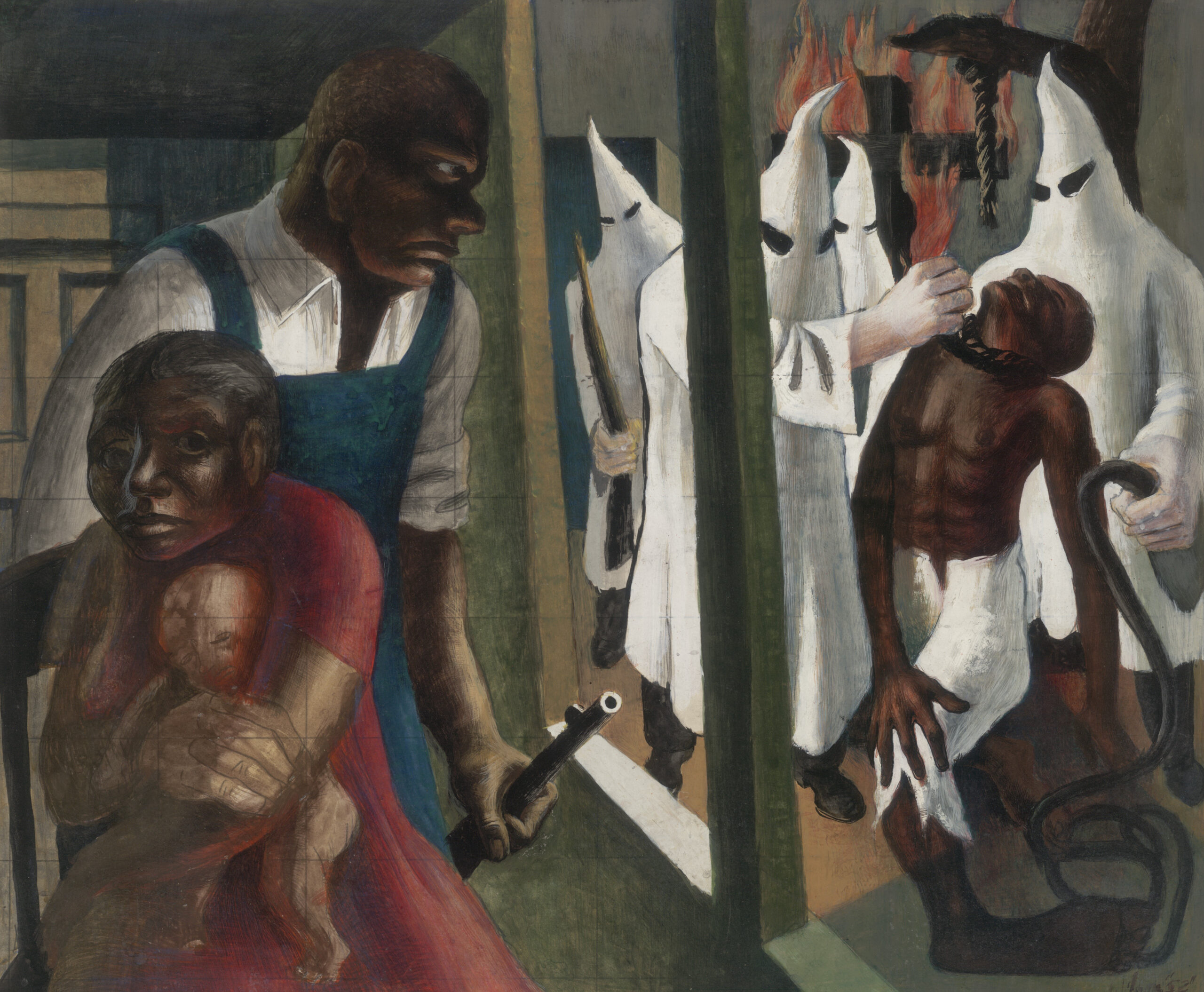
While in Mexico, Wilson painted his most provocative work, a mural titled The Incident. It was, by Wilson’s account, done to exorcise the published photographs of lynchings he had seen as a child. In the fresco, a Black man’s broken and disfigured body is being handled by the robed and hooded Klansmen who killed him, while in a nearby home, a man, shotgun in hand, prepares to protect his wife, who clutches their infant child. The dual scenes refer to the Pieta and the Madonna and Child, each stripped of their sublimity. The construct of dignity disappears in the face of violence, and in a moment, the imperative to defend one’s home and loved ones takes precedence. During the pandemic, Yale University built an excellent show around The Incident, comprised of preparatory and associated works, with posted warnings that the content could trigger an emotional response.
The Incident was painted on an outside wall, and was not meant to be permanent—student murals were soon painted over by other students at La Esmerelda as a matter of routine. But there are numerous black-and-white and color studies, as well as photographs of the mural itself, from which we can attempt to assess the painting. Since the Yale show, I’ve thought about the difficulty of matching the methods of Mexican fresco with the violent content, the reduction of the figures to broad characterizations (A naturalistic rendering has its own pitfalls, chief among them a tendency toward the overly literal and kitsch). A lively, unrelated color study titled Incident appears to depict the prelude to a lynching, and communicates frenzy where the mural and its studies are labored.
That Wilson undertook the project at all was significant. The Incident could not have been exhibited publicly in the United States in 1952—over seventy years later, such a painting would hardly fare better. Its worth was recognized by David Alfaro Siquieros, then the head of Mexico’s department to preserve murals, who wanted to protect it. The Incident existed at least until the Wilsons returned to the U.S. At some later time, it was painted over.
Courtesy of the Estate of John Woodrow Wilson / Licensed by VAGA at Artists Rights Society (ARS), New York
In 1956, Wilson settled briefly in Chicago, where he worked as an illustrator. The following year, he moved his family to New York City and taught art in the public schools. An opportunity to instruct at Boston University brought Wilson back to Massachusetts for good in 1964. He taught drawing at B.U. Until 1986. After the move to Brookline, he became more involved in advocacy for Black artists, co-founding the National Center of Afro-American Artists, and served as a consultant to the Museum of Fine Arts, Boston.
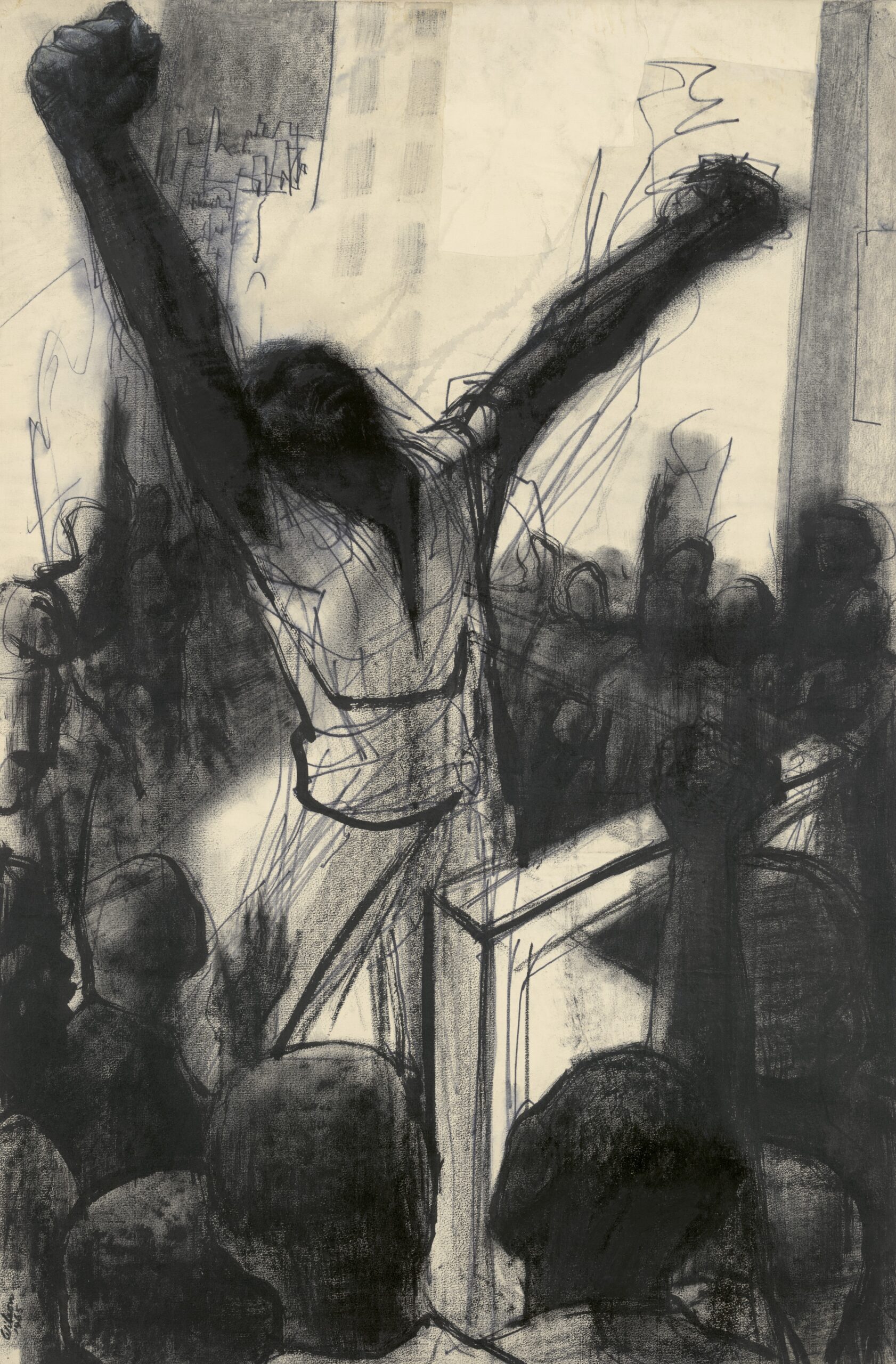
In the mid-1960s, Wilson began to explore the father-son relationship, most notably in a powerful black pastel rendering, Father and Child Reading. Emphatic graphic design lends the figures tremendous solidity in an intimate context. Father and Child Reading is drawn with a ferocity—one is tempted to say velocity—that demands the inviolability of the Black family in even stronger terms than The Incident, supported not by a shotgun but through the sharing of knowledge. At the same time, Wilson continued to illustrate books with Black subjects. In the 1970s, he embarked upon a series of life-size, full-color figure drawings in preparation for a mural. Titled The Young Americans, the models were his children and their teenage friends. Although the project was never completed, the portraits were an opportunity to draw the figure in large scale, this time with a new perspective: that of a father optimistic for the promise of the next generation. The female portraits introduce another new note, an appreciation for young women’s autonomy in their coming-of-age. One of the models became a frequent subject of Wilson’s drawings, and her bearing revitalized an idea that had long fascinated him. “I started to feel that the two-dimensional illusionistic images I was creating as a painter and printmaker were inadequate. I decided to try sculpture and chose to work in clay.” His first sculpture, the monumental head Eternal Presence, would be seven feet high.
Wilson described Eternal Presence as “a symbolic black presence infused with a sense of universal humanity.” Whatever real people inspired it, it is a synthesis of multiple sources, including Mexican art and images of the Buddha. The completed bronze was installed at the Museum of the National Center of Afro-American Artists in Roxbury in 1987. The version in the current show is a maquette, and like much of the work featured at the Met, it is on loan from the Museum of Fine Arts, Boston.

Also in the mid-1980s, Wilson fulfilled separate commissions for bronze portraits of Martin Luther King, Jr., the first an eight-foot monument in Buffalo, and the second a memorial bust for the United States Capitol. A series of drawings of King, in which Wilson searched for an image that would transcend likeness, preceded the memorials. In 2002, he produced a print that corresponds closely to the pastel of 1985. The heavy outlines that define King’s shoulders carry a different weight than those of earlier drawings, and speak to resignation as much as resistance. Particularly in the graphic work, King projects a disarming vulnerability.
In his major works, Wilson sought to communicate ideas to a broad public. Like other twentieth-century oracles—Kollwitz and Baskin offer loose parallels—Wilson’s expression was especially effective when distilled to black-and-white. He was above all a draftsman, and though he could apply line with variety and dexterity, he was most himself when inducing the deepest ebony from charcoal, pastel, ink, and even bronze. Blackness, in life and art, was to be preserved. Aware that its outdoor setting would alter the patina of Eternal Presence, Wilson left instructions for its maintenance, which include an annual application of black wax to its surface.
At the Met, I was perhaps fondest of unexpectedly intimate works, like The Dressing Table (1945), a portrait of Wilson’s sister that quietly subverts the tradition of white women viewed at their toilettes. A bevy of American Impressionists made livelihoods painting women seated in the boudoir, but I’m hard pressed to recall other comparable meditations on the Black woman in American painting. It would be years before Wilson returned to female subjects with regularity. On the north introductory wall are a study of Wilson’s granddaughter, Gabrielle (1998); Roz No. 9, Study for Eternal Presence (1972); Nefertiti (1976); and a splendid pastel of his older daughter, Becky (1969). Wilson’s wife appears here in a powerful charcoal study associated with The Incident, in which she assumes the guise of a Black woman. Absent from the show in New York is Julie and Becky (1956–78), a beautiful oil of Wilson’s wife and infant daughter that has the feel of an early Renaissance devotional piece.
It would be pleasant to say that Wilson’s determination to depict Black subjects with dignity shifted the cultural landscape, just as it would be nice to believe that the Civil Rights acts of the 1960s closed the book on institutional racism. To the contrary, it seems as if the same battles need to be reengaged by each generation, never more so than now. In their own ways, Kehinde Wiley and Amy Sherald are restating Wilson’s point, as if ignorance will be dispelled by the repetition of a moral truth. And Wilson’s art, whether confronting dehumanization and murder, commemorating the nobility of his race, or celebrating his family, remains ever relevant.
Witnessing Humanity: The Art of John Wilson has been organized by The Metropolitan Museum of Art and the Museum of Fine Arts, Boston. It is at the Met through February 8, 2026.