
At what age did you decide to become an artist?
I began drawing at an early age while studying at an art school in Ukraine, but seeing Rembrandt’s work in person for the first time was the true catalyst. I found myself completely absorbed, fascinated by the quality and power of his art. I decided to pursue art seriously at eighteen, a commitment that became my life’s path after I joined the Art Students League of New York.
How did your parents react when you told them you wanted to be an artist?
Once they realized the depth and sincerity of my passion, they became fully supportive of my decision.
Who are your favorite artists?
My favorite artists include Rembrandt, Velázquez, John Singer Sargent, Joaquín Sorolla, Ingres, Rubens, van Dyck, Johannes Vermeer, Edgar Degas, and Ilya Repin, among many others.
Who is your favorite artist whose work is unlike your own?
Gerard ter Borch. There is an impossible completeness to his small, highly finished interior scenes, not merely in the detail, but in the atmosphere itself. He captured the sense of air in a room, making the space between the viewer and the subject feel tangible. I’m in love with his textures: the light-absorbing pile of a Persian rug or the liquid shimmer of a silk dress. It is a level of precision that feels less like painting and more like a form of alchemy. I often wish I could stand behind him in his seventeenth-century studio, just to witness the process.
Art book you cannot live without?
Solomon J. Solomon’s The Practice of Painting and Drawing is essential. I also find myself constantly returning to The Letters of Edgar Degas.
What is the quality you most admire in an artist?
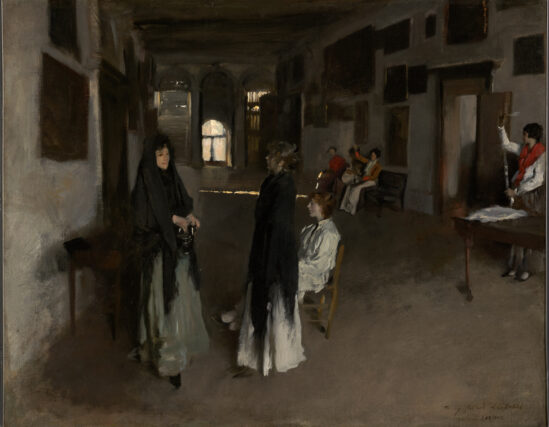
The ability to act as a witness to time and place. Through Francesco Guardi, I can walk through a Venice that no longer exists; through Joaquín Sorolla, I can feel the specific vibration of Mediterranean light from a century ago. Art is a form of time travel—it allows me to experience the world through someone else’s eye, preserving a beauty that would otherwise be lost to history.
Do you keep a sketchbook?
Absolutely. I always carry several sketchbooks of varying sizes and paper types. Life always presents opportunities for observation, and it’s refreshing to bring your art outside the studio and into the world.
What’s your favorite museum in the world?
The Metropolitan Museum of Art. I go all the time and never get tired of it. Whether I am there to sketch, draw, or paint, it remains an inexhaustible source of learning and inspiration.
What’s the best exhibition you have ever attended?
The exhibition Sargent: Portraits of Artists and Friends at the Metropolitan Museum of Art in 2015. The sheer quantity of works on view made it incredibly powerful. Seeing John Singer Sargent’s virtuosity firsthand and the power of the actual paintings was unforgettable—no reproduction comes close. It was a major source of inspiration and gave me a clearer sense of direction while studying at the Art Students League of New York.

If you were not an artist, what would you be?
To be honest, I’m not sure there would be anything to substitute for it. I would always feel like something is missing. I love cinema, I love music, I love sports, I love literature; no offense, but there is nothing like painting for me. Even when it comes to other forms of art, I admire them, but I don’t see myself being part of them. Without discovering painting and drawing, I don’t think I would fully feel like I’m on the right path.
Did you have an artistic cohort that influenced your early creative development?
Yes. At the Art Students League, the classes with Leonid Gervits, Robin Smith, Harvey Dinnerstein, and Dan Gheno provided not just technical guidance but a vital, supportive community of artists.
What is one thing you didn’t learn in art school that you wish you had?
I wish I had learned how to be an independent artist outside of the school environment. In reality, there’s no real way to fully learn that in art school, but the transition is difficult. On your own, you have to rely entirely on your discipline, dedication, and the environment you create for yourself. It ultimately forces you to figure out what you really want to do with your art.
What work of art have you looked at most and why?
It’s hard to name just one. When I’m in a museum, especially on my own, I can spend hours looking at a single painting, and to understand it better, I often draw from it. Some works I can even see very clearly in my mind with my eyes closed. One I’ve looked at extensively is the portrait Joseph-Antoine Moltedo (ca. 1810) by Jean-Auguste-Dominique Ingres. I copied it over six sessions, three hours each, and was still chasing a very subtle likeness that was difficult to grasp. The copy turned out okay, but what I learned from it has been an incredible lesson for life.
What is your secret visual pleasure outside of art?
Going back to the source of art—life itself. Observing people in everyday situations—how they move, interact, how light hits their faces, what colors and shapes I see, and how those shapes make me feel. Observing simple things in life—an empty room lit by sunlight, the sky moving, the sea, trees—anything that is life. That’s the magic of art: it allows me to see the beauty in the world and makes me a much better admirer of life and nature.

Do you listen to music in your studio?
I prefer silence; it allows me to maintain a focus on the work.
What is the last gallery you visited?
The Frick Collection, shortly after it reopened following its renovation.
Who is an underrated artist people should be looking at?
I would say Adolph von Menzel. His ability to draw, especially in sketches, is extraordinary. The fluidity and accuracy of his observation and the variety of scenes he captures from life are on a whole other level—and we don’t talk about him enough. I would also mention Oleksandr Murashko, Santiago Rusiñol, Severin Krøyer, and Émile Friant, just to name a few. It’s a bit of a hobby of mine: discovering unjustly forgotten, underrated artists.
What art materials can you not live without?
My oil painting supplies—paint, brushes, and a surface to work on. Without them, I can’t fully do what I love.
Do you create art every day?
Of course, no day without a line.
What is the longest time you went without creating art?
Honestly, since discovering painting and drawing and fully committing to it, I don’t really take breaks or vacations. I always try to work as much as possible. It’s a bit of an obsession for me.
What do you do when you are feeling uninspired?
Whatever I feel, I keep working with a brush or a pencil in my hand. Inspiration usually comes through the process; after working for a while, it shows up. I don’t wait for it or rely on it—I just carry on.
What are the questions that drive your work?
How can I capture the essence of what I am seeing in the most direct and exciting way? I am constantly trying to visually decode the world: its harmony, shapes, and aesthetic beauty through colors, values, shapes, gesture, etc.
What is the most important quality in an artist?
Conviction. I remember reading about Gustave Courbet and a phrase he lived by: “Shout loud and walk straight.” For him, it meant being direct and uncompromising, both in life and in painting. That idea of honesty and staying on your own path feels essential to me.
What is something you haven’t yet achieved in art?
Too many things, to be honest. Sometimes it feels like one life is not enough to achieve it all, but that’s exactly what makes it exciting. Even after years of painting every day, it can still feel like the first time.
What is the best thing about art in the era of social media?
The accessibility. You can instantly see great work from all over the world, study it, and stay connected to what’s happening. At the same time, nothing replaces seeing the actual painting in person, but as a tool for exposure and learning, it’s incredibly powerful.
KONSTANTIN RUDNICHENKO (@konstantin_rudnichenko) teaches Portrait Painting at the Art Students League of New York.