The most trenchant critique of Mary Cassatt’s work came from no less a wit than her erstwhile friend and mentor, Edgar Degas, who said she painted the “Infant Jesus with his English nurse.” Degas’s snark invoked Cassatt’s fusion of themes, the Madonna and Child merged with nineteenth-century childcare. Perhaps there was some envy—Degas’s paintings of families were apt to reveal disconnection, if not dysfunction. Degas’s people rarely connect in an emotionally satisfying way; Cassatt’s rarely fail to. Cassatt made the Biblical subject secular and offered entree to the intimacy of the mother and child relationship.
Things are not always what they seem. The curators of Mary Cassatt at Work, now at the de Young Legion of Honor in San Francisco, remind us that Cassatt was crafting fictions. Many of the presumed “mothers” were nursemaids, and the adults and children who posed for Cassatt were often unrelated hired models. Mary Cassatt at Work covers this, the artist’s best-known theme, and much more. Would that the selections were more judicious. The later works, painted when Cassatt was losing her eyesight, are an argument against too inclusive a retrospective (the last major Cassatt show, organized twenty-five years ago by the Art Institute of Chicago, tacitly acknowledged as much). Focus on the prime years of Cassatt’s creativity, roughly the late 1870s to late 1890s, and her standing as a major Impressionist pastellist, oil painter, and printmaker is unassailable. She reappropriated subjects often sentimentalized and made ethereal by male artists and endowed them with a matter-of-fact dignity. Cassatt’s women and children—rarely did the masculine presence intrude—have a pleasantly tangible weight.
Cassatt was born in Allegheny City, now part of Pittsburgh, in 1844. She grew up partly in Philadelphia but also traveled extensively with her family through Europe. Her art education was lengthy and difficult. At age 15, Cassatt enrolled at the Pennsylvania Academy of the Fine Arts. She found the atmosphere inhospitable—female students were not considered serious artists and were not permitted to work from nude models. In 1866, Cassatt moved to Paris, where she studied with Jean-Léon Gérôme, Charles Chaplin and Thomas Couture, and copied at the Louvre. In 1868, she became one of the first American women to exhibit at the Paris Salon. Cassatt otherwise had little success in Paris, and returned to the U.S. in 1870. The following year she confided, “I have given up my studio & torn up my father’s portrait, & have not touched a brush for six weeks nor ever will again until I see some prospect of getting back to Europe.” Her luck soon changed, when the Roman Catholic Bishop of Pittsburgh commissioned her to paint copies after Correggio in Italy. After a sojourn in Spain that yielded capable genre pieces like A Balcony in Seville, Cassatt settled in Paris. Critical of the popular Salon art, she continued to evade recognition and must have felt intellectually isolated until she encountered Degas. Seeing his work in a gallery window in 1875, Cassatt later recalled, “I used to go and flatten my nose against that window and absorb all I could of his art. It changed my life. I saw art then as I wanted to see it.” The sentiment was requited—Degas’s initial response to Cassatt’s work was “There is someone who feels as I do.” He invited her to exhibit with the Impressionists.
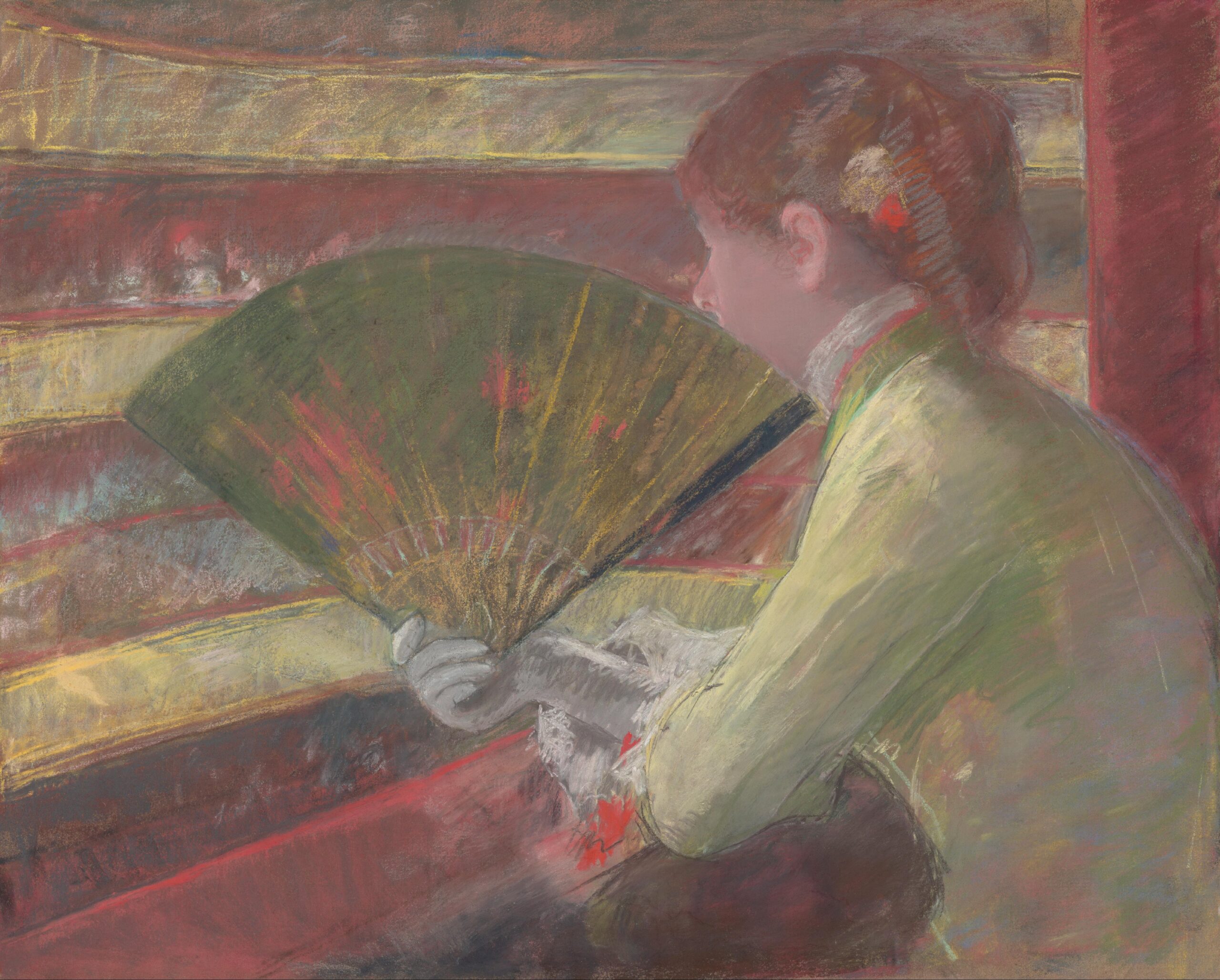
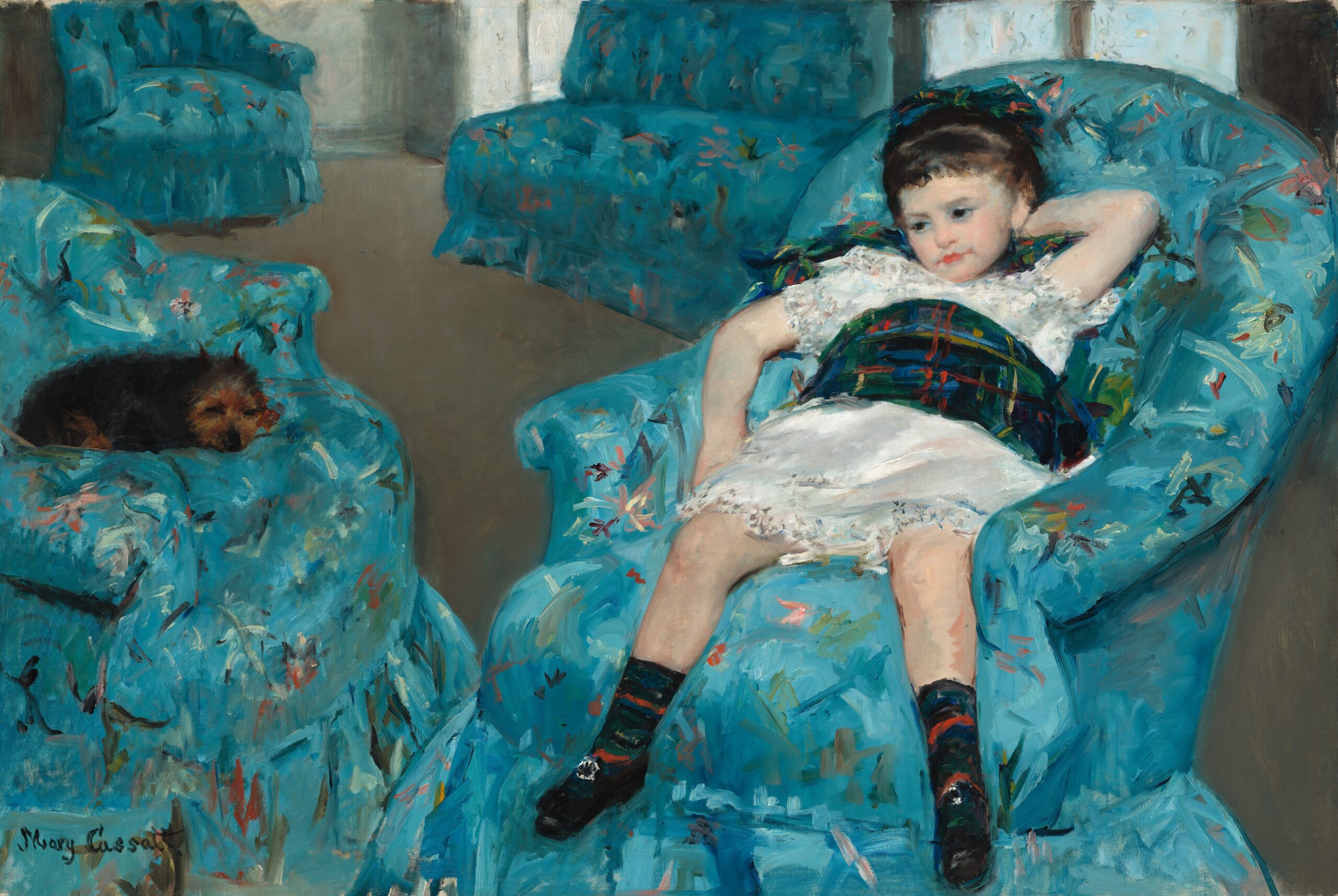
Cassatt’s transformation was immediate. The stylistic leap in three years from Mary Ellison Embroidering (1877) to Lydia Crocheting in the Garden at Marly (1880) is remarkable. By the late 1870s, she was painting freely and in a lighter palette. She produced oils, pastels, and prints of women in theatre loges. These shared some of Degas’s voyeuristic interest in women, yet Woman in a Loge possesses an admiration for its subject quite outside Degas’s jurisdiction. Perhaps Cassatt’s signature achievement of the 70s was Little Girl in a Blue Armchair, a canvas to which Degas famously contributed. The child’s provocative indolence has been much commented upon—Germaine Greer wrote “As an icon of the awfulness of being at once controlled by adults and ignored by them, this bold work could hardly be bettered.” The complex interior refutes a criticism by the American painter Jack Levine, who told me Cassatt fell short of the masters because she only painted shallow spaces. There are any number of familial interchanges set out of doors, including the impeccably composed The Boating Party (not in show).
That Cassatt was by her own account inextricably tied to Degas doesn’t compromise her individual brilliance. Gifted contemporaries like Frédéric Bazille and Gustave Caillebotte wrestled with a similar vernacular, yet neither had the genius for abstract design of The Boating Party[1], not to mention a composition that alienates the figures in Driving, or the plunging perspective of Chicago’s The Child’s Bath (not in show). If the absorption of Japanese design was not obligatory for artists of Cassatt’s generation, it certainly informed the most sophisticated experiments. It distinguishes the aforementioned paintings as well as the striking perspectives and patterns of Cassatt’s prints and their complex use of drypoint, etching, and aquatint.
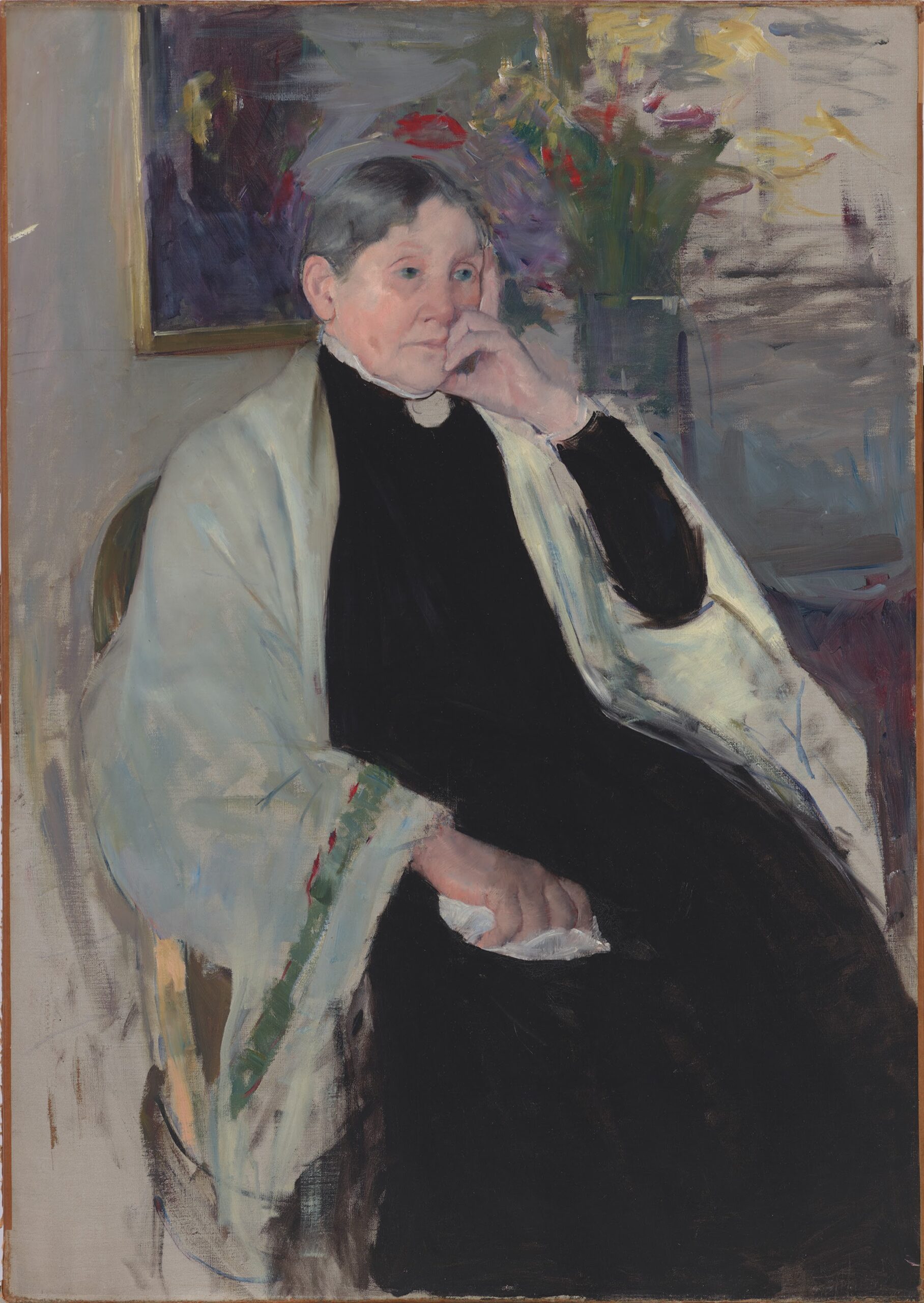
With the turn toward contemporary subjects, from the late 1870s, Cassatt called upon family members to act as models. Her favorite model was her older sister, Lydia, who had moved to Paris as Mary’s chaperone and confidante. Lydia was painted in the context of everyday life, crocheting, working at a tapestry frame, or feeding a horse. Usually, she is seen obliquely, with one startling exception, a full-length portrait in which she reclines on a divan (not in the show) and looks at us with disarming vulnerability. It may have been Cassatt’s last portrait of her sister, who died in 1882, and it is her most affecting work. Equally perceptive is Portrait of Mrs. Robert Cassatt, the artist’s mother dressed in black and gray, one hand to her head, the other clasping a kerchief in her lap. It is on one level a characterization of a strong woman tempered by weariness; on another, it is an example of Cassatt’s full gifts as a painter, the contours alternately crisp or atmospheric, the subtly graded skin tones locked in place by precise draftsmanship.
Cassatt was a sensualist, fascinated by the semi-translucency of human skin as was no other Impressionist except Renoir. Since she didn’t paint adult nudes, her main vehicle of expression was the infant body. In a relatively early oil, Mother About to Wash Her Sleepy Child, the baby’s pale skin is comprised of a frenzy of pinks and blues. The mother’s hand, dipped in the washbowl, glistens with moisture. She isn’t about to wash her child, she is already doing so. As noted in the exhibition catalogue, Cassatt sometimes applied “paint straight from the tube,” mixing color on the canvas rather than the palette. Her brushwork would become more polished by the late 80s, but she’d found her rhythm, favoring a vigorous application of paint that she’d blend with sweeps of a dry brush while the pigment was still wet. In so doing, she selectively eliminated contours and conjoined the skin of her figures, paint and color acting as a chemical bond between mother and child.
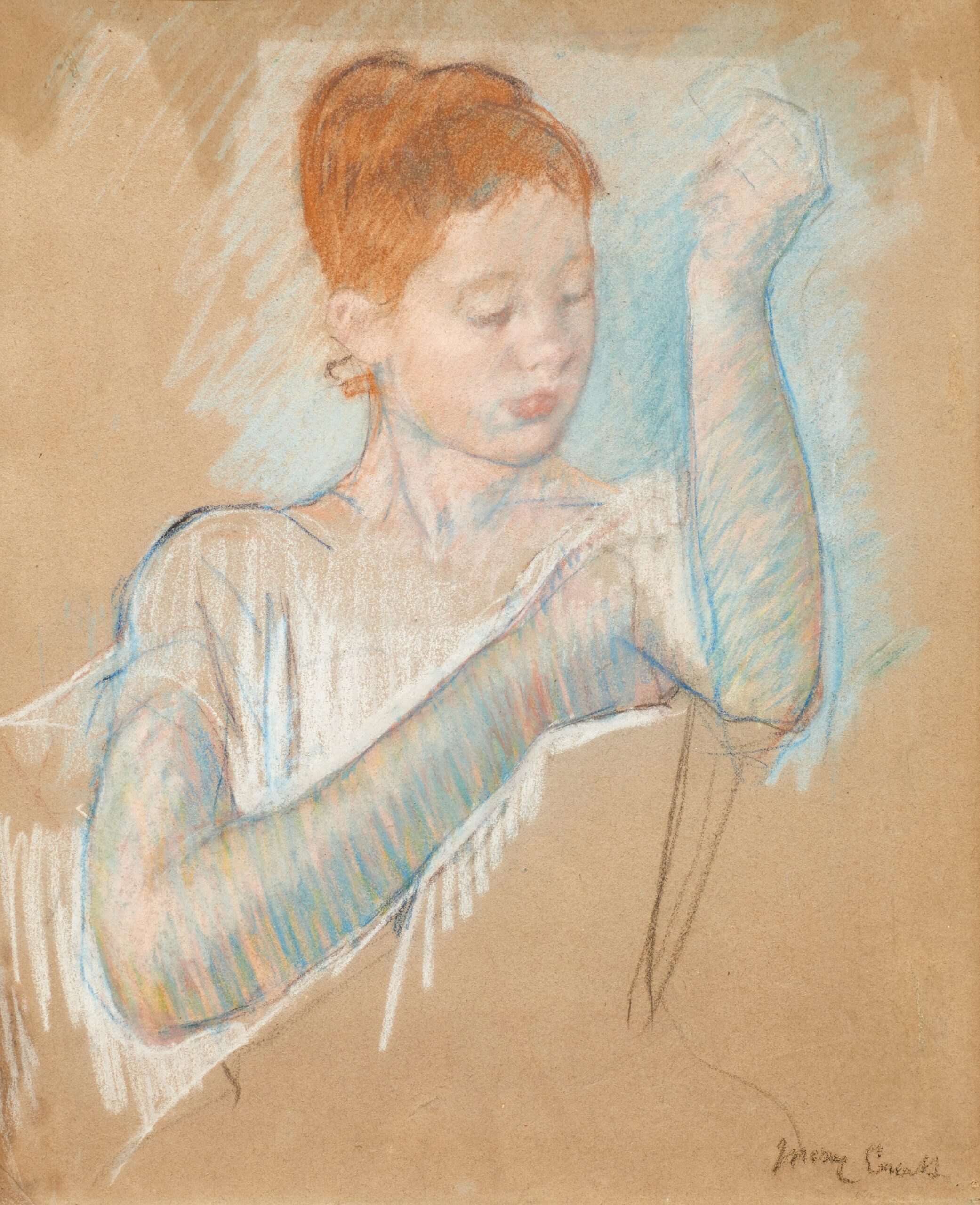
A similar handling was effective for Cassatt’s pastels. Less resolved works like The Long Gloves and Woman Arranging Her Veil are each constructed of slashing diagonal strokes. In the former, unblended blue chalk was laid atop a pink base to cool the tones, suggesting a sheer fabric and adding to the impression of gestural movement. The skin color of the woman with a veil was applied more delicately, as befitting a woman making a formal public presentation. Finished pastels like Woman in a Black Hat and a Raspberry Pink Costume and Clarissa, Turned Right, with Her Hand to Her Ear incorporate complex textures reminiscent of Cassatt’s oils, with passages painted in pastel chalk mixed with water, a technique learned from Degas. At any rate, to oversimplify Cassatt’s approach to a handful of methods is to do an injustice. The vibrancy of her best work in oil, pastel, and printmaking owes largely to technical curiosity and a willingness to blur the traditional boundaries of the media.
It would be a greater mistake to conflate Cassatt’s comfortable background with the gentility of her subject matter, and conclude even the hint of frivolousness. Writing Louisine Havemeyer, for whom Cassatt acted as an advisor on the purchase of Impressionist art, she provided a declaration for any artist who hasn’t been taken seriously:
I doubt if you know the effort it is to paint!
The concentration it requires, to compose your picture, the difficulty of posing the models, of choosing the color scheme, of expressing the sentiment and telling your story! The trying and trying again and again and oh, the failures, when you have to begin all over again! The long months spent in effort upon effort, making sketch after sketch. Oh, my dear! No one but those who have painted a picture know what it costs in time and strength!
It is the “sketch after sketch” part that intrigues me. Cassatt drew like a demon, and I think Degas’s example was critical in both her technical practice and her way of seeing, insofar as those concepts can be separated. As Degas was obsessed with the movements of horses and dancers, Cassatt trained her sights on the most fugitive subject imaginable. Anyone who has attempted to draw infants and small children soon realizes they’re dealing with a mystery of perpetual motion that is unlikely to respond to direction. Cassatt’s draftsmanship solved the mystery and did so with style.
Mary Cassatt at Work[2] is on view at de Young Legion of Honor in San Francisco through January 26, 2025.
- The Boating Party: https://asllinea.org/wp-content/uploads/2024/10/the_boating_party_1963.10.94-scaled.jpg
- Mary Cassatt at Work: https://www.famsf.org/exhibitions/mary-cassatt