
Earlier this month I flew down to West Palm Beach, as I’ve done intermittently since my parents moved there in the mid-1980s. Since then, West Palm Beach has experienced prolific growth, a boom that produced residential sprawl that now extends from the Intracoastal Waterway on the east to the edge of Everglades swampland at its westernmost border. Alligators do sun themselves in backyards, and sandhill cranes strut through the streets like they own them.
During the same period, the footprint of the Norton Museum of Art expanded commensurately. The Norton was opened by a Chicago steel magnate in 1941 and is now the largest museum in the state. It resides on the city’s east side, within an unremarkable stretch of mixed-use residential and business properties on South Dixie Highway. High-profile installations check generic museum boxes: the entrance features a giant Claes Oldenburg sculpture of a typewriter eraser overlooking a reflecting pool, and inside a massive display of blown glass by Dale Chihuly is embedded in the first-floor ceiling. The collection includes modern art, American painting, old master paintings (credible if not first-tier) and some fine post-impressionist works.
The Norton also has a program titled “Special Guests”, which features single artworks loaned from other collections. In the past these micro-exhibitions have included noteworthy French paintings; the current guests are Jacobus Vrel and Joaquín Sorolla y Bastida, one a Dutch painter active in the mid-1600s, the other a Spanish virtuoso of the late nineteenth and early twentieth centuries.
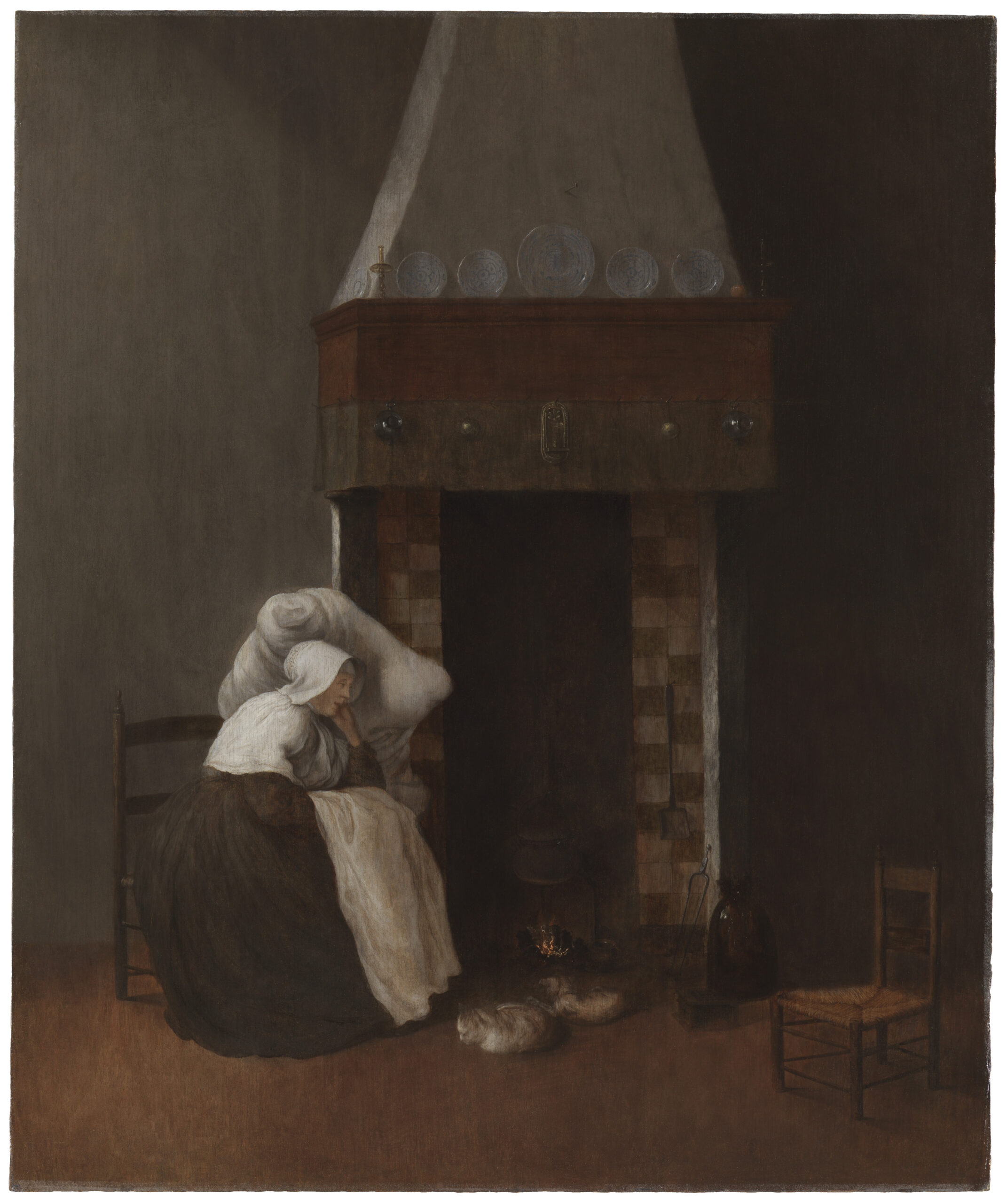
If you haven’t heard of Vrel, you’re not alone. No one knows where or when Vrel was born or where he lived, with guesses placing him all over the Netherlands or Germany. A biographical entry from the Leiden Collection—whence the Norton loan derives—throws up its scholarly hands: “The digitization of countless archival records in recent years and the access to them via the Internet have considerably enriched the possibilities for identifying the artist. It is therefore rather remarkable that he remains untraceable.” Owing to style, subject matter, and the same initials, Vrel’s paintings were once confused with those of Vermeer. Summary study of Interior with a Sick Woman by a Fireplace puts such misattribution to rest. The painting lacks Vermeer’s uniquely optical/painterly properties. Vrel’s Interior is spare. An elderly woman sits beside a modestly adorned fireplace. The figure is weakly realized, the color, wan (In fairness, other paintings by Vrel, like the National Gallery’s Young Woman in an Interior, possess an intriguing spatial and compositional complexity). Yet the scene has a meditative air and poetic sense of space.
The lack of information about Vrel and the theory that his earliest works predate those of the Delft school have recently invited speculation that he influenced both Pieter de Hooch and Vermeer. The 2023 exhibition at the Mauritshuis titled Vrel, Forerunner of Vermeer, suggested as much. The press responded accordingly—a headline in The Telegraph asked, “Did Vermeer steal his minimalist style from Jacobus Vrel?” The hypothetical line drawn from Vrel to Vermeer may sell tickets and newspapers, but the broader question is whether Vrel, unassuming and nearly unknown, played a formative role in painting of the Dutch Golden Age.

No such mysteries surround Joaquín Sorolla, a Valencian who achieved international success as a painter of portraits, landscapes, and scenes depicting the cultural heritage of Spain. Sorolla’s studies began in Valencia and continued in Madrid, Rome, and Paris. Although his work is sometimes described as impressionistic—an understandable designation, given the use of pure color and his fondness for working out of doors—Sorolla didn’t adhere to a calligraphy of dots and dashes or limit himself to rapid sketches. Beaching the Boat (Afternoon Light), on loan from the Hispanic Society of America, is a muscular piece of realism belonging to a genre that Sorolla fairly well invented and perfected: the plein air mural. Nearly ten feet high and over fourteen feet wide, Beaching the Boat commands its own room at the Norton.
Juan Ramón Jiménez, later a Nobel Laureate in literature, visited Sorolla’s studio soon after Beaching the Boat was painted in 1903 and wrote a poetic impression of the canvas.
It was an afternoon in summertime, when the sea is bluer and shines like a sea from mythology. The sand is damp and soft under our feet and our backs are covered with sun. The boat has arrived, pitching light as a feather on the belly of the waves, amidst the sailors’ voices. The afternoon is fading, the sun is round and scarlet wrapped in violet satin; and with its petals falling, a blood-red rose carpets the sea. Six docile old oxen have drawn up, they enter the water, and with their legs they kick up a rush of seafoam and cold claps of sound. The sail is already soft, the sun is yellow; the sea is blue; the bubbling crests of the waves come in and are lost… they come in and they are lost; in the distance gleams an orange-coloured sail. To the east night is beginning to fall, wrapping the solitude of the water in its veil… This is the canvas…behind it stands Joaquín Sorolla, with his tangled hair and his pipe, speaking in a loud voice, almost shouting, with his vibrant voice, as if he were on the beach, talking above the waves.
From the mid-1890s, the Valencian seacoast was the most prominent setting in Sorolla’s paintings. The shore served as nexus and backdrop both for recreational pursuits and those of maritime labor. For Sorolla, the oceanfront offered various strata of Spanish culture—well-dressed women with parasols and children playing at the water’s edge alternate for his attention alongside pescadores and net menders. It also provided an unfiltered sunlight that could flatten or model form, evince glistening highlights on sunburnt skin, and generally create powerful complementary color schemes in blue and gold. To take note of all this, Sorolla anchored enormous canvases into the sand with guide lines, and paid models to hold poses in the sun. A virtually cloudless coast became the artist’s outdoor studio.
Beaching the Boat is constructed on the circular movement of three pairs of oxen, the frontmost duo leading us into the scene. At either side, the men handling them bookend the composition. Above, a billowing sail fills most of the sky, and insures our attention remains in the foreground. All this argues against the spontaneity that characterizes Impressionism. The design was planned with care and preceded by at least one large oil sketch. There’s boldness, and even irreverence, in designing a canvas wherein the focal point is the backside of cows. Their anatomy is powerfully articulated—it is impossible not to admire the drawing of the hind legs as they break the swirling froth of the tide, or the wry juxtaposition of the driver’s head with those of the cows at right. The canvas is a feast of dynamic movement and color, a Mediterranean counterpart to the bravura of Sorolla’s friends, Sargent and Zorn. It is plein-air painting on a monumental scale.
Monumental as it is, Beaching the Boat’s whereabouts were a puzzle even to several museum employees. The painting will, presumably, receive more notice come November, when it is to be joined at the Norton by forty more Sorolla works from the Hispanic Society collection.