When did you first know you wanted to be an artist?
I never really knew. I grew into it. I’ve been in art school since elementary school, and I’ve never known the world without art. My original interest was to do comic books, but then I took my first figurative painting class at the School of Visual Arts (SVA), and that’s when I lost interest in making comics full-time.
How did the people closest to you react when you chose that path?
If “the people closest” refers to family, they’ve really had no reaction or interest—they don’t even ask me what I do. Art is sadly far, far removed from their reality. My father was supportive of any path I chose (it wouldn’t have mattered what I did), so he never discouraged or dissuaded me from attending art school or from trying to make a living as an artist. That said, his career advice for “being an artist” is very pragmatic and not at all aligned with my interest in sincerity.
Which artists have mattered most to you?
Those who have been sincere. Artists who have shown compassion and empathy in their work, such as Gustav Courbet and Léon Augustin Lhermitte.
If by “mattered most” you mean favorite painters, they include Tintoretto, Veronese, Velázquez, Rembrandt, Tiepolo, Hokusai, Sargent, Klimt, Schiele, Burt Silverman, Max Ginsburg, Irwin Greenberg, and Ron Sherr.
If by “mattered most” you mean most influential, the two works that have had the greatest impact on me are Rembrandt’s Self-Portrait (1660) and Tiepolo’s The Death of Hyacinthus (ca. 1752–53), which I saw in 1997. Tiepolo’s painting influenced me most. Rembrandt’s self-portrait revealed humanity and vulnerability, a weighted, lived experience that I could relate to and was beginning to recognize in others, and made it a prerogative for me to explore that depth in my painting of people. Feeling that connection with others became therapeutic.
However, my upbringing was filled with comics, movies, and special-effects extravaganzas. When I discovered Tiepolo—his orchestrated compositions of light and shadow, his use of complementary color, his heroic mythological and biblical scenes with large casts filling vast spaces—he became the larger-than-life painter I wanted to be, before I reconciled ego with humility.
Which artist whose work differs from yours do you most admire?
Picasso.
What art book could you not live without?
How to Draw Comics the Marvel Way by Stan Lee and John Buscema. This technique book above all others for a simple reason: it is an ultimate, lowest common-denominator, Cliff Notes version of all the important lessons that really should be properly learned from studying art history. As George Bridgman distilled Gerome’s lessons at the École des Beaux-Arts, which in turn were distilled by Andrew Loomis (who wrote industry bibles for artists), these were further distilled into How to Draw Comics the Marvel Way in the 1970s. The hundreds of copycat art books since don’t have the same spirit, substance, or enthusiasm. How to Draw Comics the Marvel Way is the most pragmatic instructional guide and doesn’t presume its audience is interested in being especially intellectual or deep. It cuts to the chase by helping the artist to have fun in finding a better voice as a storyteller. It works as a basic introduction for younger art students, informs commercial studio artists, or challenges someone who might be trying to create mega-compositions.
What qualities do you most admire in an artist?
Perseverance, sincerity, and humility.
Do you keep a sketchbook?
Yes and no. I mostly use a sketchbook for figure sketching in the studio, but when I travel, I only occasionally work in it. Sadly, I don’t work in it enough.
What is your favorite museum?
The National Gallery of Art in Washington, DC, probably has the best collection in the US, with the Metropolitan Museum of Art a close second. It’s been over twenty years since visiting the Uffizi Galleries, the Galleria dell’Accademia di Firenze, or Louvre, and thirty years since the Prado. I mention these because I’d have to reserve judgment on my favorite until I revisit them and think about all of them side by side. That said, some of the very best artworks in the world aren’t in museum collections, such as the Roman and Venetian artwork housed in churches, and the Buddhist shrines and murals found in monasteries and temples around the world.
What is the best exhibition you’ve ever seen?
Best or favorite? My favorite special exhibition was the Michelangelo show a few years ago, Michelangelo: Divine Draftsman & Designer. “Best” could be any permanent collection in any of the above museums and more.
If you were not an artist, what would you be?
Worm food.
Was there an artistic circle that shaped you early on?
My art classes in high school during junior and senior years included people I’d known for six years, but I didn’t connect visually with anyone there. None of us were pursuing a similar subject, using the same materials, or developing the same interests, and nobody in Miami, if not most of Florida, where I grew up, was thinking about pursuing representational work, so I was alone and really struggled to find a place. An artistic circle didn’t really form until I found a group of peers at SVA who were part of the Irwin Greenberg/Max Ginsburg group, which eventually led me to the Art Students League. Then, while working in Ron Sherr’s class, the circle or bond we formed in Studio 7 was really tight. But in the twenty years since class disbanded, we’ve all drifted apart. But when we do reconnect, it’s like time never passed.
What is one thing you wish you’d learned in art school?
How to self-introduce or approach galleries and exhibition spaces.
What work of art have you looked at most?
Single artwork? Not sure. I’m not sure if I would say the various movie posters by Drew Struzan or Bob Peak, Rembrandt’s Self-Portrait. Sargent’s watercolors from Venice, Velázquez’s Juan de Pareja, Regnault’s Salome, Delacroix’s Death of Sardanopolus, Tiepolo’s The Death of Hyacinthus, or maybe Michelangelo’s Sistine Chapel ceiling.
What is your secret visual pleasure outside of art?
People-watching while traveling, looking at all sorts of food markets and kitchens, Buddhist shrines in temples, and martial arts and wuxia films.
Do you listen to music while working?
Sometimes. A range from Bollywood to classical Indian sitar to Buddhist chants to rock. But if I’m painting at home, I often listen to Howard Stern or play movies (preferably with a lot of talk), which serve as background music. Also, BBC Radio.
What was the last gallery or exhibition you visited?
Witnessing Humanity: The Art of John Wilson at the Metropolitan Museum.
Which underrated artist should more people know?
Léon Lhermitte.
What materials can you not live without?
In context, if I were to go traveling, in or out of NYC, and was forced to reduce my materials to the barest, most essential that I felt I could do the most with, it would be: sketchbook, pencils, burnt sienna watercolor, a watercolor brush, and a jar for water.
Do you make art every day?
The physical act of drawing and painting—no, sadly, my teaching schedule takes up most of my time—but just passing through an everyday commute or daily job, I see hundreds of moments that could be potential “art.” In my mind’s eye, I’m drawing and painting all the time, every moment, every face. Everything is a study of colors, shapes, textures, gestures, and expressions.
What is the longest you’ve gone without making art?
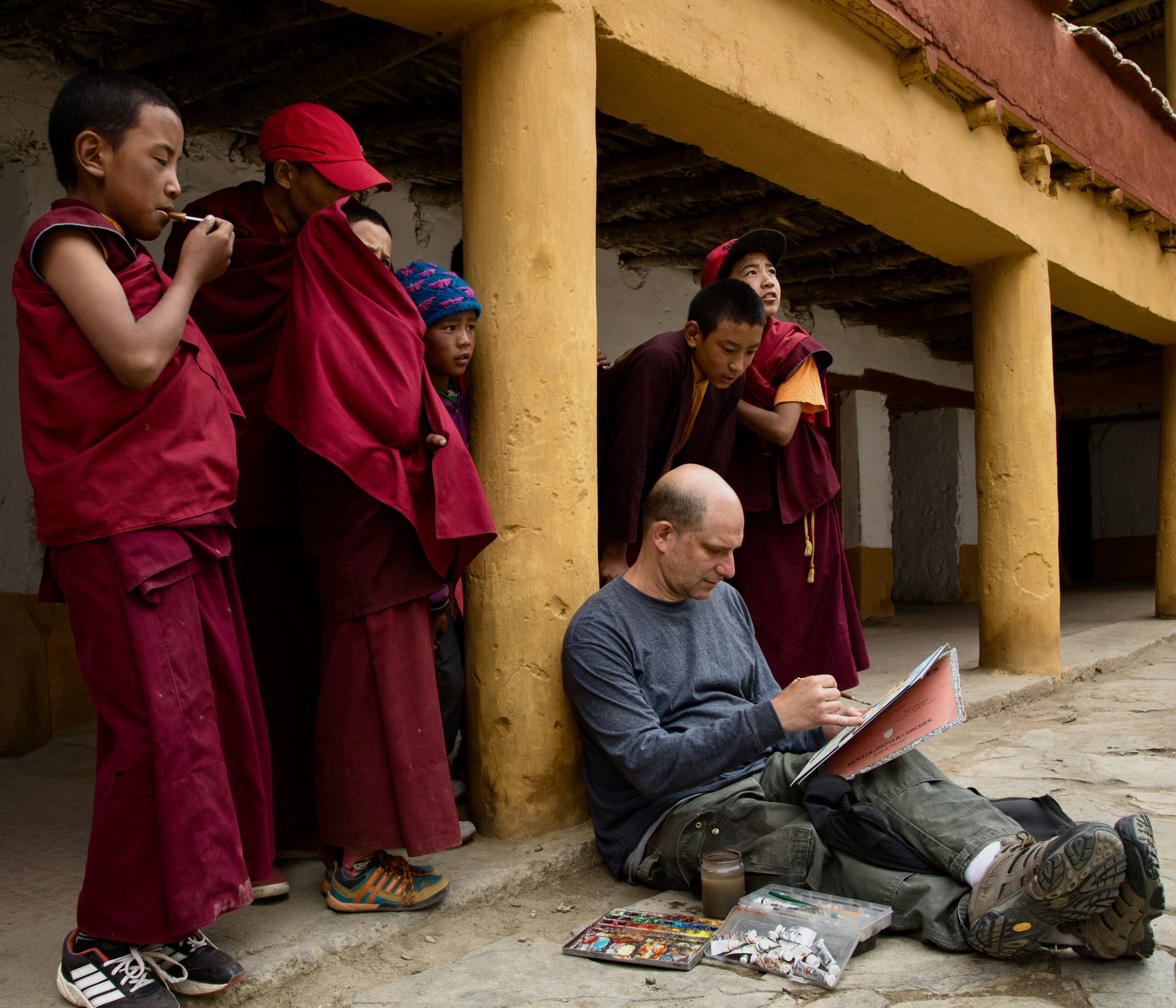
Perhaps after my first trip to India, when I spent many days and weeks just writing about art. I wanted to pursue creative writing for a bit to see if I could paint with words.
What do you do when you feel uninspired?
Chuck Close said, “Inspiration is for amateurs. The rest of us just get to work.”
What questions drive your work?
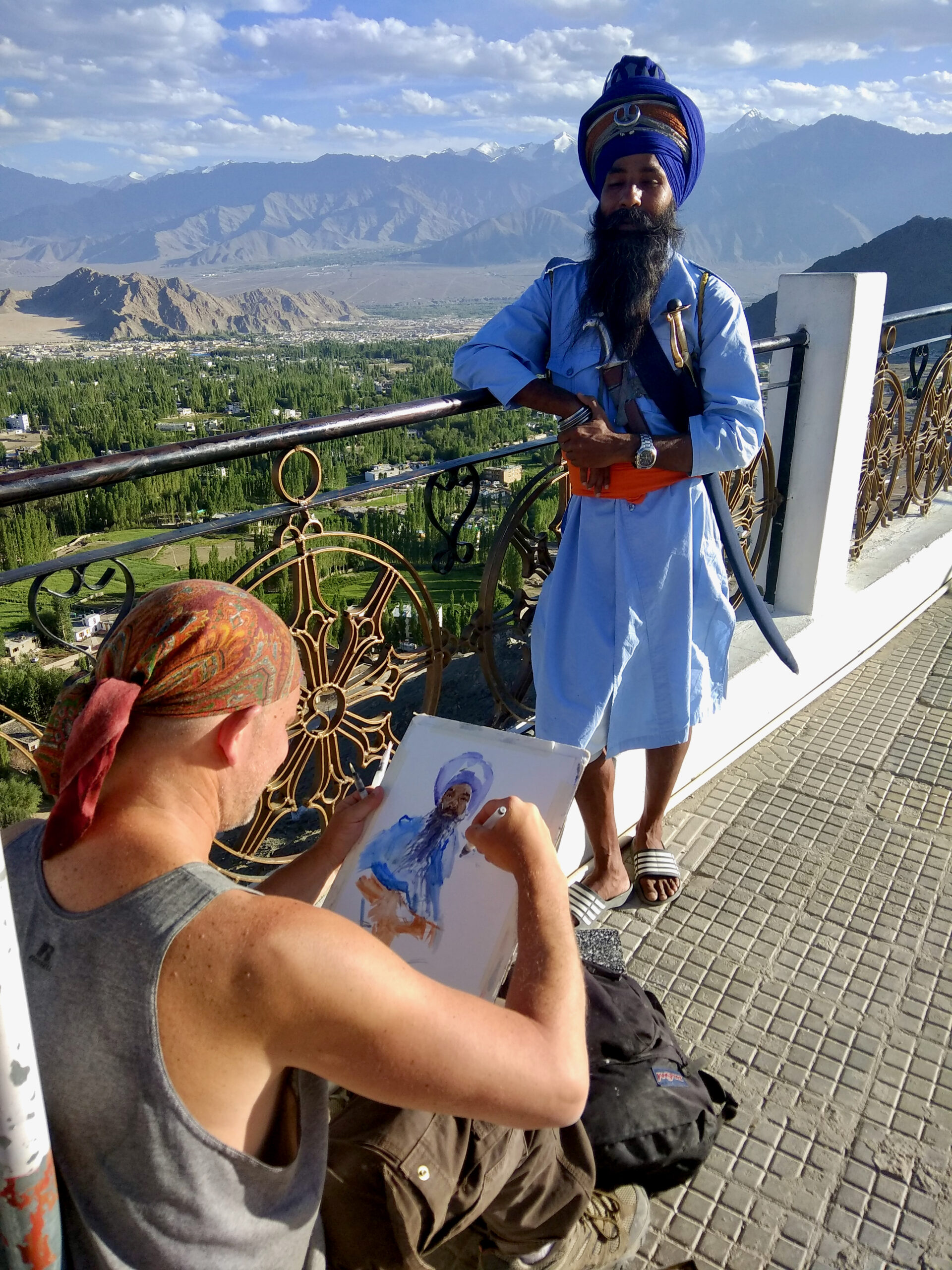
Lao Tzu wrote, “There is a universe in a blade of grass,” so my overarching question is likely, “What is there to be discovered within the universe of the subject before me?” As primarily a portraitist, the questions that arise now are: “Who is this?” “Why are they this way?” “How did they get here?” “What might they be feeling right now?” “What did they experience in the hours, days, weeks, months, and years before we met?” and “What will they experience after we part ways?” In my mural phase, however, the question was, “How can I create as grand a story as Tiepolo, Veronese, Tintoretto, or Rubens?”
What is the most important quality in an artist?
Compassion, empathy, forgiveness, sincerity, perseverance, commitment, dedication, and humility.
What have you not yet achieved in art?
The proper work-life balance that would allow me to paint more. Also, the ability to capture a location or moment at the same speed and accuracy as Sargent.
What is the best thing about making art in the age of social media?
Finding others and connecting with those on a similar wavelength, inspiring each other.
RICHARD WEINSTEIN (@richard_weinstein) teaches painting workshops at the Art Students League of New York.