
While searching for the perfect permanent home for Taunja, Twice, we hit upon the idea of gifting it to the Art Students League. Ron had a long association with the League as a hugely popular instructor, and his original idea for this painting was an exercise in observation. So, it seemed a perfect fit for the League, a painting that viewers could enjoy and which could also serve as an important teaching piece.
In addition to being an extraordinarily gifted painter, Ron was also a most entertaining storyteller. Luckily, we captured a recording of Ron telling us the story behind the painting Taunja, Twice. So, we’d like to share that with you here. The Sherr Family—Lois and Alex
One of the more intriguing and memorable projects I undertook was the creation of the painting known as Taunja, Twice. The concept behind this piece stemmed from an idea I had while teaching at the National Academy of Design. It all began with a young woman named Taunja, who was posing for my class. At the time, I didn’t think much of it; she was simply an interesting model with striking features and unique hair that made her stand out.
The original idea was straightforward: paint her once, then paint her again, side by side, without referring to the first painting. It was an exercise in observation and technique, aimed at seeing how different—or similar—the two images would be. Would she change? Would I change? Would my technique evolve? It was a challenge I set for myself to see the variances in my observation and execution.
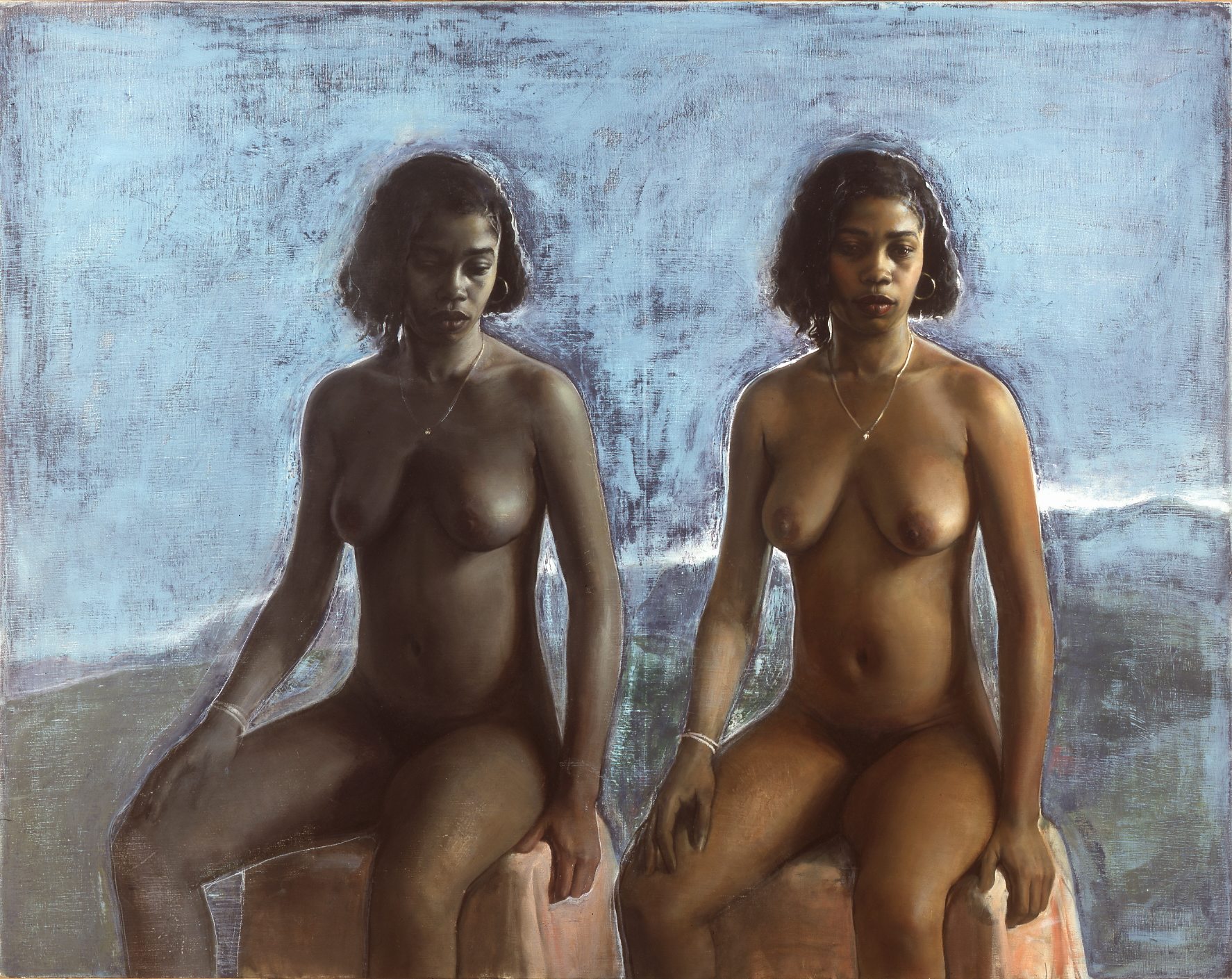
I began the first figure with Taunja posing, and after several sessions, I covered it and started the second one without looking at the first. Taunja was incredibly cooperative and posed for many hours, and I paid her $10 an hour, which was significant for me at the time. Despite the financial strain, the process was fascinating.
However, about a dozen sittings in, I cheated. I peeked at the first painting and started doubting the whole process. I began to question whether anyone would understand the point of this exercise, other than myself. This doubt led me to start making slight changes to her pose, altering the position of her head and hands, and eventually, the color scheme. I wanted one painting to look as if she were carved out of stone, a subtle reference to Edwin Dickinson’s work.
At one point, I painted a large landscape in the background, inspired by a trip to Puerto Rico. The landscape stayed for several weeks until one night I decided it didn’t fit and painted over it with a dark indigo background. The next morning, I regretted it. The paint had dried, and I couldn’t remove it, so I sanded it down, leaving the background with an interesting, textured look.
Despite all these changes, I never felt the painting was finished. There were always more things I wanted to do, adjustments to make, but eventually, I had to stop. The result was a unique piece with a story all its own — an experiment in artistic exploration and observation.
Taunja herself was an interesting character. We became quite friendly over the numerous sessions, though she was not overly talkative. I usually played music while she posed. One day, she came to my place to inform me about an incident that had made the front page of the New York Post. Her foot had been caught in the door of a subway train, and she was dragged along the platform. Miraculously, she wasn’t seriously injured, but it became a significant news story.
She wanted to know if it was okay to mention me as the artist she modeled for, as the newspapers were all over the story. I was hesitant, but after consulting with a lawyer friend, we decided it was fine. The publicity could be beneficial, she said. Although it was a brief media sensation, it highlighted the unexpected intersections between our lives and the public eye.
Taunja would often arrive at my apartment, and within seconds of walking in the door, she’d be ready to pose, completely comfortable with the process. There was an amusing dynamic where I felt the need to give her privacy when she was getting dressed or undressed, even though she had no qualms about posing nude for hours.
One particularly memorable incident involved an old folding deck chair I sat on while painting, which had a tendency to collapse unexpectedly. One day, as I was painting, the chair gave way, and I found myself flat on my back but with palette and brushes still in my hands. Taunja, in her usual calm and caring manner, tried to help me up, turning what might have been an awkward moment into a shared laugh.
Taunja came from a well-to-do family in Washington, and her sophistication and background added another layer of depth to our interactions. Despite her privileged background, she was down-to-earth and approachable, making her an ideal model and a pleasant companion during the long hours of posing.
The painting, with its two distinct versions, remains a testament to the journey we undertook together—an exploration of art, observation, and human connection. It stands as a unique piece in my collection, representing not just a technical experiment but a story of collaboration and friendship.
RONALD SHERR (1952–2022) was an instructor at the Art Students League from 1990 to 2005. To view more of his portraits, visit ronaldsherr.com.