It’s a ten-block walk from the Jewish Museum to the main entrance of the Met, and on a late spring Saturday afternoon the line to get in makes the trip feel shorter, or longer, or just aggravating for the impatient traveler. But the line moves quickly, and soon I’m inside an insanely crowded main hall and up the stairs, where it’s hardly less packed. The European galleries have been rearranged. Manet’s Young Lady in 1866[1] is tucked well back inside, having surrendered her place of prominence. It could be the loss of the familiar, but the charms of this reorientation are lost on me. Everything changes. At any rate, I’m on a fairly tight time budget, so I can’t indulge my weltschmerz. Onward to comfort food, Sargent and Paris.
Sargent, or at least his critical and public standing, changes, too. For most of the twentieth century, from the First World War until the mid-1980s, he was considered an anachronism, the last relic of a bygone era. How does one reconcile the overlap of Sargent’s later society portraits with Picasso’s demoiselles, the most dextrous painter of one generation polishing traditions while the next generation’s genius violently deconstructs them? You don’t. Sargent and Paris ends at 1890, by which time the artist had managed the greatest challenge to his elegant dialect, absorbing the aspects of Impressionism that suited his style. The show opens with Sargent’s student experience in Paris and follows his subsequent journeys through the more exotic climes of Venice and Capri, with digressions for informal portraits before culminating in the early bombshell commissions. One gallery honors the Boit girls, another room is devoted to the inescapable Madame X.
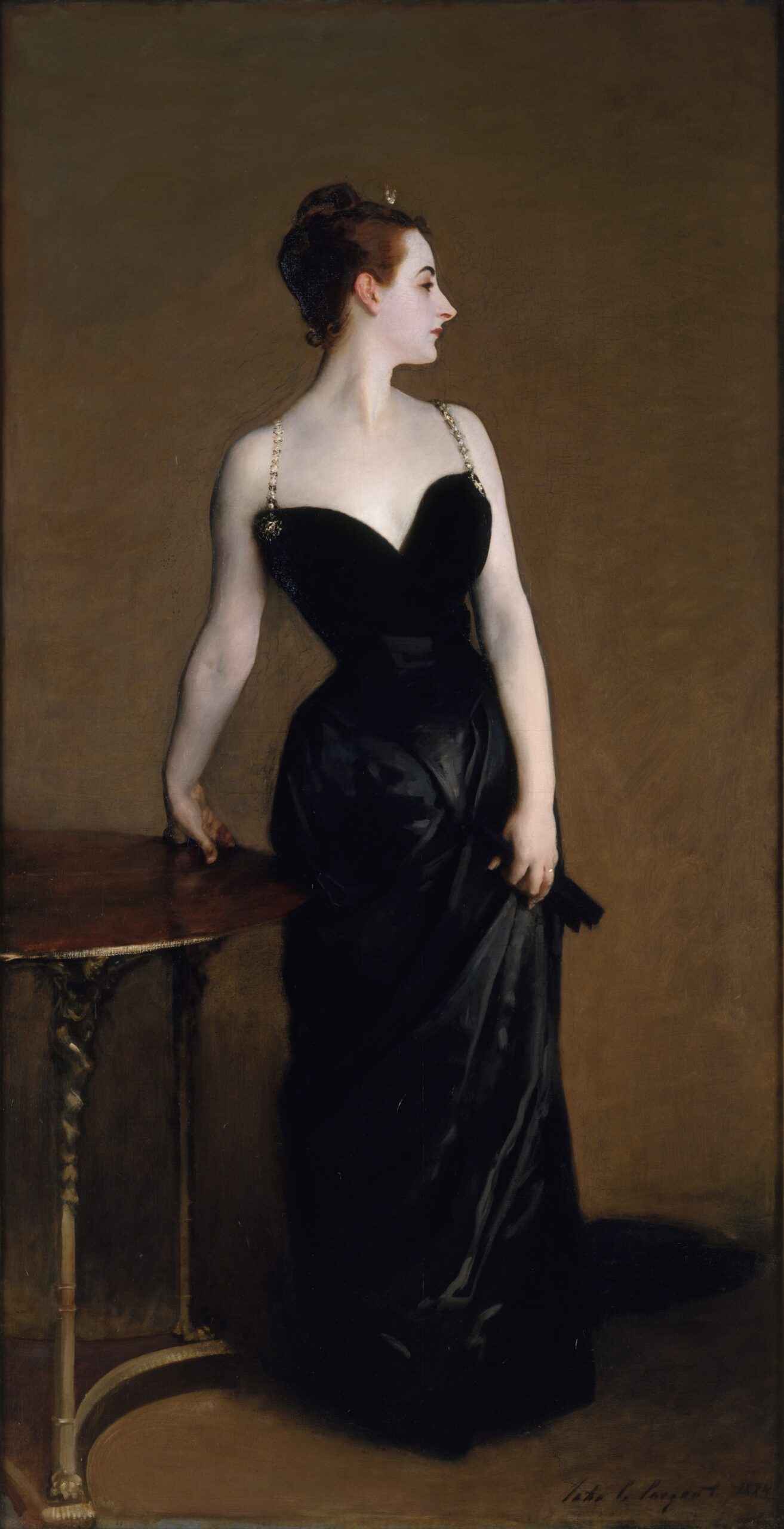
Sargent was not alone in his fascination for the woman known as Madame X—Virginie Amélie Avegno Gautreau was a magnet for painters, including another American expatriate who “could not stop stalking her as one does a deer.” Like Sargent, she was an American on the make in Paris, and both sought entrée to high society. Their plan backfired spectacularly when the portrait was first shown, on account of a fallen shoulder strap on Madame’s skintight dress. “One more struggle,” wrote a critic, “and the lady will be free.” Sargent repainted the strap in place and, chastened, fled to London. Though the French audience was offended by the portrait’s audacity, the scandal seems innocuous, especially in comparison to the uproar caused by Manet’s Olympia. Madame X is a painting of great panache, a turning point in Sargent’s career. When another critic called the portrait “a wilful exaggeration of every one of his vicious eccentricities, simply for the purpose of being talked about and provoking argument,” he was not entirely wrong. Sargent was hoping the attention would garner portrait commissions. His miscalculation of the marketplace was a temporary setback. Of longer duration was the balancing act Madame X announced, between style and substance. Sargent’s interest in Gautreau was skin-deep, extending as far as the elegance of her contours and powdered bodice. Once he began painting, he was exasperated by her “hopeless laziness.”
Madame X was the consummation of Sargent’s search for visually striking subjects. Among the earlier examples are a trio of portraits of a square-chinned young model with dark hair, eyes, and mustache. In these, Sargent experimented with dramatic value contrasts while modulating contours by painting wet-into-wet. A precocious facility for drawing with the brush, rather than the more methodical approach taught in most Parisian ateliers, was characteristic of Carolus-Duran’s influence, and looking back further, Velázquez. During a trip to Capri, Sargent was introduced to a lithe young model named Rosina Ferrara, who yielded several portraits and studies of the figure in the landscape. In one painting, Sargent placed her dancing on a rooftop, a presentiment of the Spanish paintings that led to El Jaleo[2] (not in the show). In Morocco, he made beautiful sketches of architecture, long shadows creeping across arched doorways. From there to Venice, where he painted the finest souvenirs of his youthful travels, young men and women flirting (Venetian Street and The Sulphur Match, described in the catalogue as “edgily modern.” Sargent was edgily modern the same way Michael Bublé is grunge) or strolling at their leisure (A Venetian Interior). The figures all but melt into dimly lit surroundings, muted stone walls and floors suddenly enlivened by thin shafts of sunlight. Barely in his late twenties, Sargent was following the recommended path for a young talent, traveling across the Mediterranean in search of paintable material. I don’t doubt that the people and places fascinated him, though everything is slicked up and romanticized with an eye to exhibiting back in Paris.
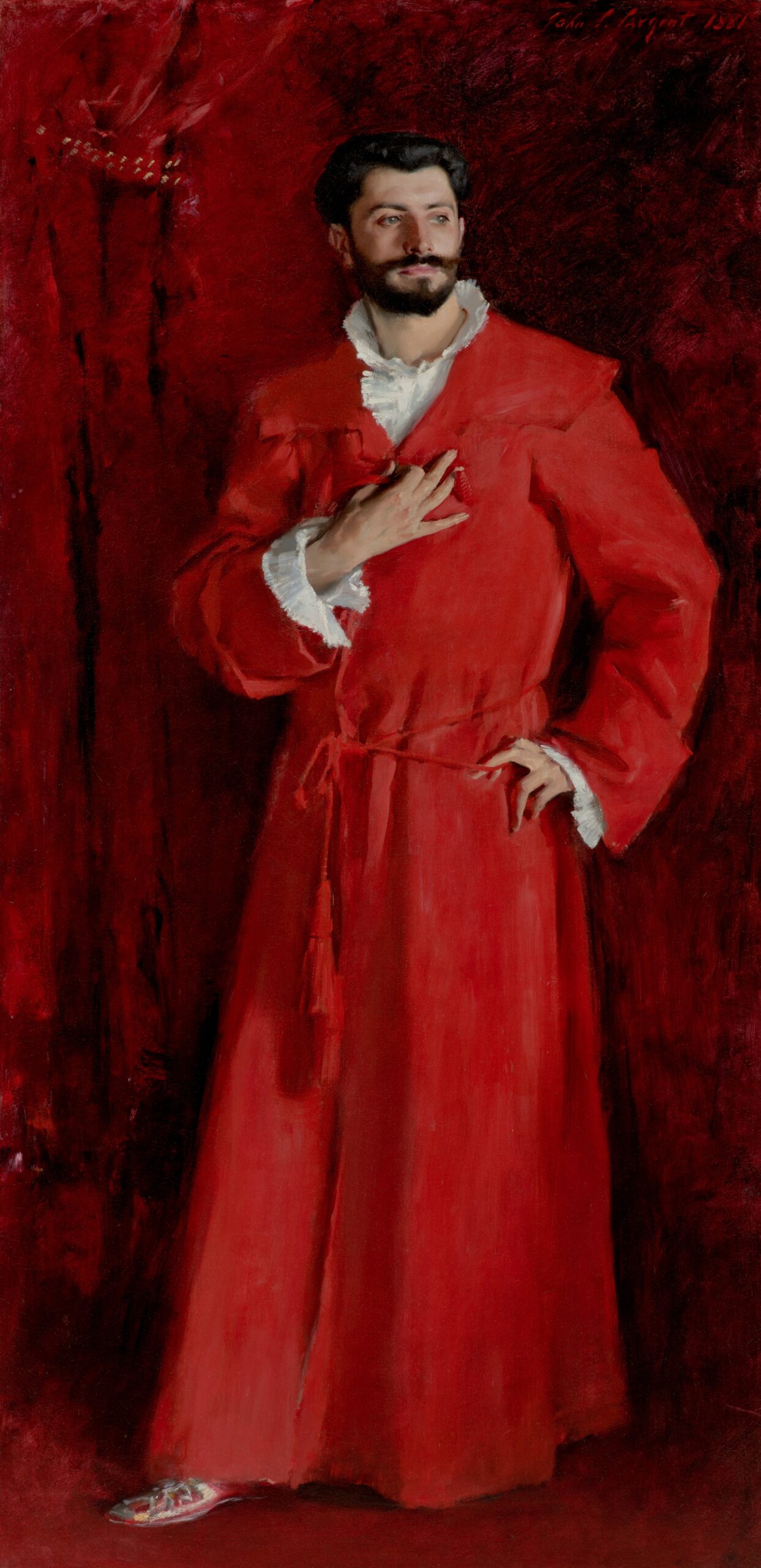
There is overlap, as one might expect from a young, ambitious artist. Even before he was hunting genre pieces in Italy, Sargent’s portrait career was underway in France. The work is accomplished, the brushwork facile if not yet showy, and except for an occasional compositional experiment (Marie Buloz Pailleron), conservative enough not to alarm his clients. The large portrait of the Pailleron children shows acuity in the revelation of his sitters’s personalities—throughout his career, Sargent was especially sympathetic to children—but the handling is Velázquez through a vaseline-smeared lens. A year later, he painted the Mephistophelean image of a dashing gynecologist, Dr. Pozzi at Home, in what John Updike called “a cozy crimson aura of satanic drag.” The floodgates opened to his grand manner portraits, some very good, others forgettable. Some of this was, to be less than charitable, the fault of the sitters (Once faced with an uninspiring subject, Cecelia Beaux put it bluntly: “….if you’ve ever seen her, you’ve seen her like scattered over the earth in dozens”). They couldn’t all be flamboyant, though Sargent strained to endow each of his sitters with the requisite glamor. Between full-scale commissions, he could lean back on informal oil studies, like those of Rodin and Albert de Belleroche, the latter of whom also sat for a profile drawing in which he looks like Mme. Gautreau’s doppelgänger.
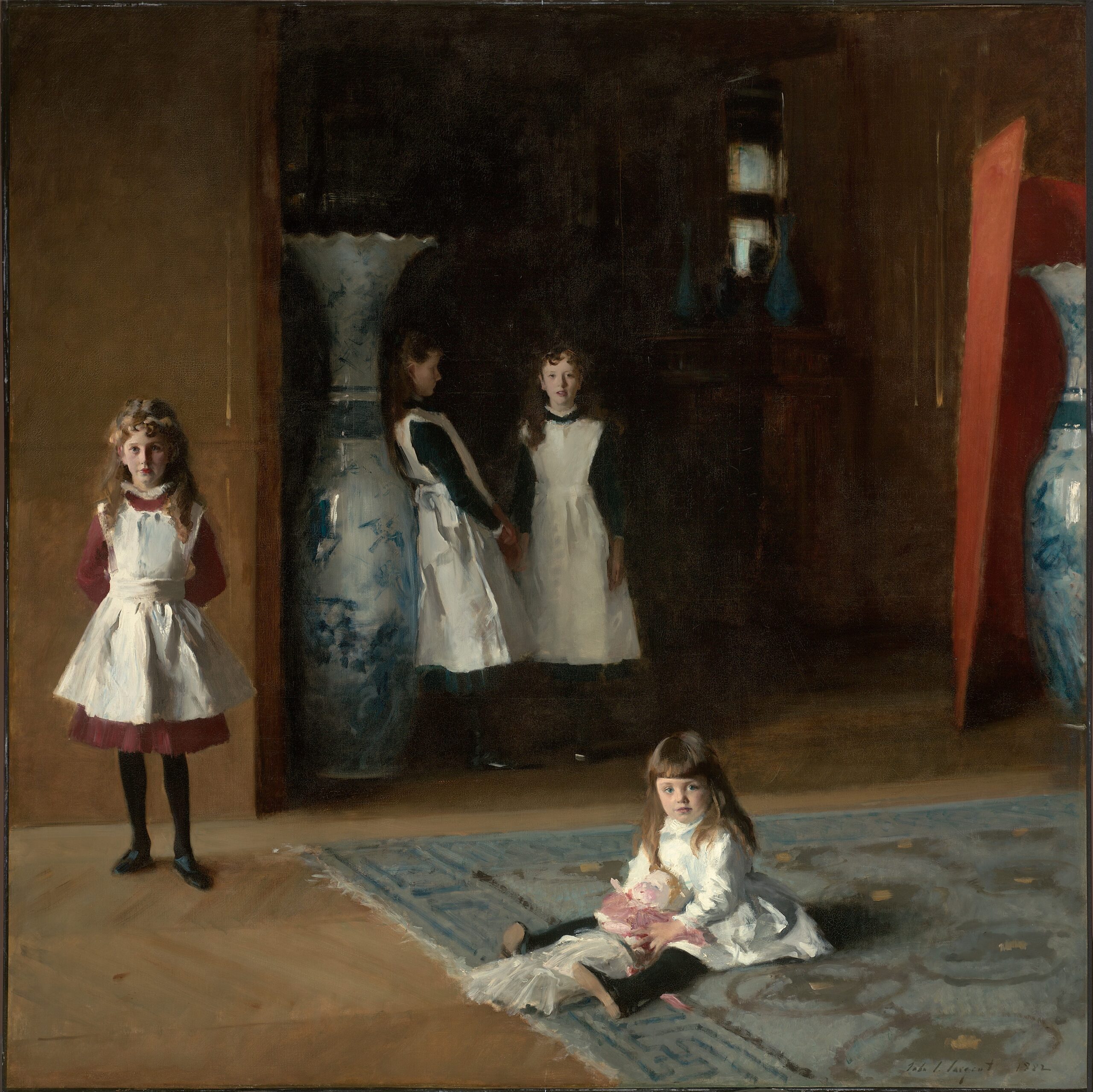
Amid this torrent of alternating commissions and intimacies, Sargent committed an unabashed masterpiece and one of the greatest group portraits of the nineteenth century. Unlike Degas’s Bellelli family or Eakins’s tribute to Dr. Gross, The Daughters of Edward Darley Boit appears to have been conceived and painted without undue preparation, as if, standing in the foyer of a friend’s apartment, Sargent knocked it out in a week or two. Like Degas’s familial study, it implies psychological layers that went clear over the heads of contemporary viewers—Henry James saw a “happy play-world … of charming children.” Three sisters dressed in starched pinafores stand at irregular intervals, one facing away from us in a shadowed alcove. The fourth and youngest child sits on a rug, holding a doll. In The Daughters of Edward Darley Boit, Sargent created a space charged with childhood mystery. He would rarely, if ever, invest an interior with that much significance again.
Placed near the back end of the exhibition is an intermezzo, a group of formal portraits of Parisian women by Sargent’s contemporaries. If the idea is to offer comparison or context to Madame X, her stylized elegance is uncontested. But the best of them, as painted by Whistler, Manet, and Renoir, give a fuller, if less sleekly realized, accounting of their subjects.
After the controversy of Madame X passed, Sargent never again tested the resilience of portrait conventions. There was a fortune to be made, as long as his sitters were properly flattered. In the bargain, they enjoyed the assurance of posing for the most gifted portrait painter of his, and several other generations. There was more than a passing chance that their likenesses would one day end up in museums. At the least, their social status was consecrated.
Later, after he’d made his mint, Sargent chafed at his lot as a portrait painter. I take him at his word when he says he abhors the job. But he gets no sympathy—he followed the blueprint of his ambitions. His contemporaries understood this. In a 1910 essay titled “Sargentolatry,” Walter Sickert wrote, “the work of the modern fashionable portrait-painter has to be considered as, in a sense, a collaboration, a compromise between what the painter would like to do, and what his employer will put up with.” Sargent compensated through facility. If he compromised autonomy in order to please the subject, he could at least put on a show of his dexterity. Facility is the most recognizable of his assets, and it comes with its own complications. Camille Pissarro’s critique was succinct: “he is not an enthusiast but rather an adroit performer.” Updike titled a review of the 1986 Whitney retrospective that jump-started Sargent’s reputation, “Something Missing,” and his conclusion echoed Pissarro. “Where no warming familiarity exists,” he wrote, “a certain distancing finesse takes over.”
Updike thought the Whitney show wouldn’t alter Sargent’s standing. In fact, it introduced a sea change in the way Sargent was interpreted and a new determination to link him to the avant-garde (Soon after the 1986 show, I overheard a Whitney docent telling her audience that Andy Warhol was the Sargent of his time. The push was well under way). Art historians began to reappraise Sargent’s brushwork, in all its lubricious flourish, as a precursor to Abstract Expressionism.
The reevaluation has less to do with art than with the culture at large. An artist’s popularity doesn’t occur in a vacuum, and Sargent’s resurgence parallels deeper trends. What troubles me is the conflation of art and money, the preoccupation with veneers, and how this all trickles down to the studios, to artists and students who envy his skill and success. Technique is generally prioritized in schools, and the fascination with Sargent’s is emblematic of a fascination with surfaces, painterly and otherwise. What was Mme. Gautreau, both as a striving arriviste and in her painted portrait, but a performance designed to attract attention? When Sargent sold the painting to the Met, he volunteered that it was probably the best thing he’d ever done. As a stripped-down expression of social ambition, it was.
On my way out, I bid adieu to Young Lady in 1866. She, too, is an artifice, albeit closer to the realist ethos. Well, all portraits are constructed on artifice. They may tell us something about the sitter, and they surely disclose something about the artist. In our response to them, we reveal ourselves as well.
Sargent and Paris[3] is on view at the Metropolitan Museum of Art through August 3, 2025.
- Young Lady in 1866: https://www.metmuseum.org/art/collection/search/436964
- El Jaleo: https://www.gardnermuseum.org/experience/collection/13259
- Sargent and Paris: https://www.metmuseum.org/exhibitions/sargent-and-paris