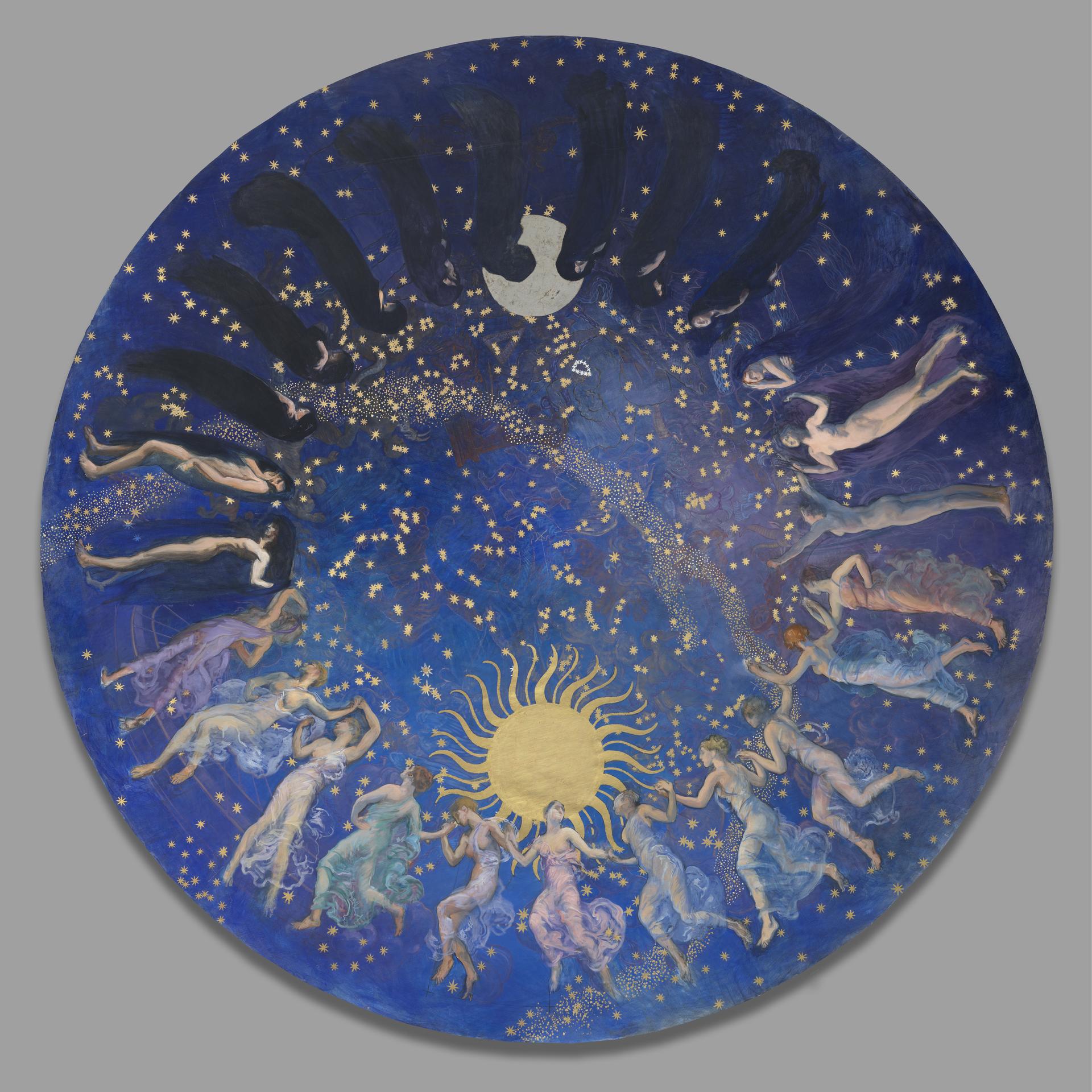
The Dance of Life is the title of a current exhibition at the Yale University Art Gallery, not to be confused with a painting of the same name by Edvard Munch. The title suggests an expansion of Munch’s theme, an allegory depicting the phases of life, but Yale’s presentation unpacks something very different: the process of public mural painting in America in the late nineteenth and early twentieth centuries, and, more broadly, figurative art from the American Renaissance. The centerpiece and culmination of the show is a group of studies for The Hours, a mural by Edwin Austin Abbey in the Pennsylvania State Capitol. Yale possesses over three thousand works by Abbey, and if nothing else, The Dance of Life is a good excuse to skim the surface of the collection.
For obvious reasons, site-specific murals could not be included in the exhibition. Holcombe T. Green Curator of American Paintings and Sculpture Mark D. Mitchell explained that they would be “far too large to move or show in a gallery. But the reality is that those final works were largely executed by teams of assistants using transfer tools to scale the studies up to full size, so they often have a dry, mechanical effect. The studies are more interesting because they show the artists’ ideas in formation.” That they do, but anyone hoping to see revelatory bursts of improvisation will be disappointed. Even while trying out various concepts and compositions, the works presented here never stray far from the academic framework of their era—public art adhered to convention, as in the preliminary oil study for Venice by Kenyon Cox, well drafted and lacking the Italian Renaissance vitality to which it pays homage. The most notable flights of fancy in The Dance of Life are Abbey’s studies for The Hours that depict women ascending through space.
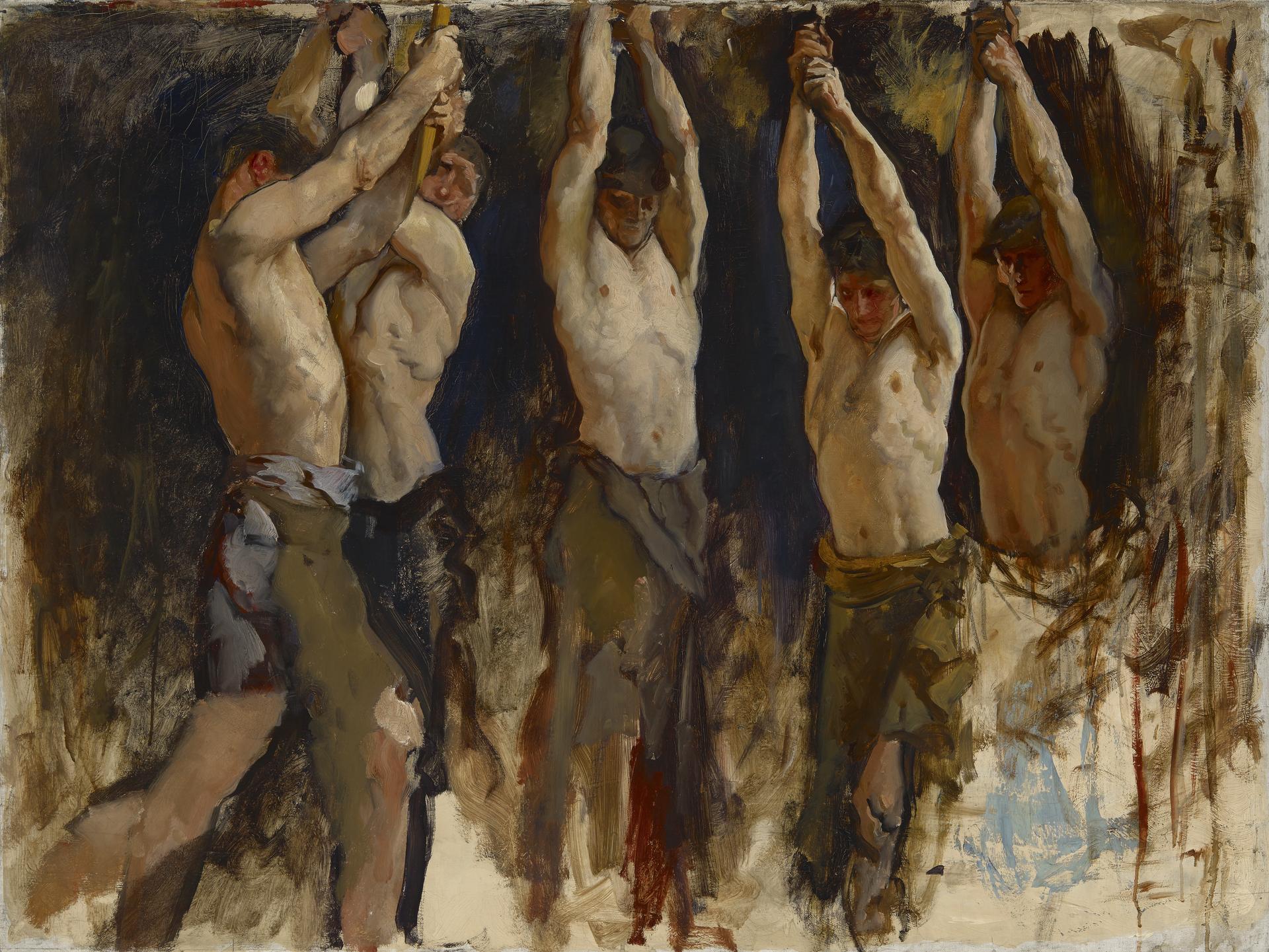
Abbey’s draftsmanship was reinvigorated when the subject was right. A study for The Hours shows the figure of Eight A.M., arisen and on the run, wrapped in a rococo excess of windblown drapery. Figure Study for The Spirit of Vulcan: Genius of the Workers in Iron and Steel joins Abbey’s mastery of the figure to a powerful expression of physical labor. The canvas transcends its mythical theme to evoke mechanical, repetitious exertion. A recent article in an Oxford medical journal uses the painting to enumerate the “occupational disorders that iron and steel workers might endure,” a clinical interpretation. Arms eternally raised in a synchronized upswing of hammers, the laborers aren’t red flags for OSHA, but anonymous martyrs of the industrial revolution. As Bryan J. Wolf observed in his lecture at Yale, the figures are analogous to hanging slabs of meat. Rembrandt’s Slaughtered Ox[1] comes to mind.
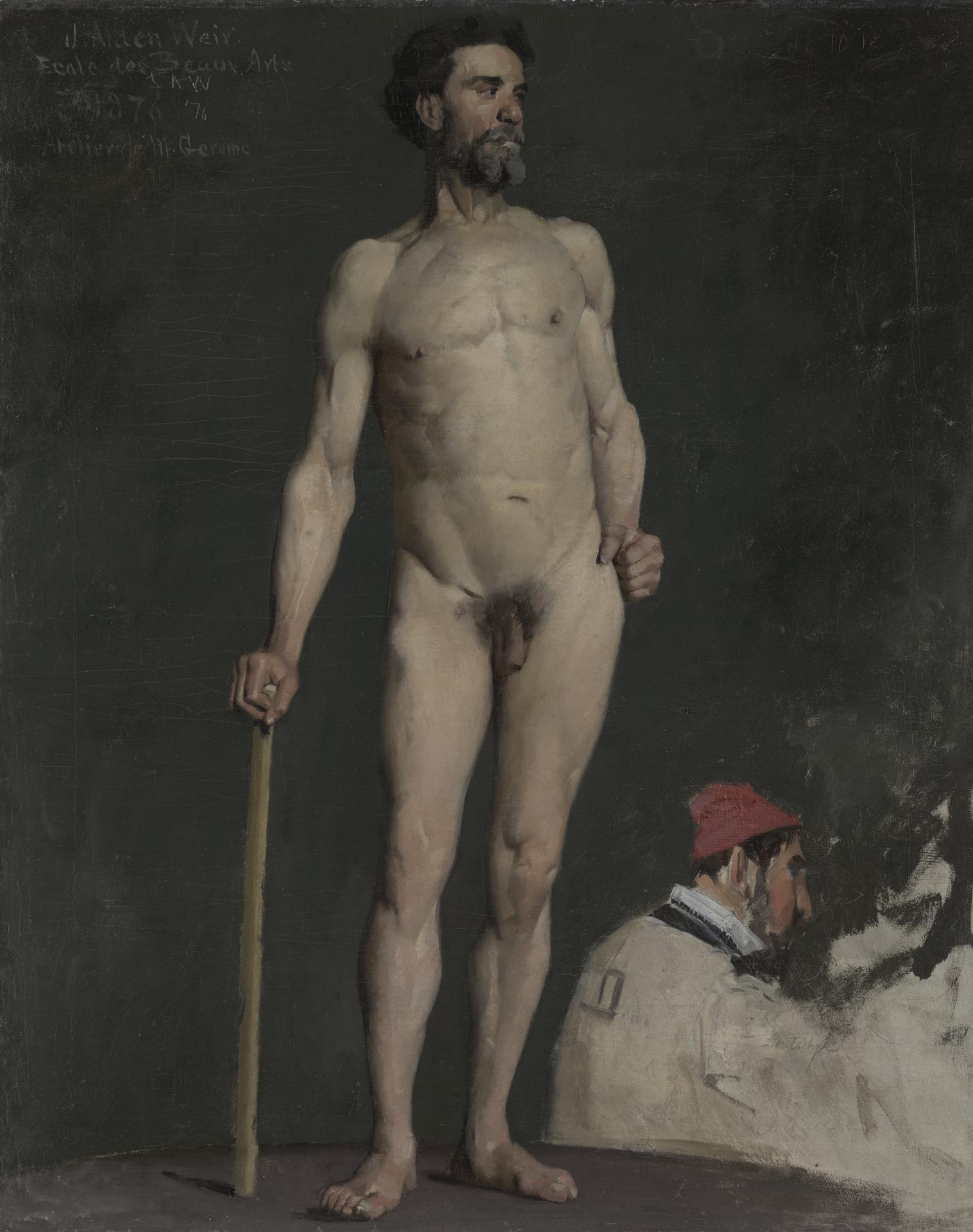
Less dramatically, a naturalistic charcoal study by Gari Melchers suggests the plodding weariness of menial labor. The drawing, reminiscent of European realism, lost some of its realistic bite when transposed to mural form in the Library of Congress. Among other notable male figures are Nude Study of a Seated Man and a fine preparatory drawing for Science Instructing Industry, both by Kenyon Cox and displaying the evolution of his style from his student years to maturity. Another student work is Julian Weir’s oil Male Nude Leaning on a Staff, a first-rate product of his education at the École des Beaux-Arts in Paris. Cox became a primary American advocate for classicism; Weir became an impressionist. Both were instructors at the League, and Cox created the school’s original logo.
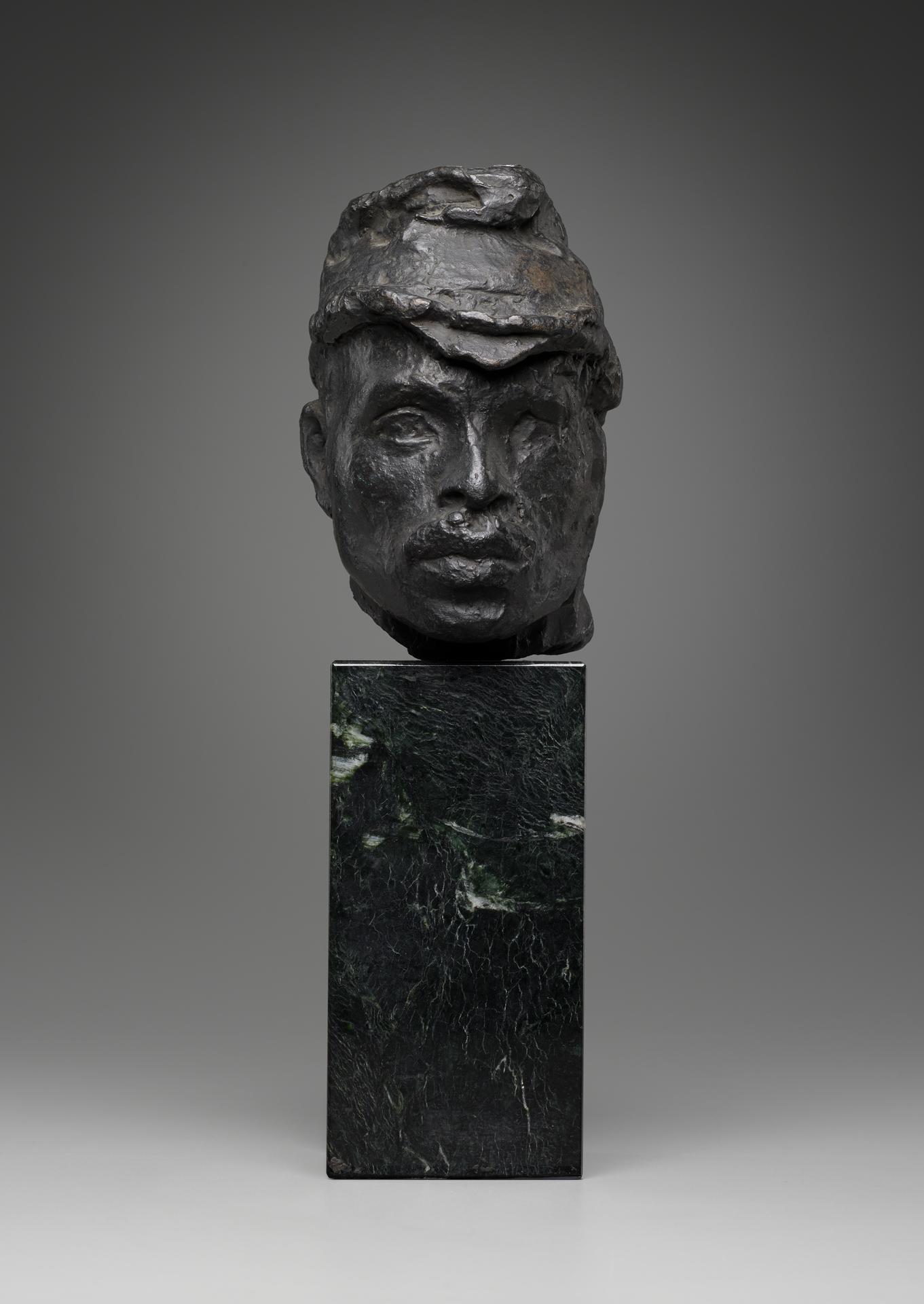
The most resonant note in The Dance of Life is pathos, and Augustus Saint-Gaudens’s sculpture wins the day, first with his Studies of African American Soldiers’ Heads, then a full-length portrait of Lincoln[2]—the Yale bronze is not a study, but a later reduction of the original twelve-foot monument. Near the show’s conclusion is Saint-Gaudens’s Adams Memorial, a solemn figure that hints at the gravitas of Rodin and grafts upon it the restrained elegance of the American Renaissance. It is installed in the same room with Abbey’s charcoal Figure Study for Mary, the Wife of Cleophas and Cashmere by John Singer Sargent; the solitary cloaked women culminate in Sargent’s enigmatic procession.
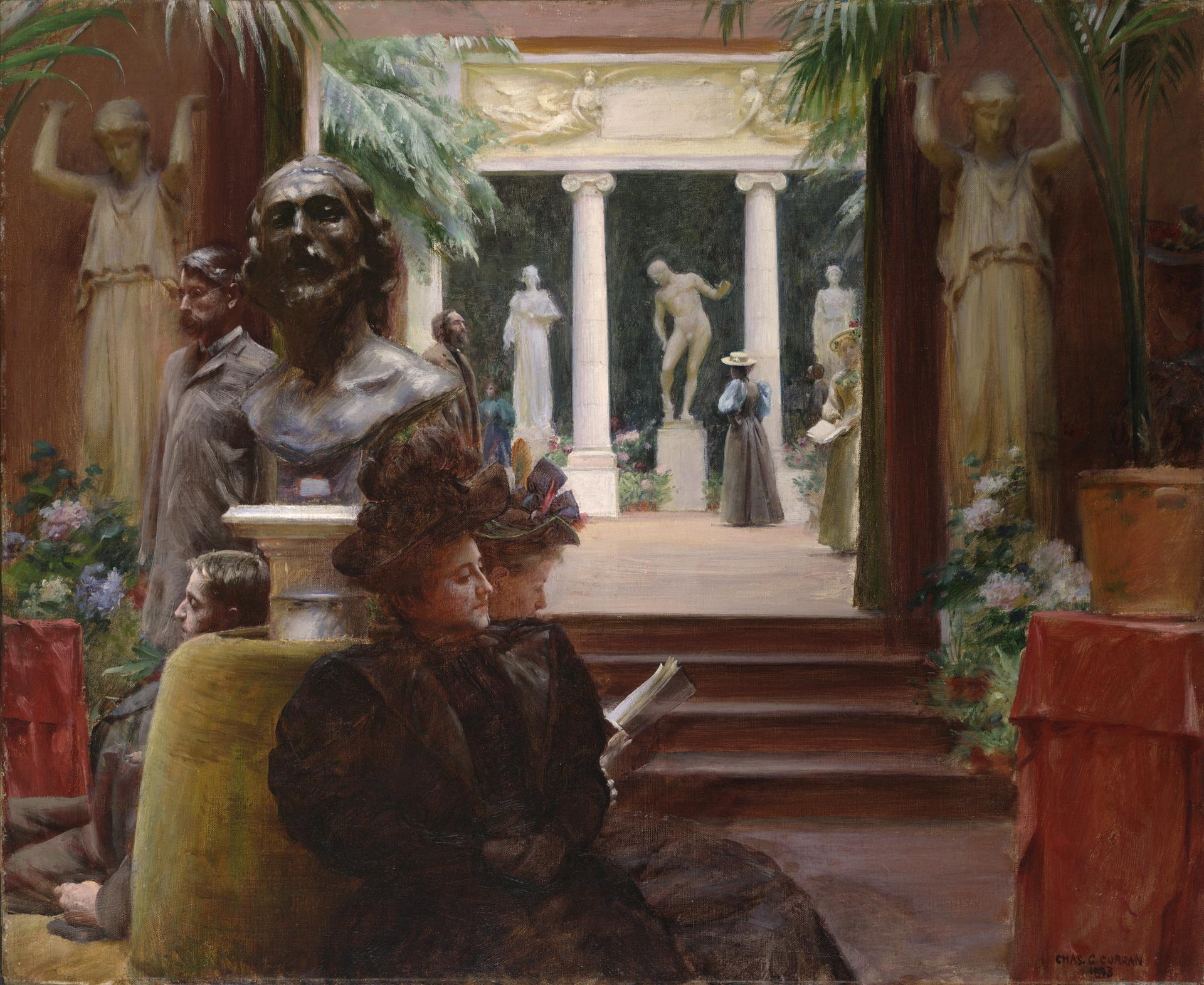
In surveying figuration in American art, the Yale exhibition expands its declared focus on public art in general or murals in particular. The fashionably dressed gallery goers in Charles Courtney Curran’s At the Sculpture Exhibition, reminiscent of James Tissot and Anders Zorn’s urban sophisticates, appear to have succumbed to the gentle tedium of viewing art. Abbey’s pastel study for Ophelia in Hamlet doesn’t relate to his murals, but with its Pre-Raphaelite overtones it does represent the era’s idealization of women. Abbey could draw like a dream, and was more versatile and sensitive to tactile qualities than his friend Sargent. I’m fortunate to own one of his delicate pen and ink illustrations.
Fifty years ago, when I was a teenager, my father bought three large oil paintings by Abbey that had turned up in a hotel basement in the northeast. They were Victorian era relics of little value in the 1970s—too large to hang in our modest south Florida home, they leaned against the living room walls. I studied them indifferently. Many years later and with greater interest, I enjoyed a tour of Yale’s Abbey collection, bequeathed by his widow to the university. Conservators worked on his canvases while a curator opened flat files filled with works on paper. Hanging on a wall in storage was Columbus in the New World, a fever dream of armored sailors planting banners against a clear blue sky and far too many flamingoes in flight. Long before cinema, Abbey could wax cinematic. His studies of ascendant wraiths in the Yale show were done in preparation for Spirit of Light, another of the Harrisburg murals. In the final version, floating women in gowns hold lit candles aloft, while behind them loom the silhouettes of oil derricks. I want to call it the most bizarre conflation of the spiritual and industrial in American painting, but I can’t summon anything to which it compares.
Late in their careers, Sargent and Abbey devoted considerable energy to mural painting, sharing a studio in England for that purpose. Perhaps they believed the work for libraries and statehouses would serve as a capstone to their careers. Sargent’s strengths were portraiture and landscape. Abbey’s best work was character-driven rather than allegorical—he consumed Shakespearean subjects, and was one of the preeminent illustrators of his time. Omitted from the show is Yale’s Richard, Duke of Gloucester, and the Lady Anne[3], which highlights Abbey’s genius for narrative, composition and characterization. It’s a great canvas, one that would make a spectacular centerpiece, but it would have been a less appropriate foundation for this exhibition.
The public art of the American Renaissance flourished in an environment still recovering from the Civil War, when the optimism of humane enlightenment and a new century had yet to displace grief as the shared national experience. Saint-Gaudens’s sculpture was attuned to this deeper emotional strain, and stands out for its inclusion of African-American soldiers and admiration for Lincoln. But the murals of the era celebrated an idealized—one could say whitewashed—vision of a national spirit, and avoided the reality of an economy and culture constructed on the backs of slaves and immigrants (As if to drive the point home, the era’s nomenclature has since been co-opted by a white supremacist organization). The conflict in our self-definition, between the fantasy of a predominantly white male Christian ideal and the acknowledgment of how we got here, has yet to be resolved.
The Dance of Life: Figure and Imagination in American Art, 1876–1917[4] is on view at the Yale University Art Gallery through January 5, 2025.
- Slaughtered Ox: https://collections.louvre.fr/en/ark:/53355/cl010065605
- portrait of Lincoln: https://asllinea.org/wp-content/uploads/2024/11/Lincolnimage.jpg
- Richard, Duke of Gloucester, and the Lady Anne: https://artgallery.yale.edu/collections/objects/61273
- The Dance of Life: Figure and Imagination in American Art, 1876–1917: https://artgallery.yale.edu/exhibitions/exhibition/dance-life-figure-and-imagination-american-art-1876-1917