 It took me a little time to warm to Euan Uglow’s work. My initial resistance was a response to the cool minimalism and geometry of his paintings. At a glance, Uglow’s interest in the nude seems a calculative endeavor. By 2000–the year of Uglow’s death—my reluctance had eroded. The poetic precision of his observation, and the recognition that the emotional charge in a painting can be covert, defused lingering objections. A trip to London twenty-five years ago included a mandatory stop at Browse & Darby[1], with the intent of seeing Uglow’s paintings and purchasing a copy of the then-definitive book on his art. It’s been frequently taken down from my shelves since.
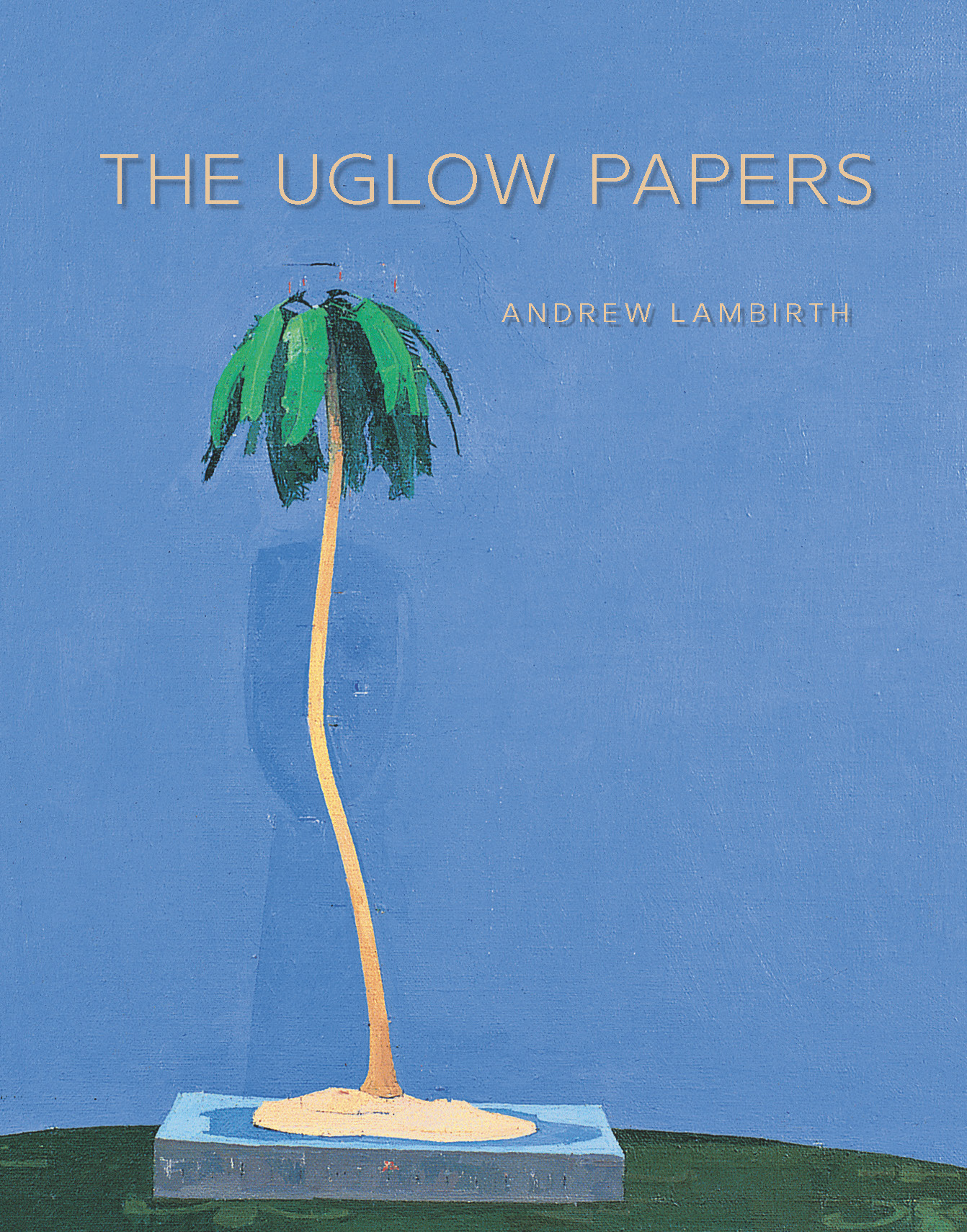
A catalogue raisonné of Uglow’s work came out in 2007, but the price and necessarily small reproductions were sticking points. I’m glad I waited. This year came the publication of The Uglow Papers, accompanied by online descriptions that looked promising. I’m guessing the officious title is meant to be tongue-in-cheek. The papers referred to are recollections of Uglow by friends, students and models, which, taken altogether, form a biography by way of anecdote. These conversations and written remembrances are compiled and edited by Andrew Lambirth, who knows the terrain and previously authored a fine monograph on Uglow’s friend and colleague, Patrick George[2]. Though the book follows a chronological path, it’s an ideal format for skipping around and reading the short chapters non-sequentially (Images are profuse and of excellent quality, and encourage the reader to abandon a linear attack). Initially, I did just that, before eventually adopting a start-to-finish approach for the purpose of writing a review. I started, as I suspect will many readers, in the middle, with Cherie Blair’s recollections. Blair (née Booth) posed nude for Uglow while working as a junior barrister. The sessions preceded her marriage to Tony Blair, who would serve as Prime Minister of the UK.
What follows is characteristic of the book’s tone throughout: intimate without being sensational, admiring without slipping into hagiography. By Cherie Blair’s account, she was a less than reliable model, young enough to write off the experience for future reference, proof to her children that she hadn’t been a prig. Uglow comes off as an avuncular figure who left an indelible impression—Blair named her son after him. When the painting[3] came to light in 2006 it briefly became tabloid fodder. Despite Striding Nude’s dishabille, with Blair wearing an unbuttoned minidress, the painting is anything but sexualized. It was never finished, and Uglow presciently completed a replica[4] using a different model. The comparison is instructive on his working method. I lean toward the unfinished version—finish, per se, is less important than the crystallization of a concept. The two Striding Nude canvases were soon excelled by Zagi[5], a more powerful take on the theme.
Uglow first met Cherie and Tony Blair in 1976 at the home of Derry Irvine, who would later serve as Lord Chancellor. Earlier that year, he had been the subject of a television documentary[6] that followed the process of Root Five Nude, one of his best figure pieces and a logistical headache. Using a borrowed studio—presumably chosen to preserve the sanctity of his home studio—Uglow struggled with changing light and the abdication of the original model (Working for Uglow was famously difficult—if favored, a model could count on lengthy employment, provided they could hold an arduous pose). What ensued was an audition to find another model whose body type was like that of the first, and who could hold the same demanding position for an unknown length of time. Once she was found, work continued on the painting. I’ve watched the program on YouTube several times. The charisma that inspired extraordinary dedication from students and models doesn’t fully translate in the video. What comes through is Uglow’s intellectual intensity and the integrity of his pursuit. He readily acknowledges that he paints for himself rather than the marketplace and sells little. In The Uglow Papers, his dealer Will Darby relates that Root Five Nude was sold to John Paul Getty Junior, who had been rewatching the documentary obsessively.
Well before the documentary, Uglow was a familiar presence at the Slade School of Art in London, first as a student and later as an instructor of graduate and undergraduate students. As a teenager, Uglow studied at the Camberwell School of Art before enrolling at the Slade. Among his teachers were Claude Rogers and William Coldstream, the influence of the latter especially noticeable in a meticulous attention to measuring. The role of measuring is important enough to merit a digression. Uglow’s exactitude went beyond nailing proportions. It was a way of examining optical perception, as in Nude, from 12 Regular Vertical Positions from the Eye[7]. Titles like Double Square, Double Square[8]; Root Five Nude; and The Diagonal[9] suggest a geometric premise. According to Lambirth, geometry was supportive to the concept rather than foundational. “On another occasion, he said, ‘I only use geometry if I think it’s going to be to do with the idea.’ It was his aim to paint a structured picture full of controlled emotion in which every mark counted as both form and meaning. Controlled emotion, perhaps, but it was also distilled, as was the sensuality in the work. Rigorous observation can be a sensuous pleasure in its own right.”
Uglow was knocking out terrific figure studies by the time he was twenty, not just the standard school studio exercises, but compositions with an abiding interest in the way models inhabit sparse, rectilinear spaces. His student paintings are more monochromatic and freer in handling than his mature works, and reflect Coldstream’s color palette of the 1950s. The purity of Uglow’s later palette and crisp facture of the paintings would eventually distance him from Coldstream’s influence, and more generally from the pre-war realism of the Euston Road/Camberwell artists.
Teaching figured prominently in Uglow’s life, and at the risk of some anecdotal repetition, the atmosphere as both workplace and social milieu is richly evoked. He would arrive at the Slade on Friday to critique paintings that were the product of long poses. Critiques could be pointed. To a student having difficulty drawing the base of a chair, he asked, “You’re not a Cubist are you?” Laura Smith, who studied with and posed for Uglow at the end of his life, recalls him questioning students individually at the conclusion of an eleven-week pose.
“Why is it so messy?”
“Why is she in a midnight wood?”
“Why is it so boring?”
To the last question I would be hard pressed not to respond, “What do you expect after eleven weeks?” A phenomenon of Uglow’s discipline as an artist was his ability to retain freshness of color and technical clarity in a work that took years to paint.
Uglow was serious about the craft and expected his students to feel likewise. Sometimes he would stop and make an explanatory drawing. On one occasion, peering through his nearly closed fist, he demonstrated how to isolate a section of the model in an effort to match the color of a single small passage of skin. Mark Dunford, who studied at the Slade in the 1980s, remembers his patience and that “he made us all aware of the gravity of what we were trying to do.” Tony Rothon, who studied with Uglow in the 1960s and later taught at the Slade, describes a traditional instructional sequence: first measuring relationships of height and width using a brush handle, then tonal structure, and finally color saturation—drawing, value, and color.
By the 1990s, Uglow had achieved legendary status at the Slade. One student writes: “I idolised Euan – a lot of us did. I once drank the dregs of my wine that he had unwittingly used as an ashtray, and, for a moment, before spitting it out, I weirdly wondered if a little of Euan might have got into me and made me a better painter.” Conversely, Maggi Hambling, a student in the mid-1960s, recalls, “At the end of my first three weeks at Camberwell, I asked him if he’d mind not teaching me for the next three years. His work is the antithesis of anything I think of as painting.” Others are critical of the fallout from his popularity. An American who was there in 1999 describes a “fascist atmosphere” among Uglow’s students, who wouldn’t deign to talk to outsiders. Rothon takes issue with his cult-like status and for presiding over “a vast factory farm of clones.” In fairness, these criticisms could apply to successful art studios anywhere, for they raise questions about the role of imitation in the instructional process and its lasting effects on artists. When another student asked about those who painted like him, Uglow responded, “As long as they make good paintings, it’s alright.”
For someone often described as private, Uglow was a social animal who enjoyed a wide circle of friends. He was a charming host. In the evening, visitors arrived at his studio in shifts, the students during the earlier hours, the heavy hitters dropping by later. He frequented the museums and galleries and supported young artists by attending their exhibitions. Georgia Georgallas, a dear friend and the subject of one of his finest portraits[10], confirms that Uglow was thoughtful but also domineering—the book is otherwise discreet on the matter of his female companions. He was overly fond of cigarettes and wine, and was something of a connoisseur of the latter. A disproportionate number of reminiscences in The Uglow Papers involve pubs and other social watering holes. Uglow enjoyed cooking for friends and had very precise tastes governing the choice of food and the proper preparation of meals. After teaching, he stayed for the Friday night Slade dinners, when students blew off steam at the end of the week. He danced with Paula Rego at a school Christmas party, and reserved Thursday nights for dinners with Patrick George. Uglow was great friends with Craigie Aitchison, and was much admired by Frank Auerbach. Not every colleague was embraced. When Lucian Freud visited a Slade party and showed an interest in one of Uglow’s female students, he urged her to stay away, calling Freud “a shit.”
I think of both Uglow’s life and the goings on at the Slade during his tenure as representing a controlled bohemianism. A bit of rebellion, even dissipation, tempered but never completely quelled by the rigors of the calling. When Uglow was asked to accompany Prince Charles to the National Gallery for a televised segment, he refused to do so if it meant wearing a suit. In the end, he did the program on his terms, without a suit.
Twenty-five years after his passing and with his legacy assured, Uglow remains largely unrecognized by the general public. He found that oxymoronic sweet spot to which Degas aspired: to be famous and unknown. Perhaps The Uglow Papers will correct the imbalance. It is fascinating from beginning to end, an indispensable read for artists and a primer on the art life for anyone else. And the paintings are killer.
The Uglow Papers by Andrew Lambirth is published by Modern Art Press. https://modernartpress.co.uk/books/the-uglow-papers/ [1]
- Browse & Darby: https://browseanddarby.co.uk/
- Patrick George: https://asllinea.org/plein-air-patrick-george/
- the painting: https://www.bonhams.com/auction/21769/lot/97/euan-uglow-british-1932-2000-striding-nude-blue-dress-1524-x-1016-cm-60-x-40-in/
- a replica: https://www.christies.com/en/lot/lot-6415777
- Zagi: https://www.tate.org.uk/art/artworks/uglow-zagi-t03418
- television documentary: https://youtu.be/jqTTLQJ9ew8?si=8E3aJNJNjW9dASaH&t=4
- Nude, from 12 Regular Vertical Positions from the Eye: https://www.liverpoolmuseums.org.uk/euan-uglow
- Double Square, Double Square: https://paintingperceptions.com/wp-content/uploads/2010/10/17Double-SquareDouble-Square_lg.jpg
- The Diagonal: https://browseanddarby.co.uk/artworks/7577-euan-uglow-the-diagonal-1971-77/
- one of his finest portraits: https://visualarts.britishcouncil.org/collection/artists/uglow-euan-1932/object/georgia-uglow-1973-p4343