Founded in 1842 and opened in 1844, the Wadsworth Atheneum in Hartford is, by its own account, “the oldest continuously-operating public art museum in the United States.” Its original building—upon which four wings of eclectic styles have been added—looks from the outside like a castle. The Wadsworth is the largest museum in Connecticut, and every few years I like to visit, if only to renew old acquaintances. Among the highlights are Zurbarán’s [1]Saint Serapion, a Michael Sweerts portrait of a boy, a Renoir portrait of Monet painting a landscape, and a fine Balthus.
New Yorkers forget that sometimes wealth and art migrate to the suburbs, away from the gravitational fields of the Met, MoMA, and the Whitney. Sometimes I forget, too. It had been over three years since my last trip to Hartford, before the pandemic. On this visit, in early March, American art was the focal point, specifically portraiture. With a half dozen works, it’s possible to construct an informal cultural timeline that touches on the Revolutionary War, the Gilded Age, Modernism, and twentieth-century issues of gender and race.
 [2]
[2]John Singleton Copley was our best portrait painter of the eighteenth century. A self-taught artist from Boston, Copley was an excellent technician; if his early figures were a bit stern of expression and stiff in gesture, they show he was also capable of penetrating characterization. Copley’s position as a consummate, if nominally nonpartisan portrait artist just prior to the Revolutionary War was compromised by his father-in-law’s business dealings with England. It didn’t help that though he had painted Samuel Adams, John Hancock and Paul Revere, Copley also accepted commissions from prominent Loyalists. However, when he moved to London in 1774, it was not solely to escape questions about his allegiances. The economic climate in America and the increasing erosion of gentility were factors, as were the draw of art history and the opportunity to be treated as something more than a craftsman for hire. For Copley, America was parochial, and Europe offered the chance to attain a more respected status. Painted three years after his arrival, Portrait of a Lady (Mrs. Seymour Fort) represents Copley’s brimful confidence in his abilities, and the comfort of settling into a more secure environment. The painting is rewarding for its appreciation of delicate substance—white lace, silk and rich velvet—as well as sensitivity to the portrait’s culminating notes, the forthright expression of the head and the marvelously rendered hands. Copley had attained the mastery of the English portraitists he admired, and painted what may be the most magnificent portrait of an elderly woman by an American artist.
 [3]
[3]John Singer Sargent’s portrait Ruth Sears Bacon (Mrs. Austin Cheney) was gifted to the museum by the subject. Sargent was Copley’s successor as the great American talent who settled in London to paint English aristocracy. The commission to paint a three year-old daughter of a New York doctor was undertaken during a trip to the States, where the girl posed standing beside a sofa. “The likeness was perfect,” recalled Dr. Bacon, “and we were delighted with it.” Sargent felt otherwise, and while visiting the Bacons in Newport, he observed Ruth as she returned from a walk, dressed in stockings and boots, and spontaneously painted the current version atop the previous, more formal portrait. There may an explanation beyond the lighting strike of inspiration for Sargent’s sudden change of heart. “Her mother,” he wrote a colleague, “is in ecstasies or in despair after every sitting, confound it.” Art historian Barbara Dayer Gallati concluded that “the cause for the abrupt revision of Ruth Bacon’s portrait was Sargent’s pressing desire to escape the troublesome emotional interplay with the girl’s mother. In this light the portrait may now be seen as the painter’s discreet yet rewarding revenge on a mother who had interfered once too often with his art.” It’s a fascinating theory, one which underscores Sargent’s sympathetic connection to the subject through her disarmingly open gaze, while dispensing with her parent’s unsolicited oversight.
 [4]
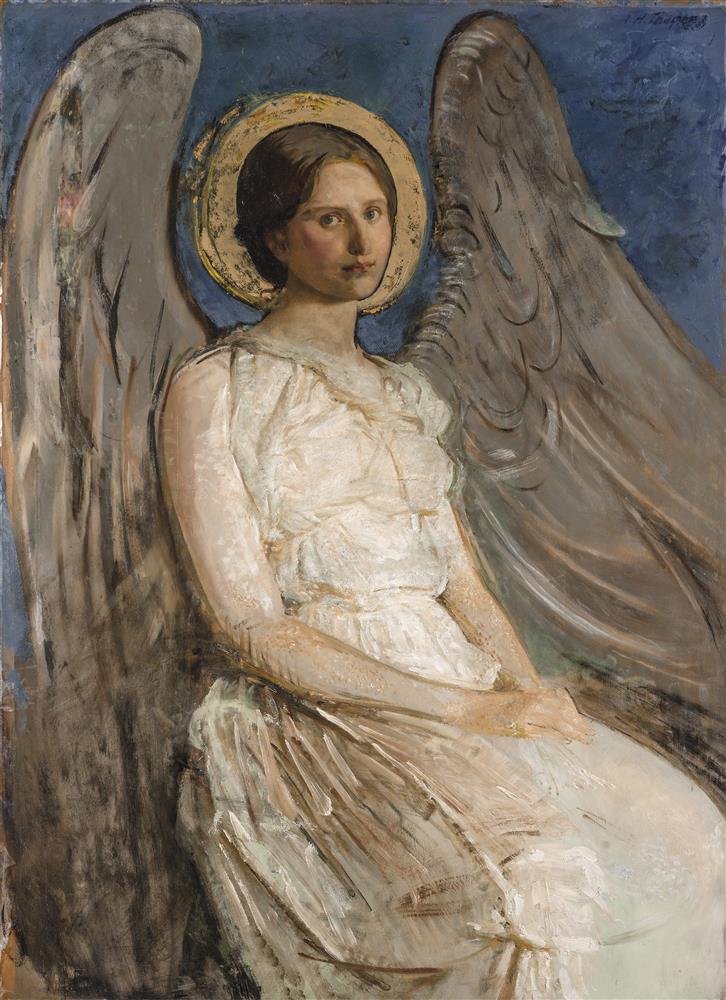
[4]In Seated Angel, Abbott Thayer subscribed to a popular late nineteenth-century idealization of the American woman as pure of spirit. Thayer fulminated against artists who he felt traded on female sexual attraction (their salient quality being “fuckableness,” he once railed in a letter), and to drive home his intent, added wings to his classically gowned models. “Doubtless,” he wrote, “my lifelong passion for birds has helped to incline me to work wings into my pictures,” a convenient melding of fascinations. In Seated Angel, the wings are superfluous; the model’s gold halo is sufficient to graduate the image from virginal womanhood to saint. The model was Bessie Price, an Irish émigré and one of three sisters hired as domestics for the artist’s household. The specificity of Price’s features grounds her in the secular realm, and refers to the tension in Thayer’s art between body and spirit. Thayer’s saving grace—no pun intended—was his nervous painterly energy. He reworked this painting for more than twenty years, right up until his death, without losing freshness of color or overworking the rich surface.
 [5]
[5]Gaston Lachaise’s move from Paris to the United States in 1906 reversed Copley’s transcontinental voyage and signaled the emergence of New York City as the center of the art world. Best known for his large sculptures of pneumatic and paradoxically lithe women, Lachaise was also an excellent portraitist. In the 1920s, he created what one art historian called “the most distinguished series of sculptured portraits executed by an American artist in this century.” These include a slightly stylized alabaster head of Georgia O’Keeffe now in the Metropolitan Museum, and Head of John Marin, a bronze cast of which is in the Wadsworth (O’Keeffe and Marin, both pioneers of American modernism, studied at the League, the latter attending life and composition classes taught by Frank DuMond in 1902 and 1903). Lachaise was tremendously skillful, able to transition from modernism to realism, and apply smooth or rough techniques depending on the subject. His vibrant, tactile portrait of Marin introduces psychological currents left largely unexamined in his smooth and abstracted female subjects. The head has terrific physical and emotive presence.
The same year that Lachaise completed his portrait of Marin, Lee Krasner—then Lenore Krassner—briefly registered as a student in George Bridgman’s summer class at the League. Over the course of the next few years, Krasner painted at least three self-portraits; the earliest depicts her in an interior beside an open window[6], and is now in the Metropolitan Museum. The second, in the Jewish Museum, shows Krasner painting amid a wooded landscape, holding her brushes and a paint rag in one hand[7]. Years later, Krasner remembered the reception when she brought the painting to class at the National Academy.
“I nailed a mirror up on a tree out in the lower part of the island and spent the summer doing a self-portrait. Then I brought it in when the session started to try to get promoted to life class. Then I was told by the instructor there, that it was a dirty trick to pretend that it was an outdoor painting, that I had done it indoors. I said, no, I did it outdoors, and I was promoted to life on probation, they would give me a try there.”
The Wadsworth’s self-portrait[8] is the most stripped-down and sophisticated of the three. Krasner is seen in three-quarters angle and turned slightly away from the light, so that the far contour of her face and neck forms an elegant dark line against the neutral background. She continued her studies with Hans Hofmann, who declared before one of her paintings, “This is so good, you would never know it was done by a woman.” Later, Krasner married Jackson Pollock, working together while largely existing within his shadow. Today she is considered a major Abstract Expressionist and an important contributor to American art in the postwar era.
 [9]
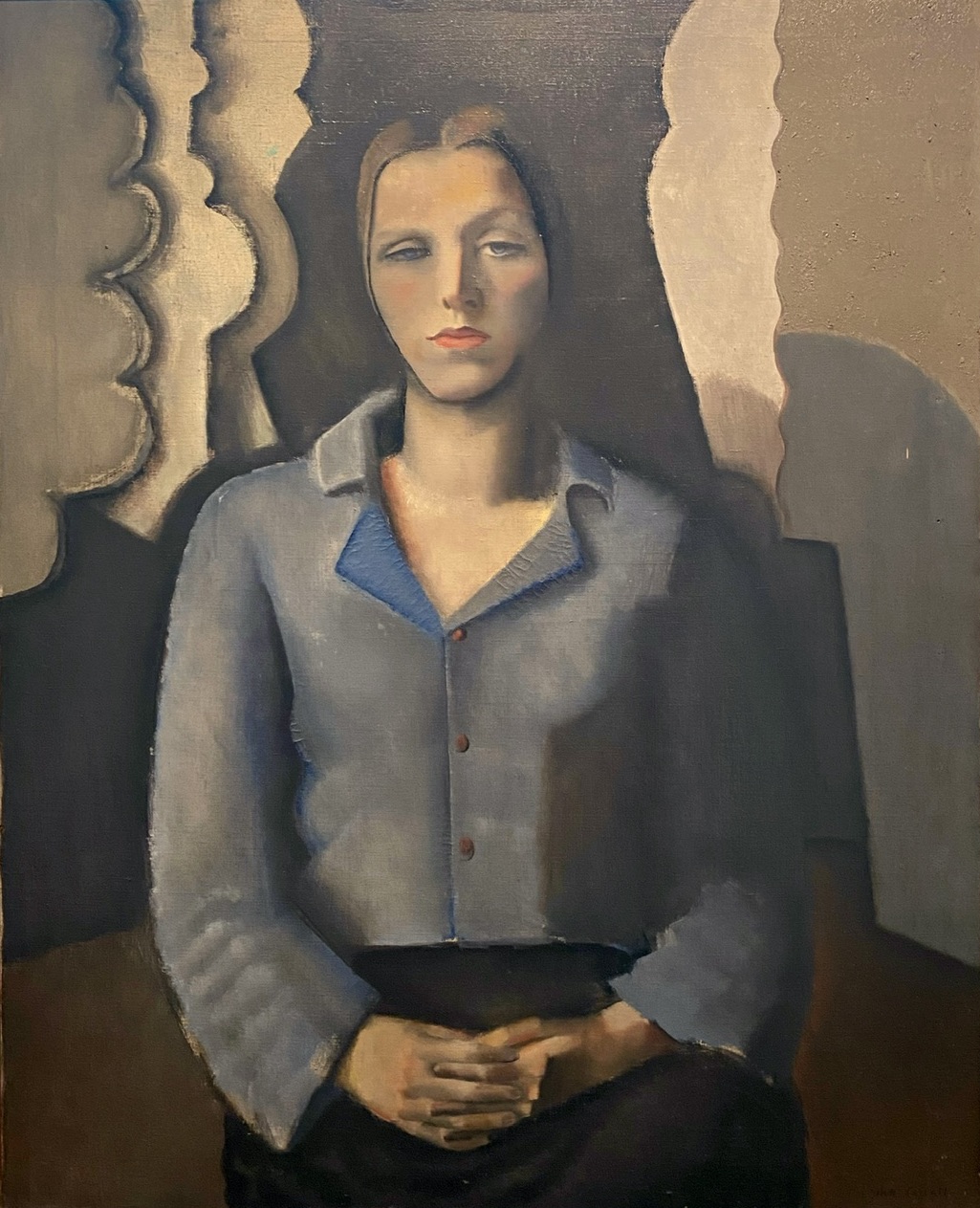
[9]John Carroll was one of the artists portrayed in Robert Philipp’s group portrait, Homage to Sargent[10], which used to hang in the lobby of the Art Students League of New York. Carroll taught at the League in 1926–27 and for a longer stint from 1944 to 1956. He was also a member of the Woodstock artist community, and a close enough friend to George Bellows to have sat for several portraits by him. Carroll’s painting seems to have alternated between a hard-edged, modern vernacular, and dreamily soft-focus figures reminiscent of French fashion illustration that are hard to look at now—the common thread is that of woman as femme fatale. His best portraits from the mid-1920s relate to the work of his Woodstock friends, Bellows and Speicher, and through them, to Cézanne. The Wadsworth’s Rose (Hobart) hits a gimlet-eyed, formalist note; one can hardly envision artist and model speaking to each other during the sittings. There’s a neat irony to the white and gray cutout shapes surrounding the figure, as if satirizing the wings of Thayer’s angel and the cult of purity celebrated by a previous generation. Hobart was a movie actress, who, in addition to posing for Carroll, became the inadvertent subject of a surrealist film by the artist Joseph Cornell.
Enter any mid-market museum in the country and you’ll probably find a painting by Kehinde Wiley, whose stated goal is to “get some images of Black faces in museums to inspire young African Americans.” The Wadsworth’s example is Portrait of Toks Adewetan (The King of Glory)[11], an ennobling portrait of a Nigerian-American derived from a 14th century Russian icon. It is, like all of Wiley’s art, not so much a painting as an image. Indeed, he is constructing a 21st century iconography of and for the marginalized. When his portrait of Barack Obama was unveiled, there was a reflexive backlash among some artists—particularly those of my demographic, aging white traditionalists—who disapproved of the image of the President seated amid and in some peril of being overgrown with foliage. As a welcome change from the monochromatic suits and ties that fill our institutional walls, I appreciated the audacity of the concept on principle alone. I’m ambivalent about the artistry: Wiley’s recognizable formula is to paint highly polished three-dimensional figures, all lit the same and painted from photos, set against chromatic, decorative scrims. Ostensibly modeled on old master conventions, this is humanism, Hollywood style. Yet his agenda is unassailable, and if museums are signing on in a belated attempt to correct a few hundred years of visual racism, their motives are beside the point. It’s been a long time coming.
We’ll close with a parlor game: favorite American portrait in the museum. In most collections of American art, the honor is apt to go to something by Thomas Eakins. I’m a sucker for the meeting of solid form and rectitude, sensuality treated seriously. But the Wadsworth’s Eakins, a full-size standing figure, is too murky and doesn’t make the cut. Neither is the Sargent, while charming and idiosyncratic, the best of his efforts. No matter that Copley’s Portrait of a Lady (Mrs. Seymour Fort) was painted in England. It’s easily the finest portrait by an American artist in the Wadsworth, a colonial era masterpiece for a venerable collection.
- Zurbarán’s : https://5058.sydneyplus.com/argus/final/Portal/Public.aspx?lang=en-US
- [Image]: https://asllinea.org/wp-content/uploads/2023/04/John_Singleton_Copley_-_Portrait_of_Mrs._Seymour_Fort_1901.34.jpg
- [Image]: https://asllinea.org/wp-content/uploads/2023/04/1bbc465642167603f4aaf8a1aa5974ea.jpg
- [Image]: https://asllinea.org/wp-content/uploads/2023/04/4dade913978daad693562615144e1084.jpg
- [Image]: https://asllinea.org/wp-content/uploads/2023/04/3D303ED8-8C96-476A-BD34-405B6ECA5341.jpeg
- the earliest depicts her in an interior beside an open window: https://www.metmuseum.org/art/collection/search/484964
- Krasner painting amid a wooded landscape, holding her brushes and a paint rag in one hand: https://thejewishmuseum.org/collection/30935-self-portrait
- Wadsworth’s self-portrait: https://m.facebook.com/WadsworthAtheneum/photos/a.96312799600/10158723633834601/
- [Image]: https://asllinea.org/wp-content/uploads/2023/04/52AEEE96-DE9D-4E74-961E-8EA0997C5782.jpeg
- Homage to Sargent: https://asllinea.org/robert-philipp-art-students-league/
- Portrait of Toks Adewetan (The King of Glory): https://www.thewadsworth.org/favorite-face/