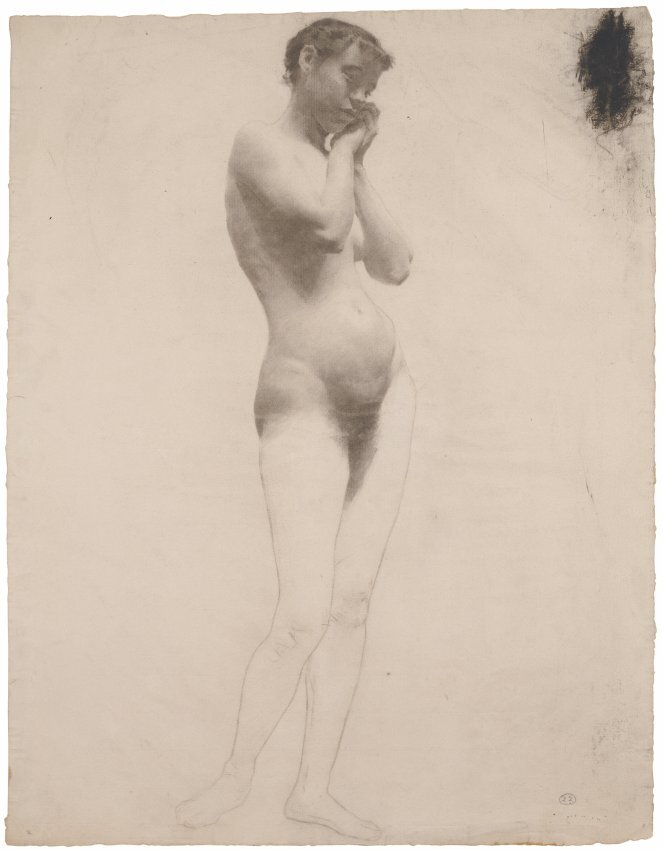
Last month, I visited the Lyme Academy of Fine Arts to view True to Form: Academic Studies from the Late 19th to Early 20th Centuries, an exhibition of student life drawings. The academy describes the show as “a transition from idealized representations of the body to more direct, observational studies. The works featured here—generously loaned by the Art Students League of New York and several private collectors—reveal this shift away from classical idealization toward a more naturalistic understanding of the human form.”
I’m familiar with the League’s drawings from my stint on their collection committee, as well as from previous exhibitions and publications. True to Form elicits mixed reactions. The Lyme show offered a chance to unpack and dust off my admiration for and reservations regarding academic drawing that go back to my student years, nearly half a century ago.
The League’s collection documents nearly a hundred and fifty years of its students’s drawings. At times the drawings have fallen into benign neglect. Former League curator Pamela Koob wrote that “In 1999, a remarkable trove of these portfolios was discovered, packed floor to ceiling in a long-forgotten closet. Locked up for fifty years, according to the League’s maintenance head, it was filled with hundreds of antique and life drawings and prints from the 1890s to the 1940s.” My guess is that a floor-to-ceiling stack of portfolios would have contained not hundreds, but thousands of works on paper. Be that as it may, the discovery highlights the institution’s dedication to preserving its legacy of draftsmanship as well as periods when the discipline fell from favor.
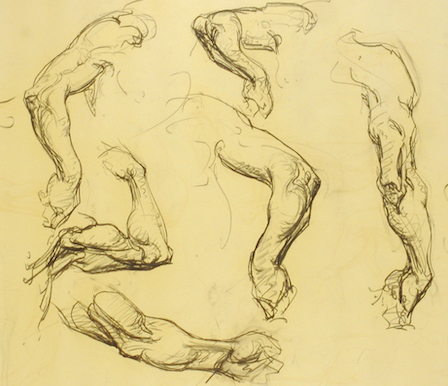
Even in the post-war decades, when fine art departments at degree granting institutions abandoned training in observational drawing, the League’s curriculum was anchored by courses in figure study and anatomy. George Bridgman’s fusion of rhythms and mechanics dominated the League’s life drawing program—and, by implication, was influential in New York City and much of the country—in the first half of the twentieth century, as was Robert Beverly Hale’s poetic intellectualism from mid-century through 1980. One of the small pleasures of attending the League in 1980 was to pore through old school catalogues in the library, expressly to study life drawings by my predecessors. A friend with a larcenous streak lifted a stack of the catalogues without my knowledge—they were soon returned, then locked away and were no longer available thereafter. Though understandable, it was as if our only window to the school’s classical past was shut. Except for the few works installed in the office and lobby, the League’s figurative history was largely inaccessible.
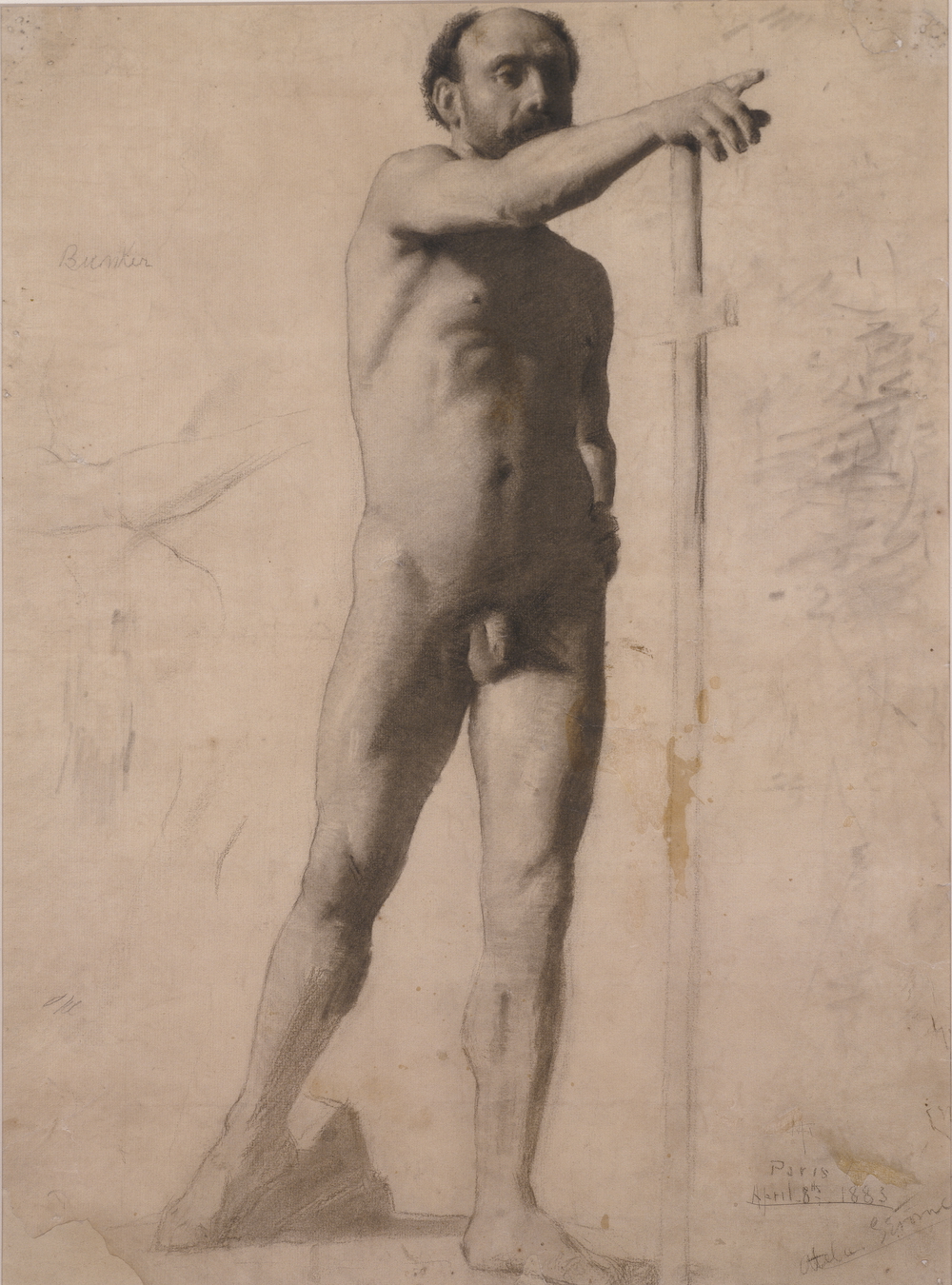
With that history as background, the selections made by Lyme’s co-artistic directors for True to Form take advantage of the League’s more recent determination to open its vaults. Publications like Classical Life Drawing Studio and on-campus exhibitions have allowed students and instructors to examine work from the League’s abundant holdings. Drawings from the late 1800s evidence an affinity for European examples, an inevitability given that many instructors and students had been to Paris or Munich. Included in the show is a standing male nude by Dennis Miller Bunker, drawn in Paris in the spring of 1883, by which time Bunker had studied at both the League and the National Academy of Design. The model is posed as if striding, his right arm outstretched, but Bunker is more interested in atmosphere than movement. Anatomy is softly sublimated to optics, a prioritization that would characterize his meteoric career as a portrait and landscape painter.
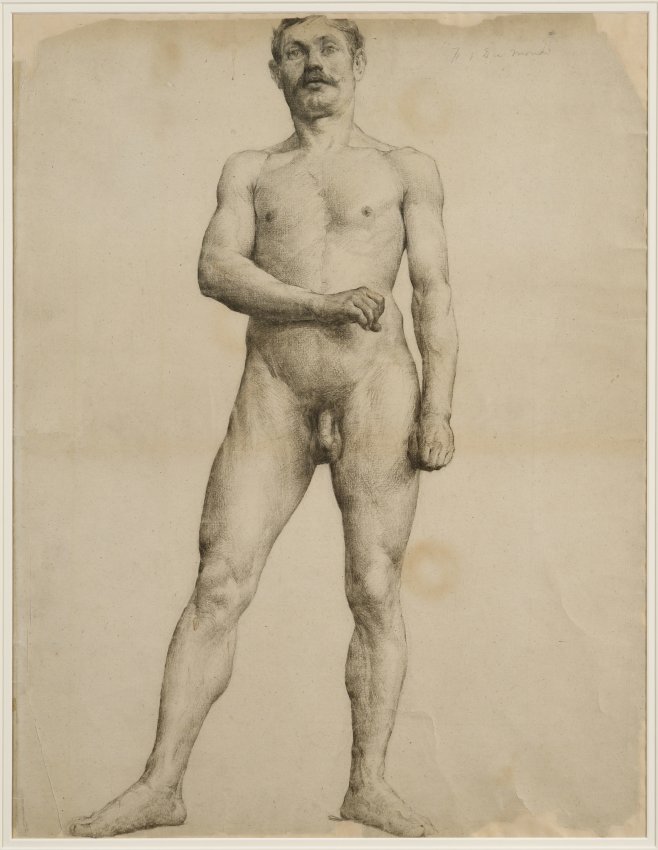
Frank Vincent DuMond’s figure drawing of ca. 1886 shares a similarly static impression. DuMond’s is an excellent, if more conventional anatomical study. The model is awkwardly frozen in place, the sum of its well-rendered parts. DuMond would later be an influential force at the League, teaching there for over fifty years, and was a mainstay of the Old Lyme art colony.
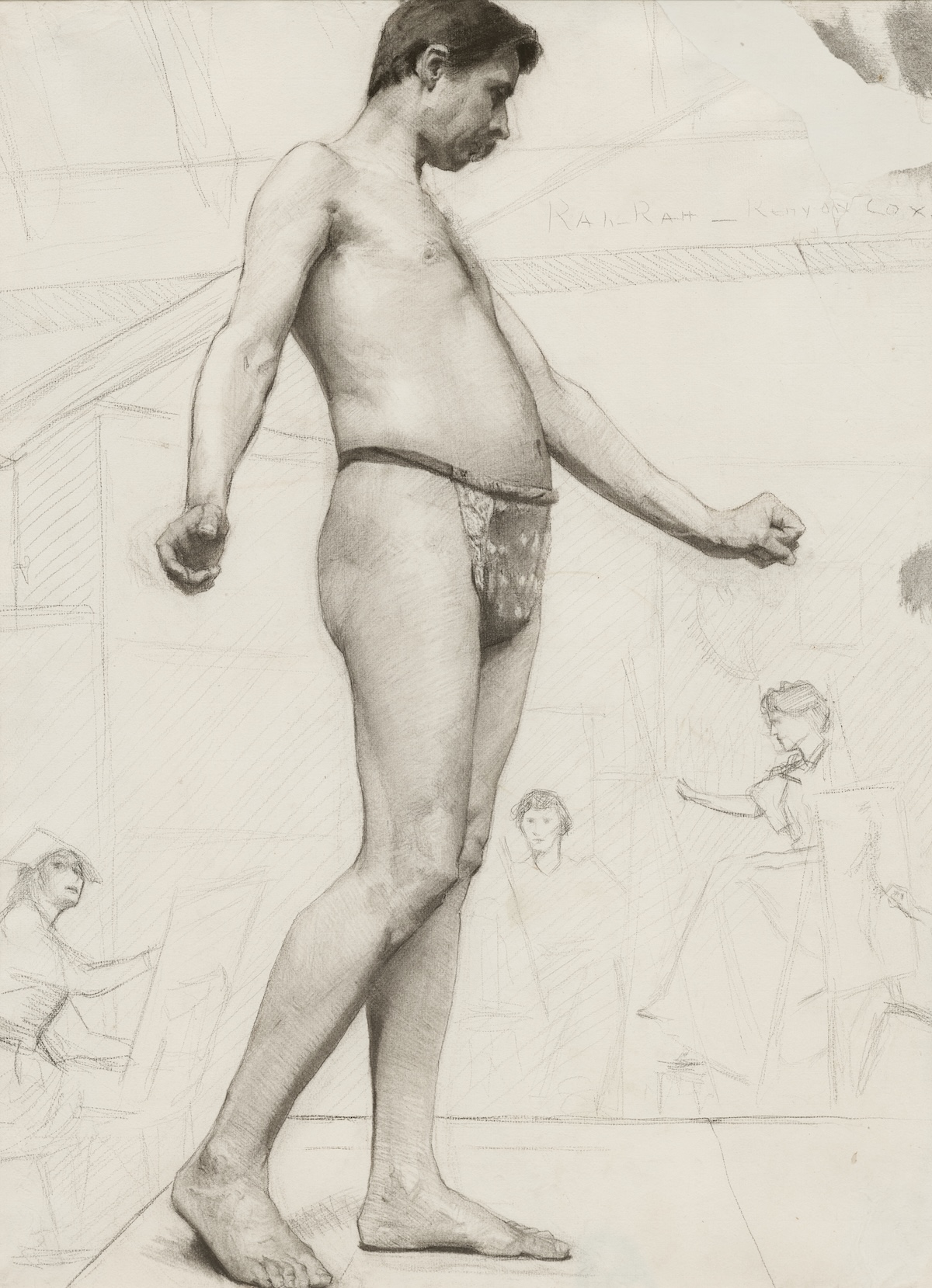
More intriguing is a figure study by Lucia Fairchild drawn several years later. Fairchild documented a life drawing class, a male model standing in the center of the studio, encircled by young female students. She came by her precocity through diligence, but she was also connected—her wealthy family hosted a who’s who of artists and intellectuals, and Fairchild seems to have developed an adolescent crush on John Singer Sargent, accompanying him to museums while keeping a journal of their intimate discussions. Lucia’s life drawings, produced at the crest of youthful assurance, are admirable examples of academic realism. Her adult life was marked by lack of recognition, a lousy husband (artist Henry Fuller) and illness, and paralleled the tragic decline of the entire Fairchild family.
The lives of Bunker, DuMond, and Fairchild are well documented, their work included in public collections. E. D. Harnits, represented by a lively figure study dated 1893, remains a full-on mystery. We don’t know if he pursued a career in art. His energetic drawing grasps the gesture and the solid forms of an unidealized figure, getting at the rough-hewn character of the model.
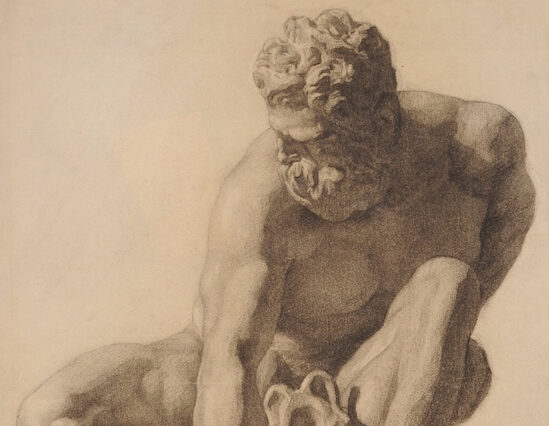
The highlights of the show may be a couple of drawings by Richard Tweedy. Tweedy’s drawings are marked by delicate precision, the culmination of anatomical lessons observed by natural illumination. In addition to several figure drawings by Tweedy, the League owns a self-portrait he painted as a student. It is competent, yet lacks the poetic intensity of his figure studies. The drawings of Harnits, Tweedy, and to a lesser extent, Fairchild, highlight the phenomenon of artists who produce some of their best work under the supervision of instructors and alongside other students. It’s one thing to draw in an environment of camaraderie that supplies both subjects and pedagogy, and quite another to chart one’s course in solitude.
If the atelier provides a supportive atmosphere that cannot be sustained once the student leaves, it may also encourage practices that are equally difficult to reproduce outside of school. These include practical challenges like securing a suitable studio space and the ready procurement of models, as well as technical approaches. To produce drawings like those in True to Form would have required at least a week (approximately 15 hours) of sustained, meticulous work, at the end of which the figure might be only half complete. With shading begun at the top, it wasn’t uncommon for a drawing to be abandoned at the pelvis or knees, time having run out long before the student could reach the feet. The corrective often prescribed by contemporary ateliers is merely to lengthen the duration of poses. Unless students also receive training in other processes, they are apt to leave school well-versed in rendering form, provided the model behave, in effect, like a still life subject.
Much as the figure is central to my work, I’ve always had reservations about the nineteenth-century academic process, as well as its revival. Enrolled in my first life drawing class at age seventeen, I was almost immediately aware of distinctions between drawing that referenced Renaissance or Baroque prototypes, and that which derived from nineteenth-century theory. Simply put, drawings of the earlier type emerge from “open” form, while those of the latter tend to be tightly circumscribed by their contours. An unfinished drawing by Michelangelo or Rembrandt doesn’t strike one as unresolved, but appears to have developed organically. Nor must it rely on a full value spectrum—form and atmosphere are implied rather than explained. Granted, it’s unfair to compare a master drawing to that of an art student. The differences relate to the underlying philosophy and ensuing process. When a figure drawing program’s ideology is primarily dedicated to a convincing mimicry of three-dimensional form, it usually demands the suppression of a student’s individuality. Mimetic technical application becomes a sufficient end in itself. The realist ateliers of the late nineteenth-century—as well as those operating today—offered less an exploration of perceptions than strategies designed to reach a predetermined solution. Notwithstanding the variations from one instructor’s class to another, there’s an undeniable similarity to most of the drawings in True to Form. A student of H. Siddons Mowbray and a student of Kenyon Cox were probably following much the same formula.
A high level of performance among students is admirable. But uniformity ought to give pause. Insofar as teachings like Charles Bargue’s have gained traction, a sense of inquiry in figure study has been supplanted by more methodical alternatives. The energetic changed in the latter half of the nineteenth century. At some point, the contour line ceased to be a conduit of vital expression, and became a container for the thing contained, namely, value gradations in simulating surface texture. A necessary armature, like the outlines in a coloring book. Those draftsmen who insisted on the autonomy of line as both a vehicle of expression and a means of suggesting depth without shading—Daumier, Van Gogh, Schiele—exist outside the academic box. Yet they, as have most great draftsmen, created idioms that distinguish their work from more conventional approaches. Let’s rephrase that: they actually embody the tradition of the artist as master of an idiosyncratic voice.
The drawings in True to Form do tend towards a naturalistic account of the figure. They display great sensitivity to their subjects and a solid, if dutiful, depiction of the volume of muscle and bone. Anyone who has spent time in skylit studios will see the connection they establish to current practice. I know that this sense of shared history can be enchanting. I also know there’s something hermetic about the atelier environment that informs even the loveliest of these drawings. True to Form is a testament to the diligence of observational study. The work speaks to the strengths and the limitations of nineteenth-century academic practices.
True to Form runs through April 27, 2025, at the Chauncey Stillman Gallery at the Lyme Academy of Fine Arts.