
“Close your bodily eye, so that you may see your picture first with the spiritual eye.” What sounds like a Zen epigram was, in fact, the advice of Caspar David Friedrich, the primary artist of German Romanticism. Nearly eighty of Friedrich’s drawings and paintings are the subject of The Soul of Nature, a major if not comprehensive retrospective at the Metropolitan Museum of Art. Friedrich pretty much invented the landscape of solitude, an idea that reverberated across nineteenth-century studios and survives—or is resurrected—today in response to the continuous tension between the natural world and man’s desire to exploit its resources. To stand in front of a landscape now probably feels a lot more elegiac than it would have two hundred years ago, when the Industrial Revolution had barely broken ground.
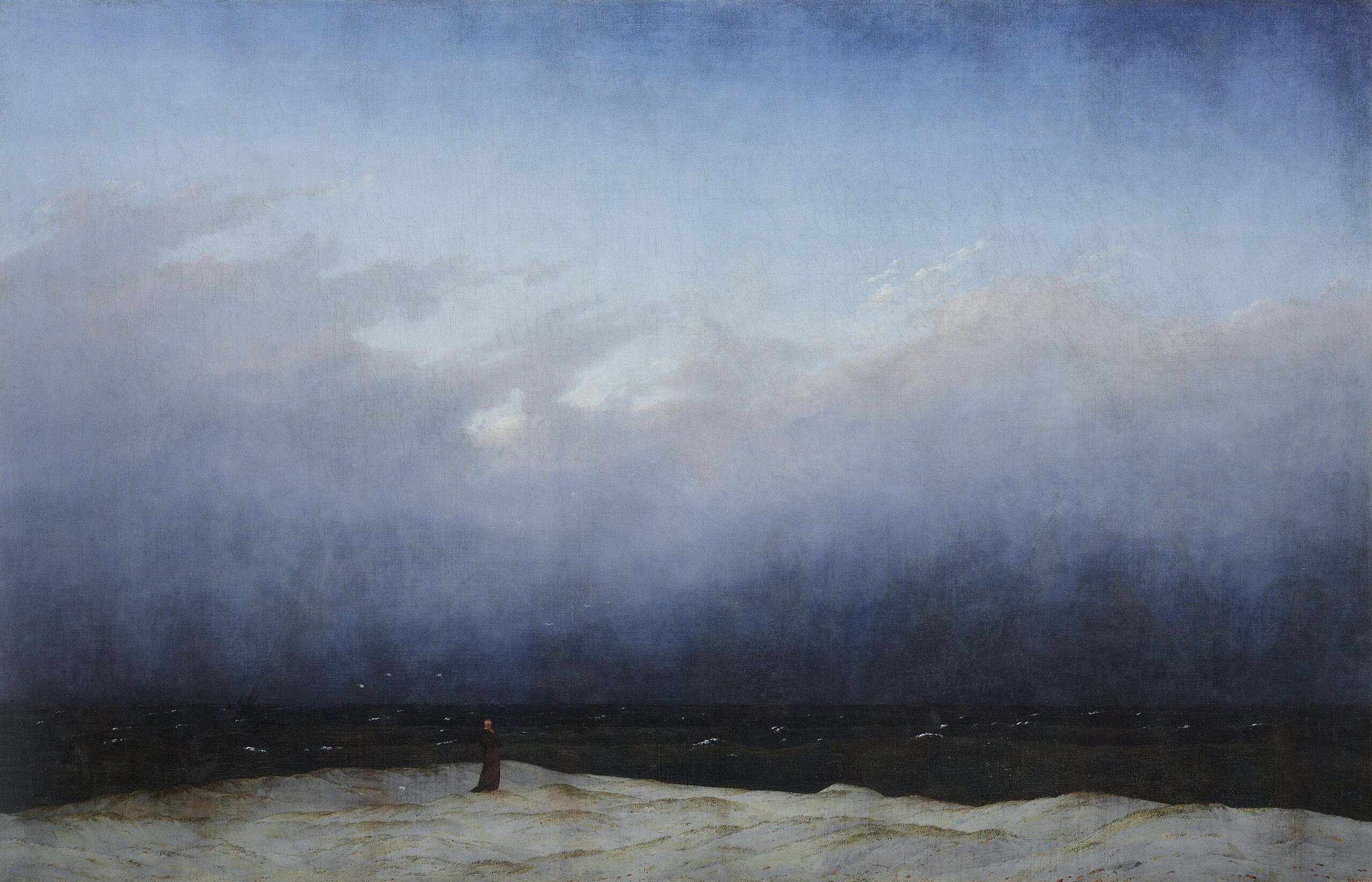
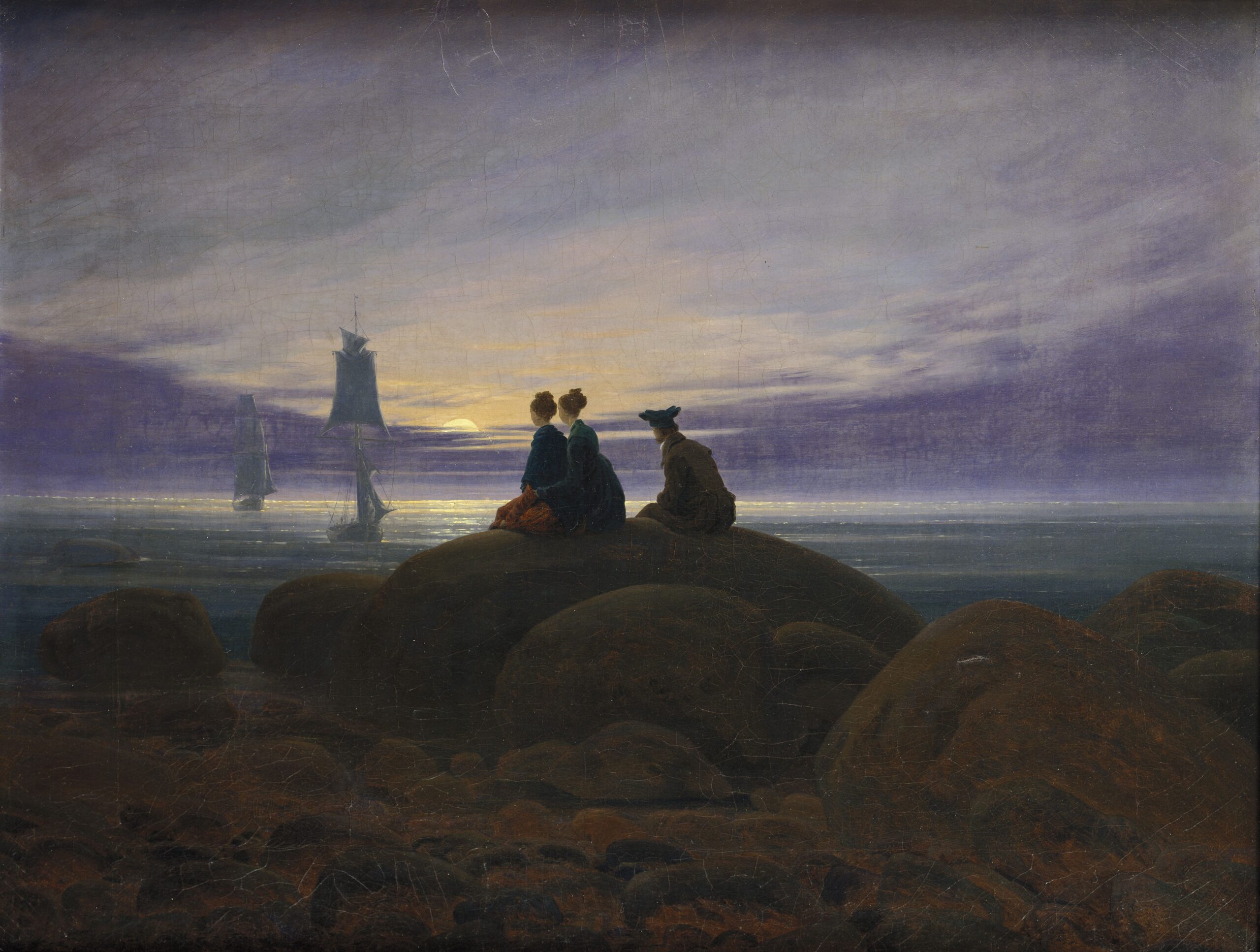
43 5/16 x 67 ½ in. (110 x 171.5 cm). Nationalgalerie, Staatliche Museen zu Berlin (NG 9/85) Photo credit: bpk Bildagentur / Nationalgalerie, Staatliche Museen zu Berlin / Andres Kilger / Art Resource, NY
Friedrich’s visions have been reinterpreted and appropriated according to the whims of successive generations. The current interest may be indicative of a renewed appreciation of vanishing natural habitats. Most damningly for Friedrich’s reputation, the Nazis saw value in the perceived nationalism of Friedrich’s depictions of the fatherland. In truth, Friedrich’s nationalism, though never in doubt, was a little complicated—he was born in a Pomeranian town that was then under Swedish dominion, and at one point he disapproved deeply enough of Prussian rule that he became a citizen of pro-French Saxony. Art historians cite an influential legacy that spans several continents and includes the Hudson River School, Russian naturalism, Edward Hopper, and Mark Rothko. Kehinde Wiley produced a straight-up reworking of Wanderer above the Sea of Fog, Friedrich’s equivalent of an antihero movie poster. His reach extended to twentieth-century literature: Thomas Beckett claimed that Waiting for Godot was inspired by one of Friedrich’s paintings, about as cool an example of cross-disciplinary influence as I’ve ever heard.
Friedrich was raised a devout Lutheran, and his inspiration derived from the Scriptures. “For Friedrich,” writes Cordula Grewe in the exhibition catalogue, “this larger whole was God, and his unwavering faith prompted the painter to see nature in allegorical terms, as reiterations of the emblems familiar from the religious literature of his childhood.” For some of the great practitioners of Romanticism, God had left the building—the themes Gericault, Delacroix, and Goya grappled with were war and insanity. There is no transcendence in The Disasters of War. Though the divine presence was implicit in the landscapes of Turner and Constable, religious symbolism was—at least initially—central to Friedrich’s art.
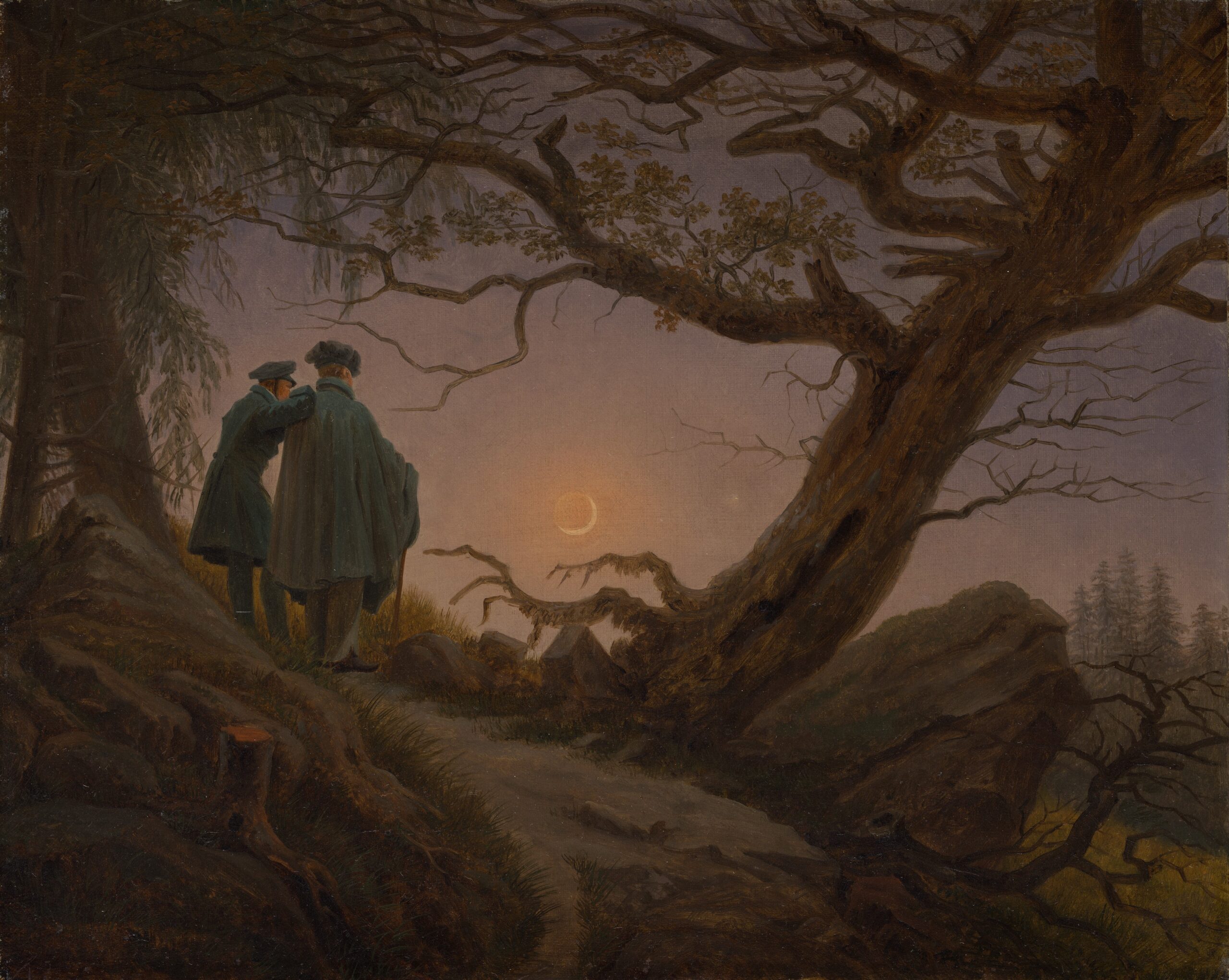
Yet it is reasonable to think that the emotional power of his painting owed as much to personal tragedy as it did religion. In youth, Friedrich lost his mother and two sisters, and at the age of thirteen, he watched his younger brother perish—possibly while saving Caspar’s life—after falling through the ice on a frozen lake. The latter incident alone explains Friedrich’s lifelong attempt to reconcile the morbid and the sublime, graveyards and ruins, and the rays of the sun, which he likened to the light of God. Arguably his greatest painting dispenses with overt symbolism, and is Friedrich’s most pessimistic work—an unsentimental view of an Arctic shipwreck titled The Sea of Ice (not in the show), is an astonishing transmutation of childhood trauma into a masterpiece of Romanticism. It requires little imagination to see Two Men Contemplating the Moon as surrogates for the artist and his lost sibling (There is a term for the motif, Rückenfigur, wherein a person turns away from the material world and contemplates the spiritual realm). The exhibition catalogue conspicuously omits mention of Friedrich’s personal life, let alone the formative tragedies.
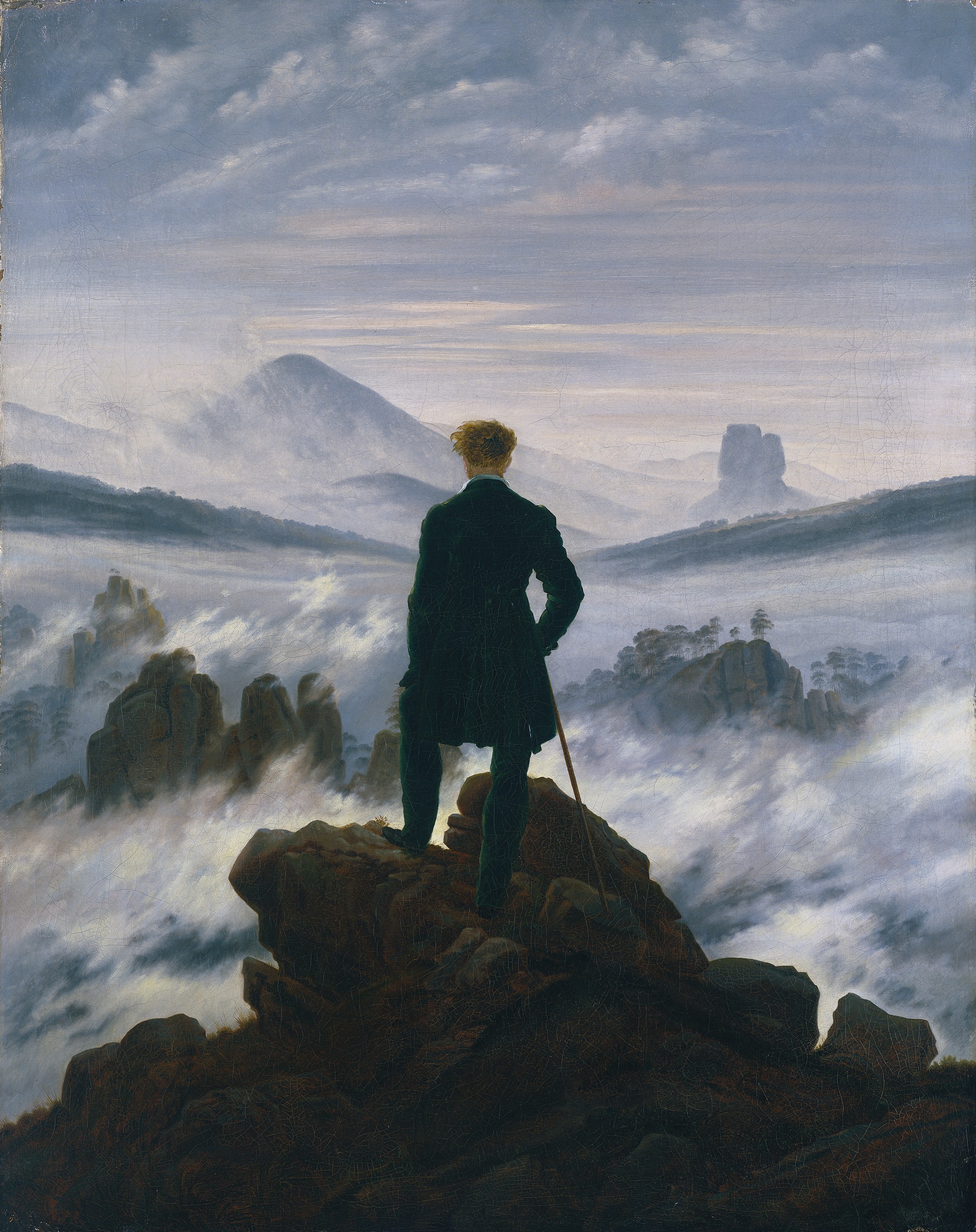
Photo: Elke Walford
Friedrich first gained public notice for The Cross in the Mountains (not in the show), a striking altarpiece that engendered critical blowback for fusing landscape and religion. Undiscouraged, he continued working the theme with diminishing returns; the numerous variations in the Met show approach neither the dramatic composition nor the profound mood of the Dresden altarpiece. The show’s “cross” paintings are of relatively modest ambitions, diminutive in size and muted in color, less showpieces than images intended for private devotion. That sense of intimacy is characteristic of the exhibition. Notwithstanding the meme-worthy Wanderer above the Sea of Fog, many of Friedrich’s greatest works are absent. And even Wanderer looks to a critical eye like an adolescent’s idea of Romanticism, or at best, something out of Byron or Brontë, the mysterious stranger appraising mountaintops, hair tousled by the wind.
The pencil and watercolor studies done from nature will win fans for their scrupulous attention to detail. But intense observation alone only goes so far. I can’t help recalling Kenneth Clark’s assessment of a famous drawing by Durer:
“….how lacking it is in concentration of purpose and in the sense of organic life; it is like the back of a case containing a stuffed animal.”
Possessing a philosophical rather than impassioned temperament, Friedrich brought to the table a gift for reflection, weighted with a vein of medieval foreboding. He found inspiring material in fog-braced mountains, the atmospherics that would later be the basis for Tonalism, as well as in the twisted ebony silhouettes of oaks, his drawings catching fire when transferred to canvas in the studio (this is notable, since Friedrich didn’t take up oil painting until his early thirties).
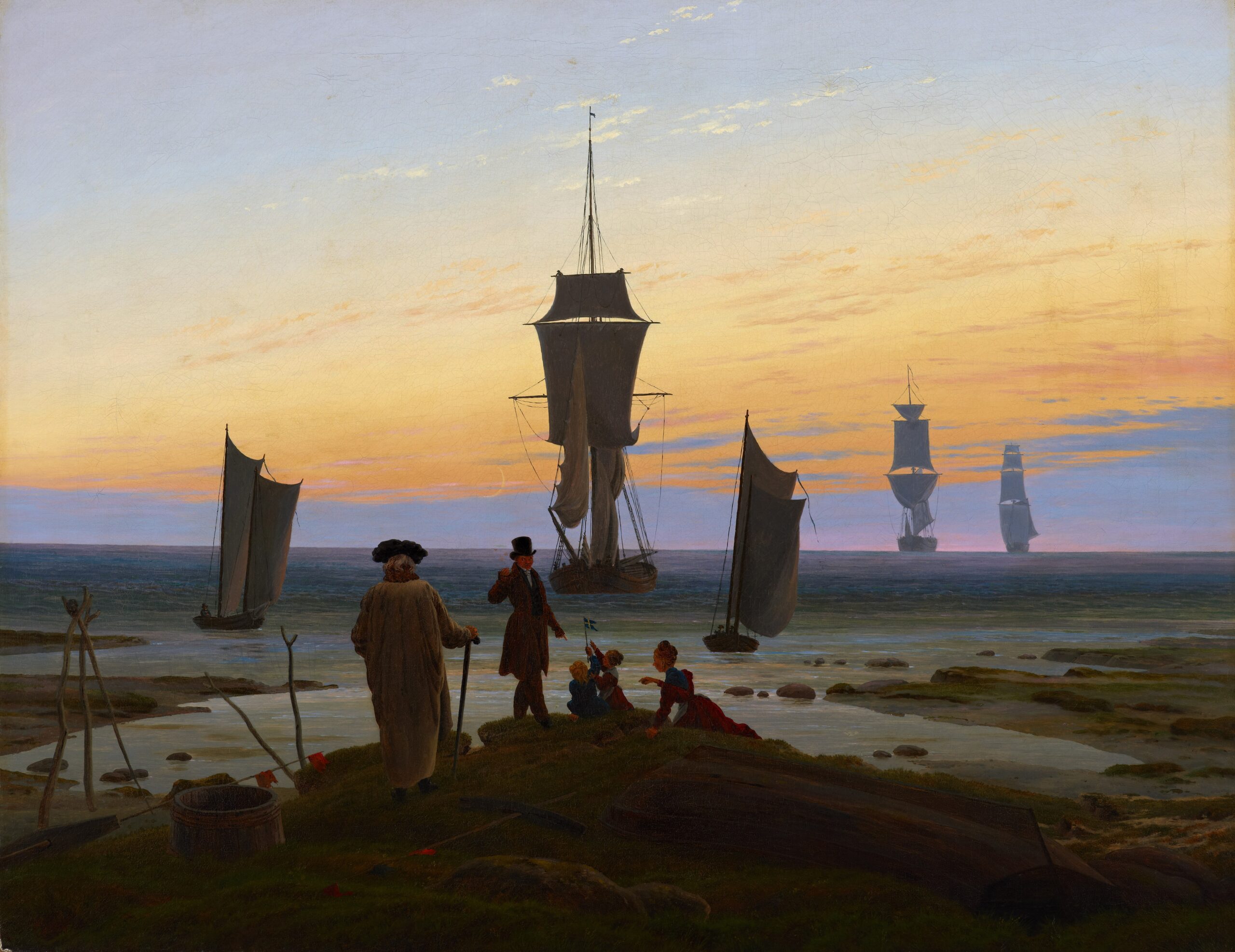
He was admirably dismissive of critical opinion. In 1815, he wrote about one of his paintings, “There is no church, no tree, no plant, no blade of grass,” just a “naked stony seacoast,” and “raised high, the cross. [To those who seek it, a consolation; to those who don’t, it’s just a cross.” Although Friedrich continued to experiment with narratives throughout his life, the works that best convey the divine presence didn’t need a cross. The best of them pioneered enigmatic tropes that reappeared later in the century. Monk by the Sea begets the mysticism of Arnold Böcklin, and along with its pendant Abbey in the Oak Wood, creates the foundation for every vast landscape of mystery; in Woman at the Window there is a prelude to the hushed interiors of Vilhelm Hammershøi; Moonlight over the Sea predicts Winslow Homer’s marines, the figures perched on rocks, each separately absorbed in the sight of the ocean; and The Stages of Life anticipates the oceanfront allegories of Edvard Munch. Would two of my favorite landscapists, Isaac Levitan and George Inness, have painted like they did if not for Friedrich? Whether these artists knew Friedrich’s work through direct contact, reproduction, or secondhand paraphrasing by other artists matters little. On different continents and with diverse motives, the ideal of a sublime landscape would persist until the next century and beyond. Realism and Impressionism merely interrupted the spell. In the wilderness, we are still apt to imagine ourselves closer to the divine.
The conceptual unity of The Soul of Nature honors Friedrich’s legacy. This is not a definitive show, but it’s as close as we’re likely to see, with the bodily eye.
Caspar David Friedrich: The Soul of Nature is on view at the Metropolitan Museum of Art through May 11, 2025.