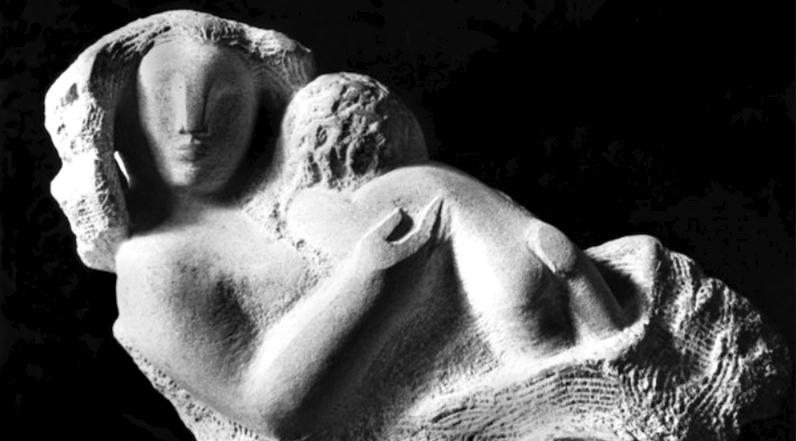
Andreas Van Heune, a sculptor from Bath associated with a recent restoration of Spirit of the Sea, gave me the name of the foundry: Bedi-Rassi, now Bedi-Makky in Brooklyn. I called there and spoke with Istvan Makki, the owner. He remembered Spirit of the Sea very well as he had done both castings himself by the French sand-cast method, his specialty. Offhand, he thought years had separated the first and second casts, but could not say how many. He told me how, in his last years, Zorach brought his son, Tessim, to meet Makki at the foundry, so that the two might know each other well. He said Zorach left the editions of many pieces unfilled at his death and that it was his intent Tessim and Makki complete them, market permitting, for the benefit of the grandchildren. Could Tessim have ordered the casting of the Machias piece? Mr. Makki could not remember. He said he would tell me only what he knew for sure, and kindly went through his records. While fairly complete records went back only to 1970, when he had assumed ownership, he said he had found evidence that the sixth and final cast of the maquette had been in June, 1966, closing the books on Spirit of the Sea within the sculptor’s lifetime. So Zorach himself had ordered a second copy of Spirit of the Sea, as he had thirty years earlier in the case of Spirit of the Dance, in hopes of getting some return for his labor on them. While Spirit of the Dance toured the nation in the 1930s, Spirit of the Sea went straight into storage at the Hahn Fireproof Warehouse of Jersey City, where it remained for over two decades. The piece, like the Spirit of the Dance duplicate, might still be the property of the Zorachs had it not been for the generosity of an old family friend, Norma Marin, the widow of John Marin, Jr., and the daughter-in-law of the painter John Marin, who, incidentally, also taught at the Art Students League. The University of Maine, which furnished me her name, offered no clue as to her motive. The Marins figure prominently in William Zorach’s autobiography. “One does not seem to make close friendships with people later in life,” Zorach wrote. “It is only in youth that one makes close friends.” Zorach met Marin early, on his first trip to Maine, in Stonington during May 1919. Marin, seventeen years Zorach’s senior, served as an early mentor. We know that Zorach consulted Marin when contemplating a trip to California and Yosemite and that the latter encouraged him to go. When the families first met, John Marin, Jr. was a little boy running wild in a Maine coast fishing town. Later, it is clear the Zorachs and the younger Marins, John, Jr. and his wife Norma, became good friends. They visited back and forth. The Marins lived in Manhattan, but spent summers in Maine, John Marin, Sr. having bought property on Cape Split in Addison in 1934. The Marins would stop overnight with the Zorachs in Georgetown, both driving up the coast and on the return to New York. For their part, each August the Zorachs drove up to Cape Split. The couples went sailing on Pleasant Bay and went ashore on Flint Island. Its beach stones so impressed the sculptor that he loaded the boat with as many as it could hold. He took such findings to his studio, carved them, crated them, and sent them on to his gallery with the Marins when they stopped on their return trip. He did a portrait of little Lisa Marin. This is a story of more than passing friendship: a rare thing in life. When her husband died in 1988, to honor his memory, Mrs. Marin evidently remembered the good times she and her husband had shared with the Zorachs. Accordingly, she arranged with Tessim to rescue Spirit of the Sea from its storage-warehouse oblivion and give it a home in fresh air. Spirit of the Sea is best seen in Bath, where it surmounts a fountain ensemble. There it rests in a seven-foot granite basin atop a four-foot diameter granite drum. These, firmly rooted on concrete pilings, rise in the middle of a pond. Water travels up piping concealed in the drum, swirls into the basin and overflows in sheets into the pond below. It is the focal point of the principal city park, a spacious, well-landscaped square fronting the city library. As the overall height of the ensemble is fourteen and a half feet, the viewer positioned at the water’s edge sees the statue from below. Quite possibly Zorach, who engineered the whole, took this into account when designing his piece, which to me looks more dynamic when seen from below than it does head on, as one sees it in Machias. Also, while it is out in the open in Bath, it is in a confined space in Machias, where luxuriant shrubbery threatens in the growing season. For all that, it is better to see it as it is in Machias than not to see it at all. There it is prominent from U.S. Route 1, the coastal artery. And, as it flanks the entry of the university’s art department, one likes to think it affords some students with a vision of what is possible in sculpture. For further reading— Malvina Hoffman, Heads and Tales (1936) _____. Sculpture Inside and Out (1939) William Zorach, Zorach Explains Sculpture (1947) _____, Art Is My Life (1967) Among the many who contributed to this article, a few who went out of their way to help me deserve mention: Dahlov Ipcar and her son Bob; Dr. Peter Zorach; Norma Marin; Andreas Van Heune, sculptor, of Bath, Maine; Istvan Makki, foundryman, of Brooklyn, New York, and especially Bernie Vinzani, Chairman of the Art Department, University of Maine, Machias. My neighbor Peter Knuppel cheerfully furnished use of his computer on several occasions. Lastly, to my collaborator Eric S. Beckjord, who prepared the manuscript and other materials for electronic submission, I say, Thanks, Dad.